

CONTROL LINE SCALE
Bill Boss 77-06 269th Street New Hyde Park, NY 11040
Control systems
Control systems used in Control Line Scale models are usually the two- or three-line type, and sometimes a combination.
- Two-line systems are generally used in conjunction with electronic controls. These controls use one or more channels where digital signals are passed up insulated lines operating one or more servos (which perform operational features such as throttle control, bomb drop, and flaps).
- Three-line systems are generally used with the standard Roberts or GS bellcrank for throttle control. Other operating functions may be incorporated through additional bellcrank-and-pushrod arrangements.
Some scale modelers prefer a combination: the three-line arrangement for throttle control, and an independent electronic system for the other features. In that case the up and down lines of the three-line system are insulated for passing the electronic signal.
Four-line bellcrank system (Karl-Georg Krafft)
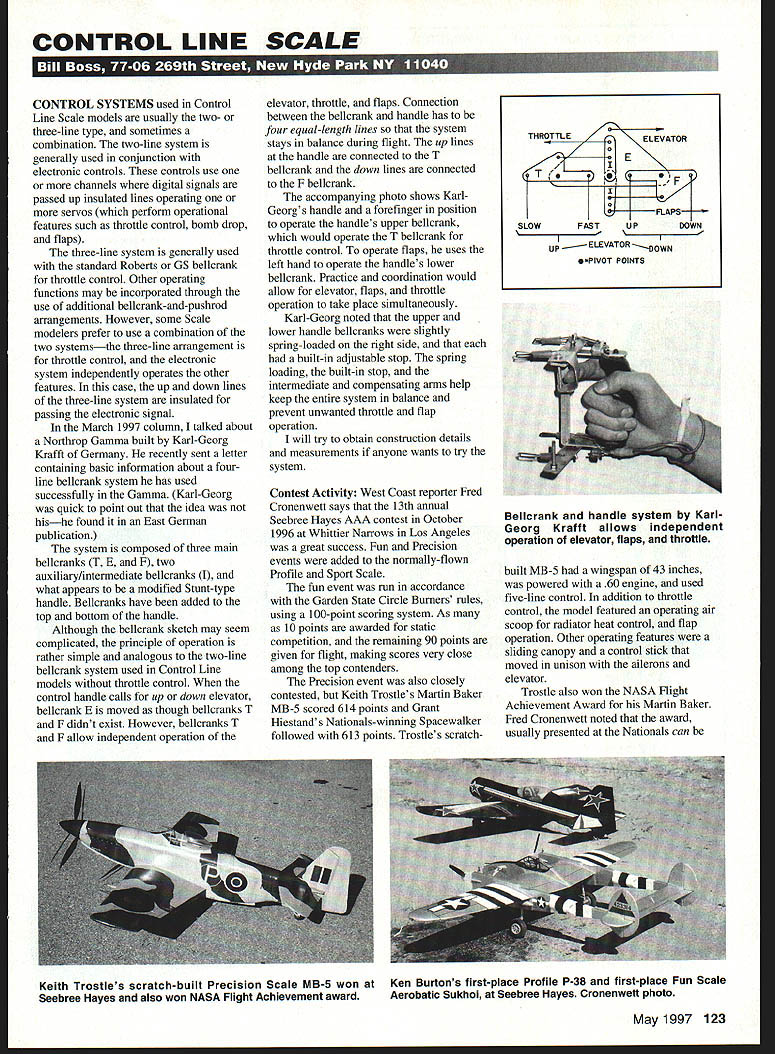
In the March 1997 column I discussed a Northrop Gamma built by Karl-Georg Krafft of Germany. He recently sent a letter describing a four-line bellcrank system he has used successfully in the Gamma (Karl-Georg noted the idea was not his; he found it in an East German publication).
The system components:
- Three main bellcranks: T, E, and F
- Two auxiliary/intermediate bellcranks: I
- A modified stunt-type handle with added bellcranks on the top and bottom
Although the bellcrank sketch may seem complicated, the principle is simple and analogous to the two-line bellcrank system used in Control Line models without throttle control. Key points:
- When the handle calls for up or down elevator, bellcrank E moves as though bellcranks T and F didn't exist.
- Bellcranks T and F allow independent operation of elevator, throttle, and flaps.
- The connections between the bellcrank and handle must be four equal-length lines so the system stays in balance during flight.
- The up lines at the handle are connected to the T bellcrank; the down lines are connected to the F bellcrank.
The accompanying photo (from Karl-Georg) shows his handle with a forefinger positioned to operate the handle's upper bellcrank, which actuates the T bellcrank for throttle control. He operates flaps with his left hand on the handle’s lower bellcrank. With practice and coordination, elevator, flaps, and throttle can be operated simultaneously.
Karl-Georg noted that the upper and lower handle bellcranks are slightly spring-loaded on the right side and each has a built-in adjustable stop. The spring loading, stops, and the intermediate/compensating arms help keep the system balanced and prevent unwanted throttle or flap operation.
I will try to obtain construction details and measurements if anyone wants to try the system.
Contest activity
West Coast reporter Fred Cronenwett reports the 13th annual Seebree Hayes AAA contest (October 1996, Whittier Narrows, Los Angeles) was a great success. Fun and Precision events were added to the normally flown Profile and Sport Scale.
- The Fun event followed the Garden State Circle Burners' rules using a 100-point scoring system: up to 10 points for static competition and 90 points for flight, producing very close scores among the top contenders.
- The Precision event was closely contested. Results:
- 1st: Keith Trostle, Martin Baker MB-5 — 614 points
- 2nd: Grant Hiestand, Spacewalker — 613 points
Trostle’s scratch-built MB-5: 43-inch wingspan, powered by a .60 engine, and using five-line control. In addition to throttle control, the model featured an operating air scoop for radiator heat control, flap operation, a sliding canopy, and a control stick that moved in unison with the ailerons and elevator. Trostle also won the NASA Flight Achievement Award for his MB-5.
Bob Banka of Scale Model Research donated three of his latest catalogs and 50% discount certificates for the first-place winners in the Precision, Sport, and Profile events.
Other winners and notable entries:
- Sport: Lynn Boss placed first with a .90 four-stroke-powered Royal SR Corsair, using the standard three-line system for throttle control and down elevator to drop a bomb.
- Profile: Ken Burton took first with a P-38 “Joltin’ Josie” and also flew a Sukhoi.
- The Sukhoi began as a Midwest ARF RC kit, had a 54-inch wingspan and was powered by a .24 engine.
- The scratch-built P-38 weighed three pounds, had a 44-inch wingspan, and was powered by two Fox .15 engines. Ken enlarged the P-38's three-view drawings with an overhead projector to draw plans.
- Both Ken’s models used throttle control via single-channel electronic systems.
Fred noted the addition of the Profile and Precision events increased participation and allowed Precision- and Sport-type models to compete against their own kind. The Fun event also allowed non-scale modelers (especially Stunt and Carrier fliers) to try a Scale-like event.
Getting ready for the flying season
By the time you read this column many areas will be coming out of the cold weather and modelers will want to fly. Before rushing to the field, check the following:
- Inspect control lines and handles for cleanliness and condition if they’ve been sitting all winter. Check terminations, look for broken cable strands and corrosion, and replace parts as necessary.
- Check engines to ensure they are free of deposits and turn over freely. A little Marvel Mystery Oil can help loosen a stiff engine.
- If you use a lead-acid battery for engine starting, make sure all terminals are corrosion-free, starter cables are in good shape, and the battery is fully charged.
- Verify fuel that’s been stored over winter is still good. If an engine that ran well on old fuel gives trouble, change the fuel before blaming the engine.
- At the field, take great care starting and setting the needle valve—keep your hands away from the spinning prop.
Make the start of another flying season a safe one.
Contact / submissions
Please send ideas, notices of upcoming CL Scale events, contest reports, and especially photos of CL Scale activity to the address at the top of this column.
Transcribed from original scans by AI. Minor OCR errors may remain.

