
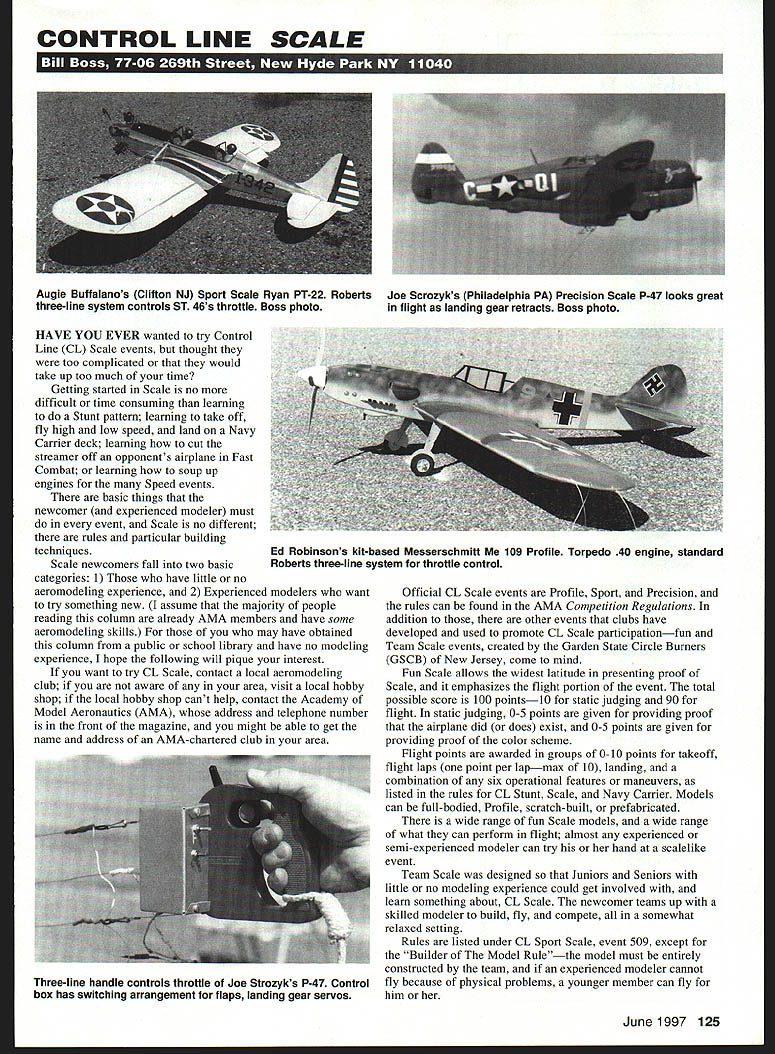
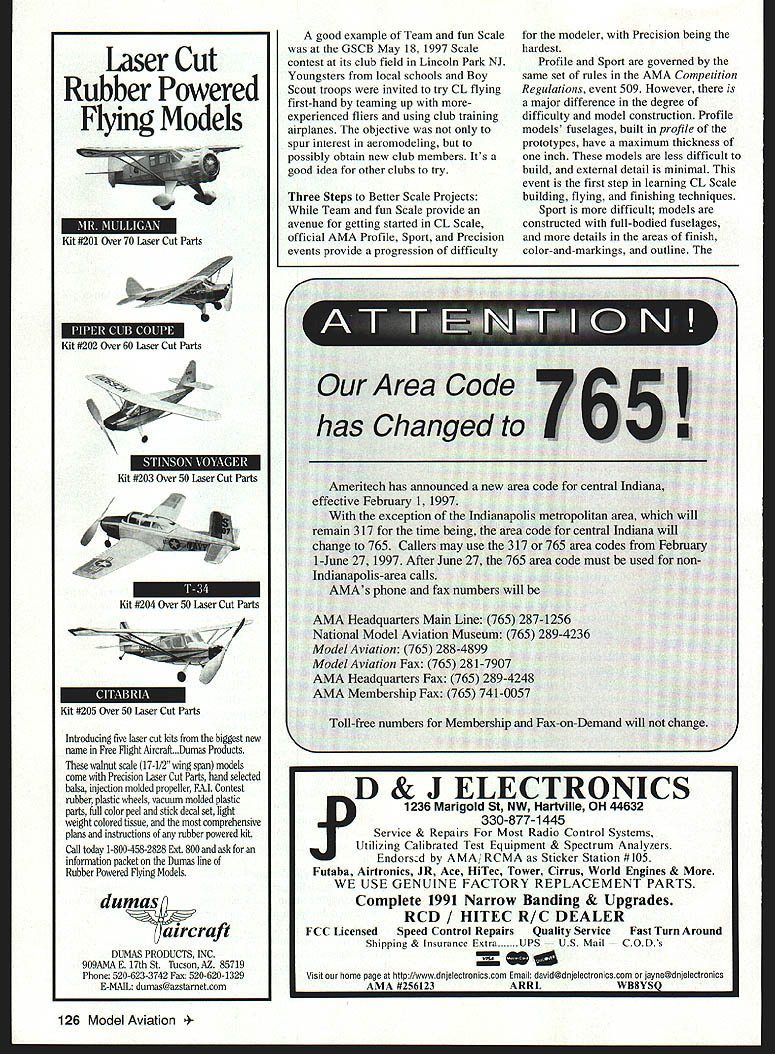
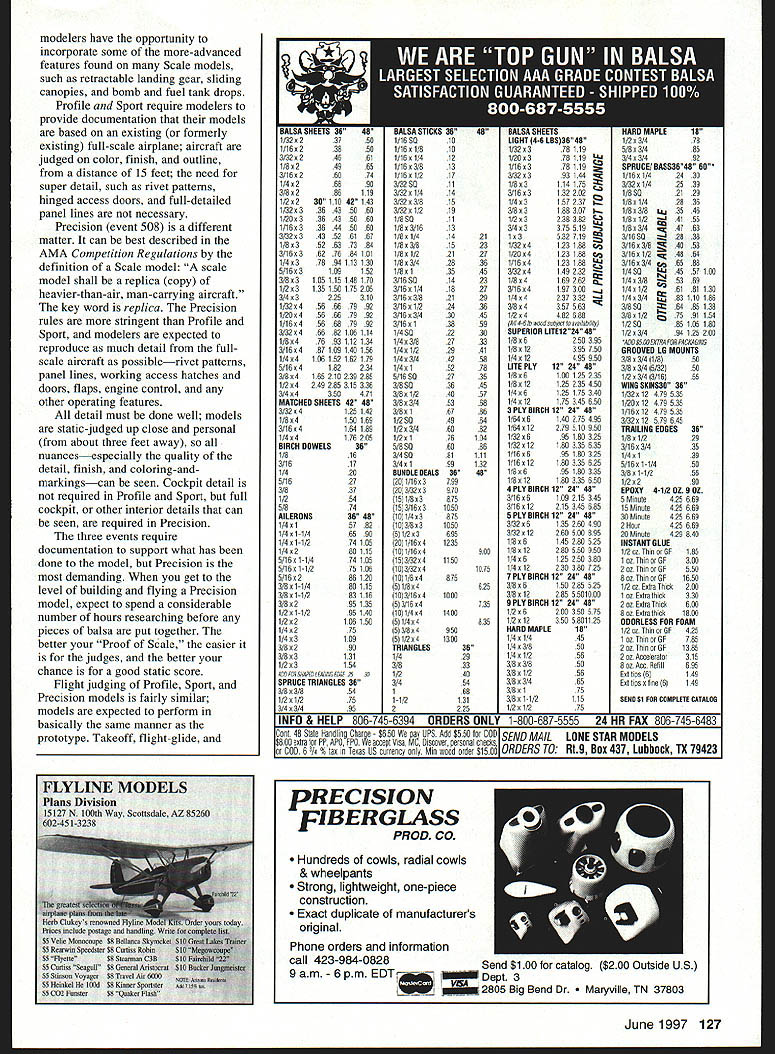
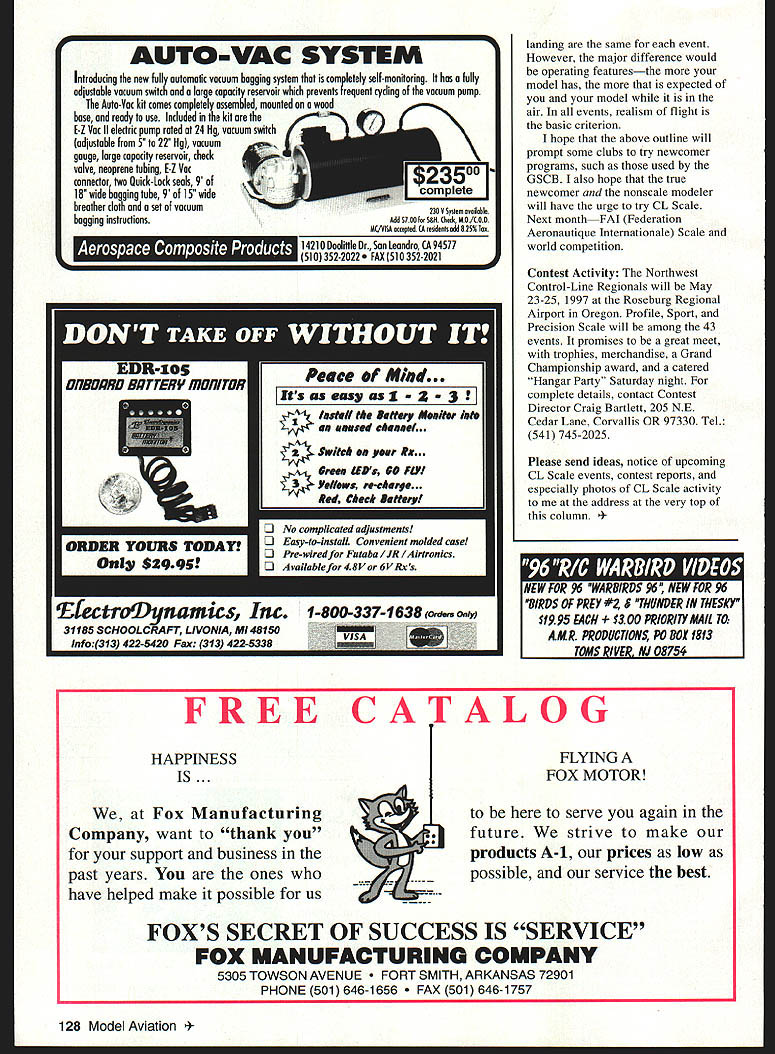
CONTROL LINE: SCALE
Bill Boss — 77-06 269th Street, New Hyde Park, NY 11040
Have you ever wanted to try Control Line (CL) Scale events, but thought they were too complicated or that they would take up too much of your time?
Getting started in Scale is no more difficult or time consuming than learning to do a Stunt pattern; learning to take off, fly high and low speed, and land on a Navy carrier deck; learning how to cut the streamer off an opponent's airplane in Fast Combat; or learning how to soup up engines for the many Speed events.
There are basic things that the newcomer (and experienced modeler) must do in every event, and Scale is no different: there are rules and particular building techniques.
Scale newcomers fall into two basic categories:
- Those who have little or no aeromodeling experience.
- Experienced modelers who want to try something new.
(I assume that the majority of people reading this column are already AMA members and have some aeromodeling skills.) For those of you who may have obtained this column from a public or school library and have no modeling experience, I hope the following will pique your interest.
If you want to try CL Scale, contact a local aeromodeling club; if you are not aware of any in your area, visit a local hobby shop. If the local hobby shop can't help, contact the Academy of Model Aeronautics (AMA) — their address and telephone number are in the front of the magazine — and you might be able to get the name and address of an AMA-chartered club in your area.
Official CL Scale events are:
- Profile
- Sport
- Precision
The rules can be found in the AMA Competition Regulations. In addition to those, there are other events that have been developed and used to promote CL Scale participation—fun and Team Scale events, created by the Garden State Circle Burners (GSCB) of New Jersey, come to mind.
Fun Scale allows the widest latitude in presenting proof of Scale and emphasizes the flight portion of the event. The total possible score is 100 points:
- 10 points for static judging
- 90 points for flight
Static judging:
- 0–5 points for providing proof that the airplane did (or does) exist
- 0–5 points for providing proof of the color scheme
Flight points are awarded in groups of 0–10 points for:
- Takeoff
- Flight laps (one point per lap — maximum of 10)
- Landing
- A combination of any six operational features or maneuvers (as listed in the rules for CL Stunt, Scale, and Navy Carrier)
Models can be full-bodied, profile, scratch-built, or prefabricated. There is a wide range of Fun Scale models and a wide range of what they can perform in flight; almost any experienced or semi-experienced modeler can try his or her hand at a scale-like event.
Team Scale was designed so that juniors and seniors with little or no modeling experience could get involved with, and learn something about, CL Scale. The newcomer teams up with a skilled modeler to build, fly, and compete, all in a somewhat relaxed setting.
Rules are listed under CL Sport Scale, event 509, except for the "Builder of the Model Rule" — the model must be entirely constructed by the team. If an experienced modeler cannot fly because of physical problems, a younger member may fly for him or her.
A good example of Team and Fun Scale was at the GSCB May 18, 1997 Scale contest at its club field in Lincoln Park, NJ. Youngsters from local schools and Boy Scout troops were invited to try CL flying first-hand by teaming up with more-experienced fliers and using club training airplanes. The objective was not only to spur interest in aeromodeling, but to possibly obtain new club members. It's a good idea for other clubs to try.
Three Steps to Better Scale Projects
While Team and Fun Scale provide an avenue for getting started in CL Scale, official AMA Profile, Sport, and Precision events provide a progression of difficulty for the modeler, with Precision being the hardest.
Profile and Sport are governed by the same set of rules in the AMA Competition Regulations, event 509. However, there is a major difference in the degree of difficulty and model construction.
Profile models have fuselages built in profile of the prototypes with a maximum thickness of one inch. These models are less difficult to build, and external detail is minimal. This is the first step in learning CL Scale building, flying, and finishing techniques.
Sport is more difficult: models are constructed with full-bodied fuselages and require more detailing in finish, color-and-markings, and outline. Modelers have the opportunity to incorporate more-advanced features found on many Scale models, such as retractable landing gear, sliding canopies, and bomb and fuel tank drops.
Profile and Sport require modelers to provide documentation that their models are based on an existing (or formerly existing) full-scale airplane. Aircraft are judged on color, finish, and outline from a distance of 15 feet; super-detail such as rivet patterns, hinged access doors, and fully detailed panel lines are not necessary.
Precision (event 508) is a different matter. The AMA Competition Regulations define a Scale model as "a replica (copy) of a heavier-than-air, man-carrying aircraft." The key word is replica. Precision rules are more stringent than Profile and Sport, and modelers are expected to reproduce as much detail from the full-scale aircraft as possible — rivet patterns, panel lines, cockpit access hatches and doors, flaps, engine controls, and any other operating features.
All detail must be done well; Precision models are static-judged up close and personal (from about three feet away), so all nuances — especially the quality of the detail, finish, and coloring-and-markings — can be seen. Cockpit detail is not required in Profile and Sport, but full cockpit or other interior details that can be seen are required in Precision.
The three events require documentation to support what has been done to the model, but Precision is the most demanding. When you get to the level of building and flying a Precision model, expect to spend a considerable number of hours researching before any pieces of balsa are put together. The better your "Proof of Scale," the easier it is for the judges and the better your chance for a good static score.
Flight judging of Profile, Sport, and Precision models is fairly similar; models are expected to perform in basically the same manner as the full prototype. Takeoff, flight-glide, and landing are the same for each event. However, the major difference is operating features — the more your model has, the more that is expected of you and your model while it is in the air. In all events, realism of flight is the basic criterion.
I hope that the above outline will prompt some clubs to try newcomer programs, such as those used by the GSCB. I also hope that the true newcomer and the non-scale modeler will have the urge to try CL Scale. Next month — FAI (Federation Aéronautique Internationale) Scale and world competition.
Contest Activity
The Northwest Control-Line Regionals will be May 23–25, 1997, at the Roseburg Regional Airport in Oregon. Profile, Sport, and Precision Scale will be among the 43 events. It promises to be a great meet, with trophies, merchandise, a Grand Championship award, and a catered "Hangar Party" Saturday night.
For complete details, contact: Craig Bartlett, Contest Director 205 N.E. Cedar Lane, Corvallis, OR 97330 Tel.: (541) 745-2025
Please send ideas, notices of upcoming CL Scale events, contest reports, and especially photos of CL Scale activity to me at the address at the very top of this column.
Transcribed from original scans by AI. Minor OCR errors may remain.

