
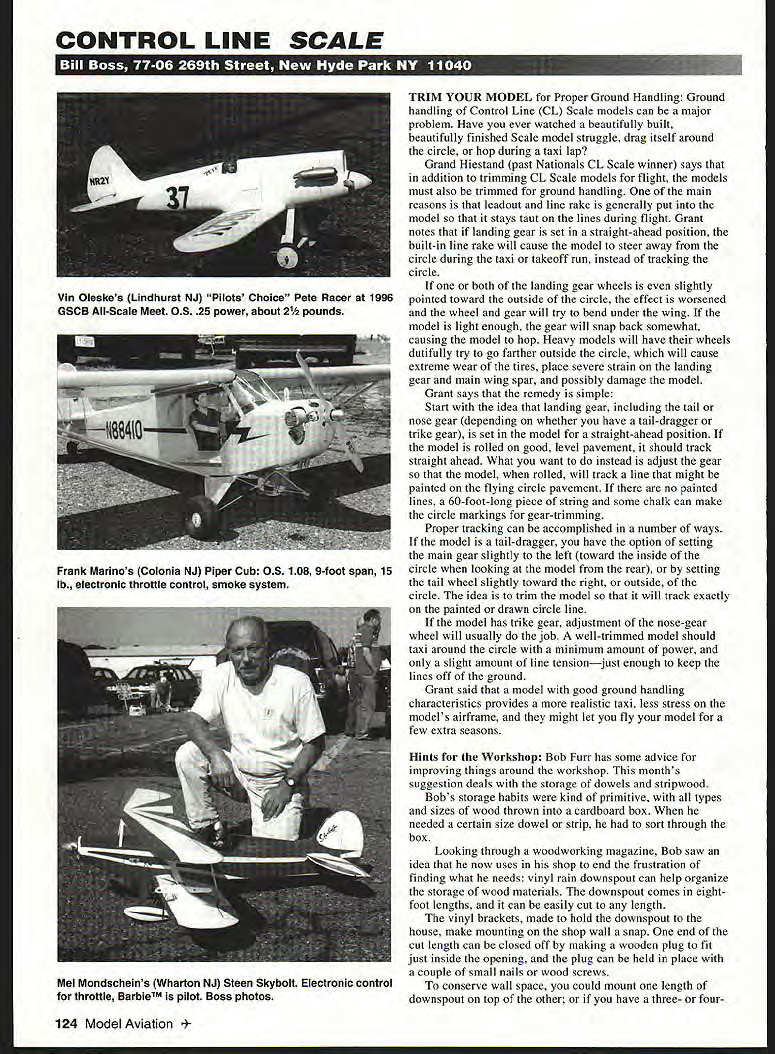
CONTROL LINE SCALE
Bill Boss, 77-06 269th Street, New Hyde Park, NY 11040
TRIM YOUR MODEL for Proper Ground Handling
Ground handling of Control Line (CL) Scale models can be a major problem. Have you ever watched a beautifully built, beautifully finished Scale model struggle, drag itself around the circle, or hop during a taxi lap?
Grant Hiestand (past Nationals CL Scale winner) says that in addition to trimming CL Scale models for flight, the models must also be trimmed for ground handling. One of the main reasons is that leadout and line rake is generally built into the model so that the lines stay taut during flight. Grant notes that if landing gear is set in a straight-ahead position, the built-in line rake will cause the model to steer away from the circle during the taxi or takeoff run instead of tracking the circle.
If one or both landing gear wheels is even slightly pointed toward the outside of the circle, the effect is worsened and the wheel and gear will try to bend under the wing. If the model is light enough, the gear will snap back somewhat, causing the model to hop. Heavy models will have their wheels dutifully try to go farther outside the circle, which will cause extreme tire wear, place severe strain on the landing gear and main wing spar, and possibly damage the model.
Grant says the remedy is simple: start with the idea that landing gear, including the tail or nose gear (depending on whether you have a tail-dragger or trike gear), is set in the model for a straight-ahead position. If the model is rolled on good, level pavement, it should track straight ahead. Instead, adjust the gear so that the model, when rolled, will track a line that might be painted on the flying circle pavement. If there are no painted lines, a 60-foot piece of string and some chalk can make the circle markings for gear-trimming.
Proper tracking can be accomplished in several ways. If the model is a tail-dragger, you have the option of setting the main gear slightly to the left (toward the inside of the circle when looking at the model from the rear), or by setting the tail wheel slightly toward the right, or outside, of the circle. The idea is to trim the model so it will track exactly on the painted or drawn circle line.
If the model has trike gear, adjustment of the nose-gear wheel will usually do the job. A well-trimmed model should taxi around the circle with a minimum amount of power and only a slight amount of line tension—just enough to keep the lines off the ground.
Grant said that a model with good ground handling characteristics provides a more realistic taxi, less stress on the airframe, and might let you fly your model for a few extra seasons.
Hints Workshop
Bob Furr has some advice for improving things around the workshop. This month's suggestion deals with storage of dowels and stripwood. Bob's storage habits were primitive: types and sizes of wood thrown into a cardboard box and sorted through as needed. Looking through a woodworking magazine, Bob saw an idea and now uses it to end the frustration of finding what he needs.
A vinyl rain downspout can help organize storage of wood materials. The downspout comes in eight-foot lengths and can easily be cut to size. Vinyl brackets made to hold downspouts on a house make mounting them on a shop wall easy. The cut end of a length can be closed off by making a wooden plug to fit just inside the opening; the plug can be held in place with a couple of small nails or wood screws. To conserve wall space, you could mount a length of downspout at the top of one shelf; others have three or four.
Book Review
Ghosts: Vintage Aircraft of World War II by Philip Makanna will evoke memories in all who served in WWII—especially in the aviation branches—of the great airplanes and the part they played in winning that conflict. The book has excellent photos of most fighters and bombers that were bought from war surplus or recovered from the jungles, seas, and deserts around the world. Many of the airplanes were restored to full flying status, while others became superb museum pieces in many countries.
Accompanying many of the photos are short stories or anecdotes relating personal experiences of the pilots and aircraft crews. The foreword is by Brigadier General Chuck Yeager, one of WWII's great pilots. Jeffrey Ethell, one of the most prolific aviation writers, provides comments and statistics about the WWII aircraft. While the book provides the reader with great photos and fascinating field accounts, it might also provide the Scale modeler with ideas for the color scheme of a next Scale project.
The book has ISBN 0-934738-29-7, and depending on where you purchase it, could cost $15 to $35. I obtained my copy at a local Barnes & Noble clearance sale for less than $15.
Model Warplanes 1996 by John C. Fredriksen, Ph.D., is the latest in a series of catalogs listing plans, kits, scale drawings, photos, cowls, retractable landing gear systems, and other accessories. This catalog is Vol. 4, which covers Allied aircraft in the 1939–1945 era. Previous volumes cover WW I (1914–1918), the Golden Age (1919–1939), WW II Axis (1939–1945), and the Jet Age (1946–1996). Each volume is $15, and all five volumes are $55. Send orders to John Fredriksen, 461 Loring Ave., Salem, MA 01970; Tel.: (508) 745-9849.
Contest Activity
The Cholla Choppers club will be holding its Fall Classic September 20–21, 1997. The contest will take place at Columbus Park (Silverbell), Tucson, AZ. Contact Contest Director (CD) Ted Snow at (520) 838-0146 for full details and for what CL Scale events will be flown.
I would like to congratulate the Cholla Choppers on its anniversary; it has been an official Academy of Model Aeronautics chapter since January 16, 1947. I wonder how many other clubs have lasted more than 50 years? The club is a great way to join a fine group of men and women whose primary activity is Control Line.
The Garden State Circle Burners (GSCB) will hold their 20th annual George L. Gaydos Memorial all-Scale meet September 14, 1997. There will be Precision, Sport, Profile, fun, and team Scale events.
This year's meet will be about five miles south of the old Teterboro Airport site; the old location property was sold. The new location is a parking area at 1200 Wall St., Lyndhurst, NJ, near the Medieval Times Restaurant at the intersection of Route 17 and Route 3. The new area is reportedly much larger and in better condition than the old one.
In addition to trophies for the top three places, the George L. Gaydos Competitors Award will be given for the best overall Scale performance in each event. For full contest details, or for a travel map to the new meet site, contact CD Bill Reynolds at (201) 226-5611; Fax: (201) 226-3450. You can also call the GSCB Hotline at (201) 835-5649 for up-to-date CL information and contest status.
Please send ideas, notices of upcoming CL Scale events, contest reports, and especially photos of CL Scale activity to me at the address at the top of this column.
Transcribed from original scans by AI. Minor OCR errors may remain.

