
CONTROL LINE SCALE
Bill Boss, 77-06 269th Street, New Hyde Park NY 11040
Ground handling and setting up your model for proper ground tracking was presented in the August 1997 column; Grant Hiestand told us of the importance of proper ground handling and how to accomplish it. During the next couple of months, I will explore ideas from Fred Cronenwett, my West Coast reporter, about throttle control and test flying (especially for new Scale models).
Throttle Control
While some of this may be old hat to some readers, I am sure that there are newcomers to aeromodeling, especially to Control Line (CL) Scale, who might benefit from a few words on the basics. Who knows? Maybe some of the old-timers might even find it interesting.
Some CL models, such as those flown in Speed and Combat, use engines with a fixed venturi and needle valve and run at a fixed rpm (until the fuel supply is gone). Other models, such as those flown in Navy Carrier, Scale, and Sport flying, have throttle control. Throttle control is possible when the engine is equipped with a carburetor that allows the venturi to be opened and closed, metering the air/fuel mixture and giving control of the engine rpm. Such an arrangement is what you want for Scale models.
While it is possible for a model without throttle control to participate in a Scale competition, the odds of placing are not very good. Throttle control is essential in performing many of the flight and ground maneuvers, and it allows Scale models to be flown in a realistic manner.
The most commonly used methods of controlling the throttle are:
- The standard three-line handle and bellcrank.
- Newer electronic systems and servos used by many Scale modelers.
Fred Cronenwett points out that while pilots may not think too much about throttle control, it is perhaps one of the most important aspects of Scale flying, and it must be used properly throughout a Scale model's flight.
One of the first things you want to do before taking a new model into the air is make sure that it taxis properly. A review of ground handling from last month's column might be necessary.
Preflight taxi and takeoff checklist:
- Verify the model tracks properly around the circle.
- Start the engine and make needle valve and/or idle adjustments.
- Lower the engine rpm to idle; the model should be able to stand still on its own.
- Apply a little power to get the model rolling. If it begins to roll too fast, cut back on the power and try again.
- Avoid applying too much power at once; excessive torque may cause the model to come into the circle. Be prepared to step back to keep tension on the lines.
- Take your time and get the feel of the model and its tracking around the circle. When satisfied with taxi capabilities, you're ready for takeoff.
Do not be the Scale modeler who starts the engine, runs to the middle of the circle, picks up the handle, and calls for release with the engine at full throttle — this produces an unrealistic, cannon-like launch. The proper and most realistic method is:
- Start the engine and verify it runs properly from idle to full power.
- Go out to the handle (unless a ground crew started the engine).
- Bring the engine rpm to idle speed and call for release of the model.
- Gradually apply power for the takeoff roll and liftoff.
Tail-wheel takeoff technique:
- Keep the tail on the ground until the model has picked up some speed by applying a small amount of up elevator.
- As speed increases, slowly bring the elevator to neutral; the tailwheel should begin to come off the ground, leaving the model to roll on the main gear.
- Continue increasing engine power until sufficient speed is attained, then apply a slight up elevator to allow the model to rise on its own.
Nose-gear takeoff technique:
- Apply a small amount of down elevator to keep the nose wheel on the ground during the takeoff roll.
- As ground speed increases, release the down elevator to allow the nose wheel to leave the ground while the model still rolls on the main gear.
- Apply a slight up elevator while increasing engine rpm and allow the model to lift off on its own.
Never force the model off the ground before it is ready to fly; that may cause a stall with potentially disastrous results. Flying characteristics vary by model; patience, practice, and experience are essential.
When your model has climbed out and reached a proper flight altitude, you can cut back on power and fly at cruising speed. Remember that the goal in Scale events is realism — your model should look and fly like the prototype.
I'll continue next month with more of Fred's ideas and thoughts on test flying, with emphasis on getting that work-of-art back on the ground in one piece.
1950s Plans
Would you like copies of plans and tracings of all the wood parts for one of the old Aristocrat, Eureka, Kyosho, or Kyo multiengine CL Scale kits? Ken Wilson can supply copies of many of these early models, including:
- Douglas DC-6B
- Beech C-45
- Fairchild C-119
- C-124 Globemaster
- P2V-4 and P2V-7 versions of the Neptune
- Convair B-36
For a full listing of plans, send a SASE to: Kenneth D. Wilson 2324 E. Florida St. Evansville IN 47711-4812
If a self-addressed stamped envelope is not enclosed with your request, the list will not be sent. Telephone inquiries: (812) 477-7176, 9 a.m.-9 p.m. Central Daylight Saving Time.
Hint for the Workshop
Do you have a scroll saw that is not equipped with a blower or vacuum to keep sawdust off your work while cutting? Bob Furr notes his Dremel scroll saw does not clear sawdust, and because he wears a dust mask he cannot see the cutting line.
Bob's simple fix:
- Cut a small hole in the mask and insert a straw.
- Blow through the straw to direct air to the cutting area. It takes very few puffs to keep the area clear. With practice you can inhale through your nose and exhale through your mouth.
Bob also found his scroll saw table picking up rust after many years of use. After cleaning with steel wool, he applied a coat of auto wax on the flat metal surface of the saw table. Benefits:
- Helps keep the metal rust-free.
- Greatly reduces drag and friction when cutting.
This item was found in the Orbiting Eagles (Omaha NE) newsletter.
This Month's Photos
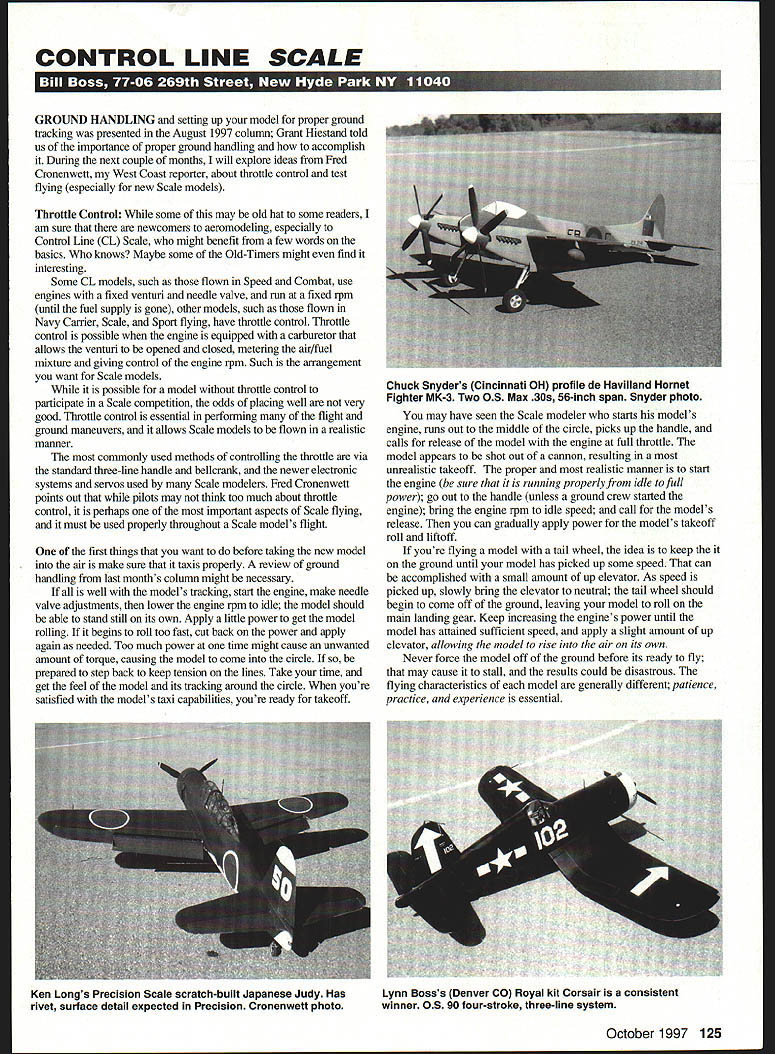
- The Profile de Havilland Hornet Fighter MK-3 was scratch-built by Chuck Snyder of Cincinnati, Ohio. The MK-3 has a wingspan of 56 inches and is powered with two O.S. Max 30s. The model is equipped with electronics for operation of the flaps, bomb drop, and throttle control.
- In the May issue I showed a couple of the great models from last year's Seebree Hayes contest (at Whittier Narrows in Los Angeles). The Japanese Yokosuka D4Y3 Suisei "Judy" was built by Ken Long of Whittier, California. It is a scale model he flew in the 1986 Fédération Aéronautique Internationale (FAI) trials. The Judy crashed and has now been restored and is competing again. The model has a wingspan of 56 inches and is complete with rivet and great surface detail. An electronic system provides control of the engine throttle, flaps, and retractable landing gear.
Please send ideas, notices of upcoming CL Scale events, contest reports, and especially photos of CL Scale activity to me at the address at the very top of this column.
Transcribed from original scans by AI. Minor OCR errors may remain.

