

CONTROL LINE SCALE
Bill Boss 77-06 269th Street, New Hyde Park, NY 11040
Test Flying (continued)
In the August and October columns I talked about setting up Scale models for proper ground handling, throttle control, and taxiing, and I have progressed to the point of getting the model into the air. I'll continue the discussion with the Flight Glide (required number of laps in competition) and getting that super-special project safely back on the ground.
Now that you know you can fully control the aircraft's engine and successfully get the model airborne, consider how the model will react. (If it is properly powered, you should have gotten it airborne without having to apply full throttle.) Keep it airborne, but only two or three feet above the ground. That gives you an opportunity to evaluate the model's stability, and a short distance in which to get the model back on the ground in case of emergency.
During this low-level flight, you want to see if the model's center of gravity (CG) is okay. Use these checks to evaluate handling:
- Does the tail of the model hang down, requiring down elevator to lift?
- Do you need nose weight?
- Is line tension good?
- Do you need more rudder offset?
- Is elevator control oversensitive? Does a slight elevator movement give large reactions in the model's flight?
If you feel that changes or corrections are required, this is the time to get the model back on the ground and make them. After making changes, put the model back into the air and proceed with flight tests.
If the airplane handles satisfactorily, put on some power and climb, in a realistic manner, to a cruising altitude. The climb depends on the type of model:
- Fighter type: climb to altitude can be fairly quick and steep.
- Bomber type: climb should be slow and gradual.
This principle also applies to the takeoff roll; bombers normally have longer takeoff rolls than fighters.
At cruising altitude, you can cut back on the power, keeping the model at cruising speed for at least 10 laps, as though you were in competition.
Operating features
If the model is equipped with operating features such as bomb- or fuel-tank-drop or flaps, this would be the time to try them out. If the model has gear retraction, you may not want to try it on the first flight; it's best to be sure of your model and the way it handles before you do so. You may want to wait until you have completed a few good flights and are comfortable with the model's performance.
While bomb- or fuel-tank-drops don't usually pose flight problems when executed (only that they might not work), flap actuation can be another matter. Flaps are part of the landing procedure, and to stay out of trouble they should only be lowered at reduced speeds. If you lower them at high speed, you could damage the flap structure because of wind pressure, or your model could take you by surprise and climb sharply. Be prepared for the unexpected when applying flaps on a new model for the first time.
Landing
Landing is the final phase of the flight-testing discussion, and it's most important for keeping that great Scale project in one piece. As you took time getting your model up to cruising altitude, so should you take time in getting the model back on the ground. It is not urgent to get your model on the ground immediately upon completing the 10 flight laps and demonstrating the operating features.
The keys to successful landings are patience and proper use of throttle control. The type of model dictates the speed with which you approach the landing:
- Bomber type: a slow, gradual reduction of engine power should allow you to bring your model down in two or three laps, gracefully settling itself on the ground.
- Fighter type: can be quicker in getting on the ground, but care should be exercised to allow the model to settle itself on the ground; kamikaze-type approaches don't offer very good dividends.
Remember, practice and patience will keep that special Scale project flying much longer.
For further descriptions of what is required in competition for Control Line Scale Flight, please read and study the Judging Guide that starts on page 135 of the 1996–1997 AMA Competition Regulations. Thanks to Fred Cronenwett for the thoughts presented here on test flying, and for some of this month's photos.
This item was found in the Orbiting Eagles' newsletter.
Book Review
The Concise Guide to Axis Aircraft of World War II by David Monday is 255 pages of many of the aircraft manufactured for the war by Germany, Italy, and Japan. More than 130 aircraft and 400 illustrations are featured in the book, including black-and-white and color photos, some great artwork, and sections on "History" and "Specifications" of each airplane. The plans to build one of the Axis aircraft, three-color plates and color side views can provide you with ideas for the color scheme.
The book is available (for less than $15 plus shipping and handling) from Zenith Books, Box 1, Osceola, WI 54020-0001.
Wise Owl Worldwide Publications
Wise Owl Worldwide Publications might be the place to find the documentation for that special Scale project. The Wise Owl company is the source of several British publications that have been providing modelers with excellent documentation for many years. In addition to subscriptions to many foreign and domestic modeling magazines, you can obtain:
- Albatros Productions: a source of Datafile and Datafile Specials of WWII subjects filled with close-up black-and-white photos, scale drawings, and color-and-markings information.
- Warpaint Series books: containing photos, scale drawings, and color schemes of WWII and contemporary aircraft.
- The Nexus Plan Handbook No. 3: a catalog of hundreds of scale drawings of aircraft from 1914 to modern jets.
For full details and a listing of services provided by Wise Owl Worldwide Publications, write to: Wise Owl Worldwide Publications 4314 West 238th St. Torrance, CA 90505-4509 Tel.: (310) 375-6258
This Month's Photos
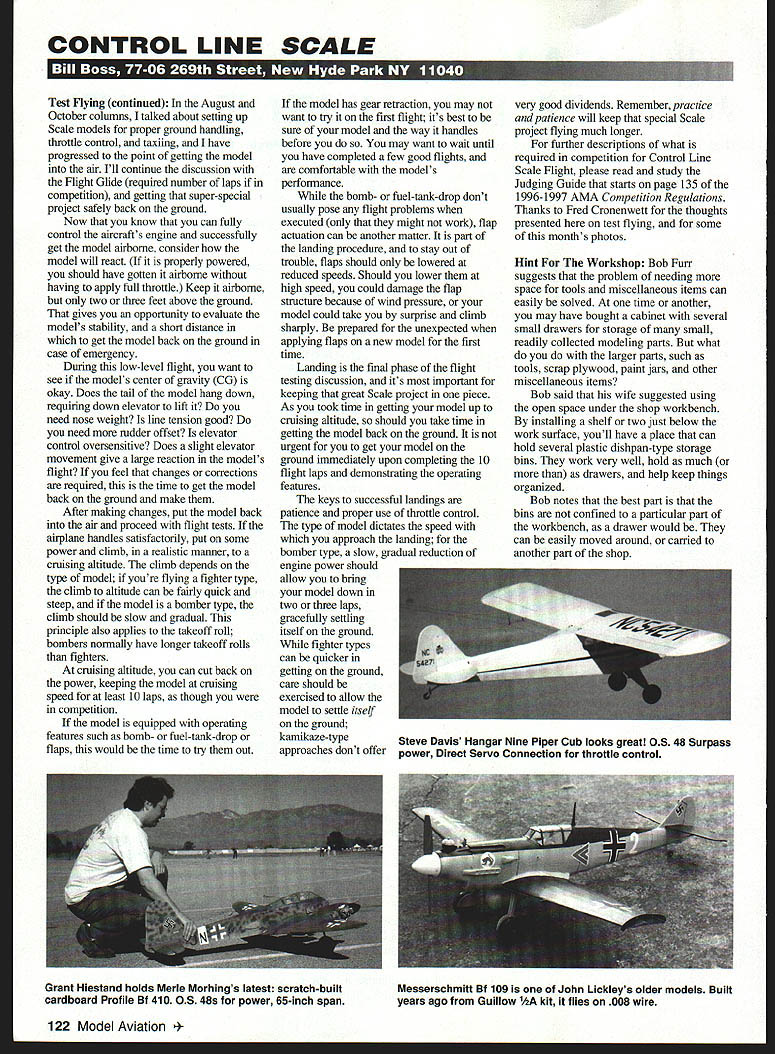
- The Hangar 9 Piper Cub by Steve Davis is powered by an O.S. 48 Surpass. Steve's model is controlled electronically with a JR XF622 radio, which is normally used for Radio Control flying, but it has a feature called Direct Servo Connection, which Steve uses to pass signals up the flying wires for the Cub's throttle control.
- The twin-engine Messerschmitt 410 profile is another of Merle Morhing's great-looking cardboard-built models. The aircraft has a 65-inch wingspan, weighs seven pounds, features flap and throttle control, and is powered with two O.S. 48s.
- Several years ago John Lickley built the Messerschmitt Bf 109, which is still given an occasional flight. The model was built from a Guillow 1/2A kit and powered with a Cox Black Widow engine. The fuselage was planked to a point just beyond the rear of the cockpit for added strength for the engine mounting and to protect against vibration. The model weighs slightly more than 1/2 pound and flies well on .008 wire.
Please send ideas, notices of upcoming CL Scale events, contest reports, and especially photos of CL Scale activity to the address at the very top of this column.
Hint Workshop
Bob Furr suggests that the problem of needing space for tools and miscellaneous items can easily be solved. At one time you may have bought a cabinet with several small drawers for storage of small, readily collected modeling parts. For larger parts, tools, scrap plywood, paint jars and other miscellaneous items, Bob said his wife suggested using the open space under the shop workbench.
Install a shelf just below the work surface and you'll have a place that can hold several plastic dishpan-type storage bins. They work very well and hold a lot. Drawers help keep things organized. Bob notes the best plan is to confine particular parts to a workbench drawer so they can easily be moved around or carried to another part of the shop.
Transcribed from original scans by AI. Minor OCR errors may remain.

