
Control Line: Scale
Bill Boss 77-06 269th Street, New Hyde Park, NY 11040
The P-39Q Cobra II was one of two Airacobras flown in the mid-1940s at the Cleveland Air Races. Cobra I was flown by Jack Woolsams in August 1946 and was lost above Lake Ontario after qualifying for the Cleveland Air Races. The P-39Q Cobra II, flown by Tex Johnston, qualified for the same 1946 races and went on to win the Thompson Trophy. Both models had been stripped of military components, lightened, given better-rated engines, and had their original three-bladed propellers replaced with four-bladed props. The Cobra II raced again in 1947 and 1948 (it reached 471 mph in 1948). It was flown after that until 1969, when it crashed during an attempt to break the propeller-driven speed record.
The Cobra II shown this month is the work of Joe Scrozyk, Philadelphia, PA, and has operating systems that include Rhom Air retracts, flaps, and throttle control. The model is built from a vintage Top Flite kit and is powered by a Fox .78 engine. Joe noted that the kit was not one of the current Top Flite offerings but is about 25 years old. Model control is via a combination of the standard three-line U.S. bellcrank and handle for throttle control, while the flap and Rhom Air gear retraction systems are controlled by electric servos.
Although Joe's model was built for Sport Scale (no points are awarded for cockpit details), he dressed it up with full cockpit detail, including operating doors. This type of detail enhances the appearance of any scale model.
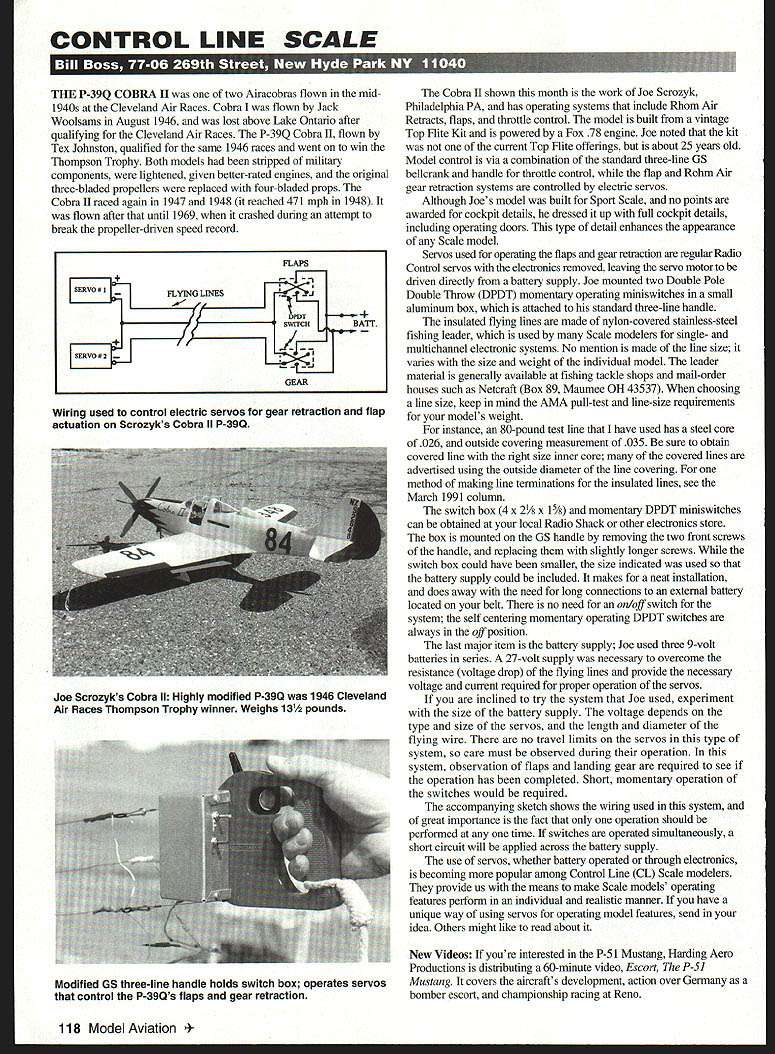
Servos used for operating the flaps and gear retraction are regular radio-control servos with the electronics removed, leaving the servo motors to be driven directly from a battery supply. Joe mounted two Double Pole Double Throw (DPDT) momentary miniswitches in a small aluminum box, which is attached to his standard three-line handle.
The insulated flying lines are made of nylon-covered stainless-steel fishing leader, which is used by many scale modelers for single- and multichannel electronic systems. No specific line size is mentioned; it varies with the size and weight of the individual model. The leader material is generally available at fishing tackle shops and mail-order houses such as Netcraft (Box 89, Maumee, OH 43537). When choosing a line size, keep in mind the AMA pull-test and line-size requirements for your model's weight.
For instance, an 80-pound-test line that I have used has a steel core of 0.026" and an outside covering measurement of 0.035". Be sure to obtain covered line with the right-size inner core; many covered lines are advertised using the outside diameter of the line covering. For one method of making line terminations for the insulated lines, see the March 1991 column.
The switch box (4 x 2 1/8 x 1 5/8 inches) and momentary DPDT miniswitches can be obtained at your local RadioShack or other electronics store. The box is mounted on the handle by removing the two front screws of the handle and replacing them with slightly longer screws. While the switch box could have been smaller, the size indicated was used so that the battery supply could be included. It makes for a neat installation and does away with the need for long connections to an external battery located on your belt. There is no need for an on/off switch for the system; the self-centering momentary DPDT switches are always in the off position.
The last major item is the battery supply; Joe used three 9-volt batteries in series. A 27-volt supply was necessary to overcome the resistance (voltage drop) of the flying lines and provide the necessary voltage and current required for proper operation of the servos.
If you are inclined to try Joe's system, experiment with the size of the battery supply. The voltage depends on the type and size of the servos and the length and diameter of the flying wire. There are no travel limits on the servos in this type of system, so care must be observed during their operation. In this system, observation of flaps and landing gear is required to see if the operation has been completed. Short, momentary operation of the switches is required.
The accompanying sketch shows the wiring used in this system; of great importance is the fact that only one operation should be performed at a time. If switches are operated simultaneously, a short circuit will be applied across the battery supply.
The use of servos, whether battery operated or through electronics, is becoming more popular among control-line (CL) scale modelers. They provide us with the means to make scale models' operating features perform in an individual and realistic manner. If you have a unique way of using servos for operating model features, send in your idea. Others might like to read about it.
New Videos
If you're interested in the P-51 Mustang, Harding Aero Productions is distributing a 60-minute video, Escort: The P-51 Mustang. It covers the aircraft's development, action over Germany as a bomber escort, and championship racing at Reno.
Also available is Introduction to Control Line Flying and Building. Aimed at the CL newcomer, this might be a nice addition to the club library, for showing to new members and presenting at scout meetings and schools. It might also be a good item for clubs to donate to their local library as a way to interest others. The videos cost $19.95 plus $3 shipping and handling and can be obtained from Harding Aero Productions (4782 Unity Line Rd., New Waterford, OH 44445; Tel.: (330) 457-1600).
Workshop Hints
One problem with using gap-filling cyanoacrylate (CyA) glue is when the tip clogs after use. A solution is to buy a package of extra tips, and rather than mutilating the one that is stopped up, put it in a tightly capped jar (such as a baby food jar) filled with acetone. The acetone will dissolve the CyA by the next day, leaving the tip as good as new. (Put a new cap on the just-used CyA bottle.) Make sure that the tip is thoroughly dry and free of acetone before using it again.
Acetone can be a fire hazard if improperly handled, so treat it as such. Eye protection and good work-area ventilation are highly recommended. This tip was found in the Orange County R/C Club Eagle Newsletter.
1997 Directory of Model Aviation CL Scale Items
January
- Notes on NASA (National Association of Scale Aeromodellers) Competition Committee
- When is "big" too big?
- Workshop hint — box of tissues in the workshop
February
- How to paint pilot figures
- Plans enlargement service
- Field tip — fuel filler overflow reservoir
March
- Overseas Mail — Northrop Gamma by Karl Georg Krafft
- Documentation problems
- Contest Activity — GSCB (Garden State Circle Burners) annual scale meet
April
- 1996 World Competition
- Southeastern states contest activity
- Workshop hint — CyA glues and eyeglasses
- Book review — Warbird Tech Series
May
- Four-line control system
- West Coast contest activity
- Pre-flying season equipment check
June
- Getting started in CL Scale
July
- Comments on FAI (Fédération Aéronautique Internationale) World Competition
August
- Trimming CL Scale models for ground handling
- Workshop hint — use vinyl rain downspouts for wood storage
- Book review — Ghosts, Vintage Aircraft of World War II
- Contest Activity — Cholla Choppers and GSCB
September
- 1999 CL Scale rules proposals
- Overseas mail from Poland
- Workshop hint — opening screw-top paint bottles
- Contest Activity — Sebree Hayes and Skyliners Annuals
October
- Test flying CL Scale models, Part I
- 1950s plans available
- Workshop hint — keep sawdust off scroll saw work
November
- Test flying CL Scale models, Part II
- Workshop hint — dishpan storage bins
- Book review — Concise Guide to Axis Aircraft of WWII
- Wise Owl World Wide Publications
December
- Nationals competition coverage
Please send ideas, notices of upcoming CL Scale events, contest reports, and especially photos of CL Scale activity to me at the address at the top of this column.
Transcribed from original scans by AI. Minor OCR errors may remain.

