
CONTROL LINE SCALE
Bill Boss 77-06 269th Street New Hyde Park, NY 11040
Suceava is a quaint town in the northeast corner of Romania that is surrounded by hills, mountains, and large forests. Townspeople use the Suceava River, which runs through the village, for swimming and fishing. Families farm and raise fruits, vegetables, and various farm animals on the outskirts of the town, which is known for several historical sites, including monasteries, churches, and ruins of cities dating back to the 14th century.
You might wonder, "What does Suceava have to do with CL (Control Line) Scale?" It's where the 1997 European F4B & F4C (CL and RC — Radio Control) Scale Championships were held. Piotr Zawada (Poznan, Poland), who has contributed accounts of foreign activities to this column, sent this month's photos and results of the CL portion of the competition.
Teams from Romania, Poland, Czechoslovakia, Russia, Ukraine, and France participated in the championships. Poland took top honors (team members finished first, third, and fourth), Czechoslovakia placed second, and Ukraine finished third.
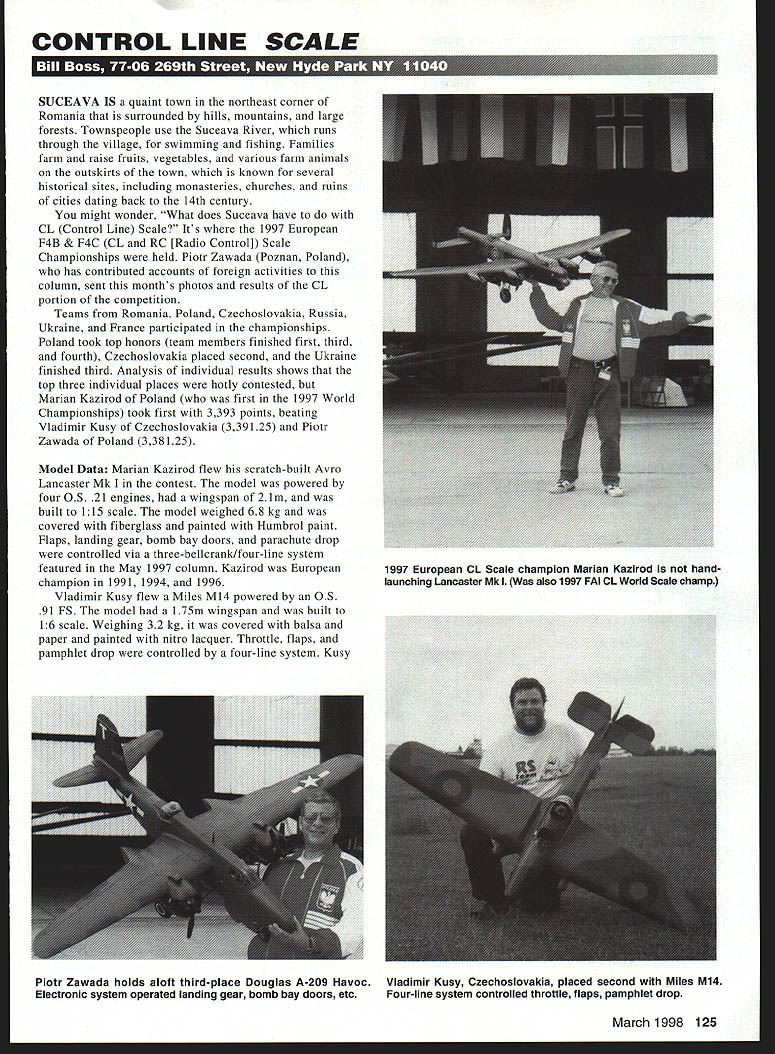
Analysis of individual results shows that the top three individual places were hotly contested, but Marian Kazirod of Poland (first in the 1997 World Championships) took first with 3,393 points, beating Vladimir Kusy of Czechoslovakia (3,391.25) and Piotr Zawada of Poland (3,381.25).
Model Data
Marian Kazirod — Avro Lancaster Mk I
- Scratch-built model powered by four O.S. .21 engines.
- Wingspan: 2.1 m; scale: 1:15.
- Weight: 6.8 kg.
- Covered with fiberglass and painted with Humbrol paint.
- Features: flaps, landing gear, bomb bay doors, and parachute drop controlled via a three-bellcrank/four-line system (as featured in the May 1997 column).
- Kazirod was European champion in 1991, 1994, and 1996.
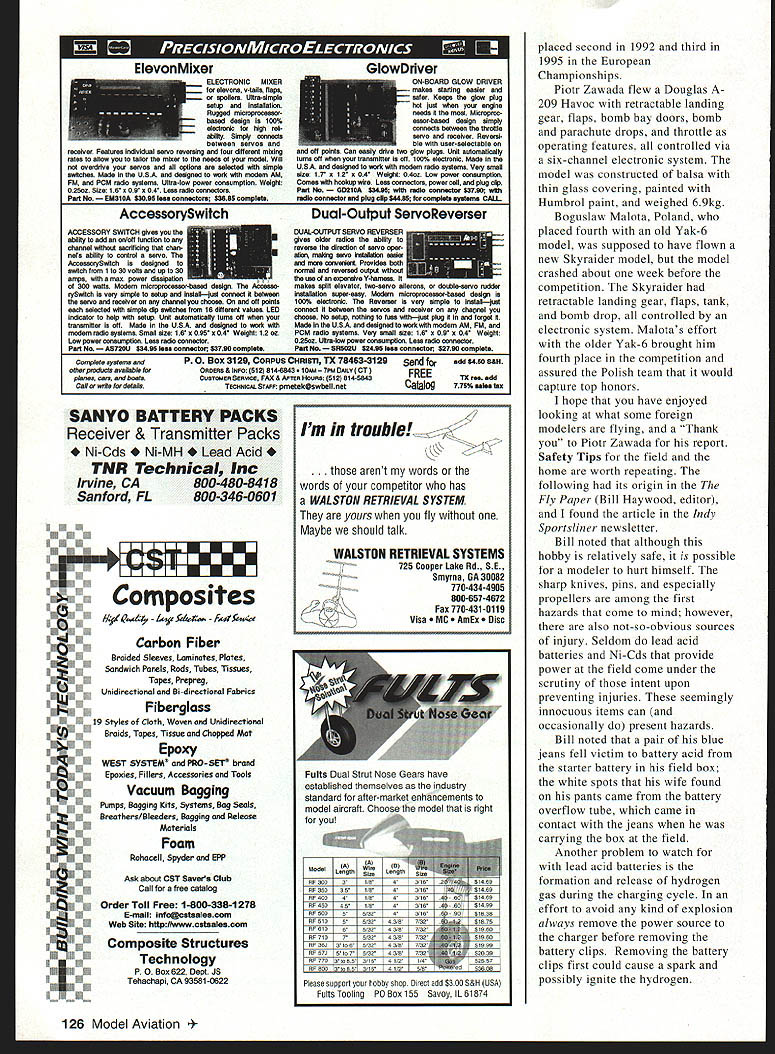
Vladimir Kusy — Miles M14
- Powered by an O.S. .91 FS engine.
- Wingspan: 1.75 m; scale: 1:6.
- Weight: 3.2 kg.
- Covered with balsa and paper and painted with nitro lacquer.
- Features: throttle, flaps, and parachute drop controlled by a four-line system.
- Kusy placed second in 1992 and third in 1995 in the European Championships.
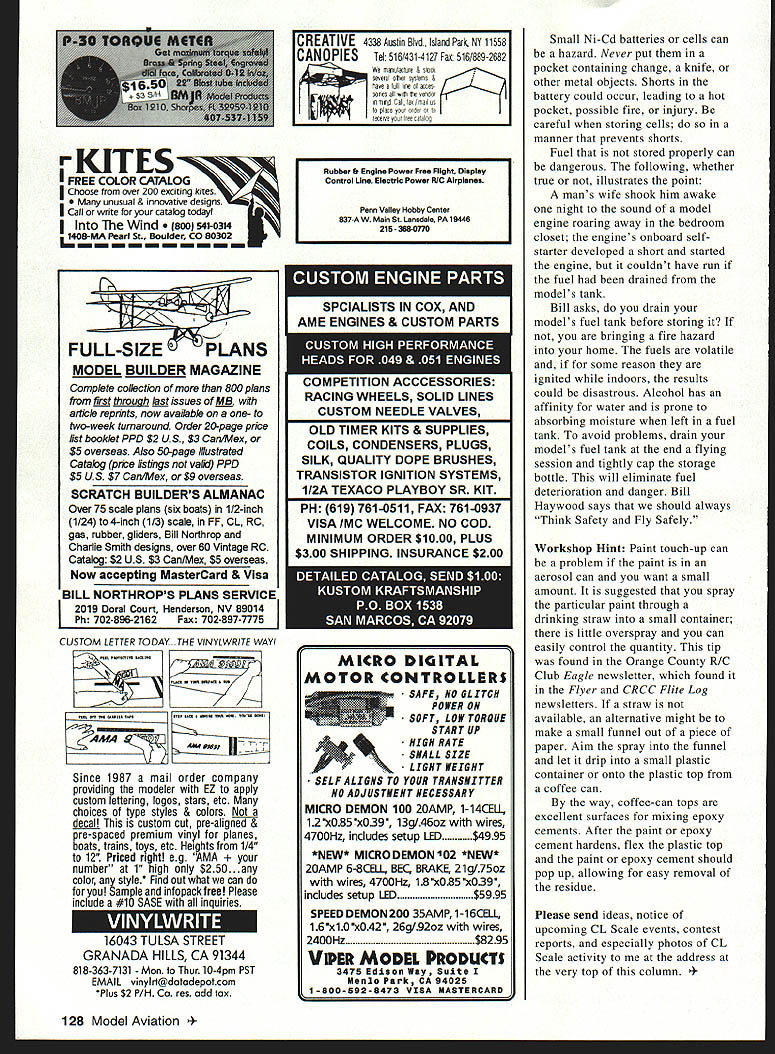
Piotr Zawada — Douglas A-20G Havoc
- Constructed of balsa with thin glass covering; painted with Humbrol paint.
- Weight: 6.9 kg.
- Features: retractable landing gear, flaps, bomb bay doors, bomb and parachute drops, and throttle — all operated via a six-channel electronic system.
Boguslaw Malota — Yak-6 (old model)
- Poland; placed fourth with an older Yak-6 model.
- Malota had planned to fly a new Skyraider, but it crashed about one week before the competition. The Skyraider featured retractable landing gear, flaps, tank, and bomb drop, all controlled electronically.
- Malota’s effort with the old Yak-6 brought him fourth place and helped secure the Polish team’s top honors.
I hope you have enjoyed this look at what some foreign modelers are flying. Thank you to Piotr Zawada for his report.
Safety Tips
Safety tips for the field and the home are worth repeating. The following originated in The Fly Paper (Bill Haywood, editor) and was reprinted in the Indy Sportsliner newsletter.
Bill noted that although this hobby is relatively safe, it is possible for a modeler to hurt himself. Sharp knives, pins, and especially propellers are among the more obvious hazards. However, there are also less obvious sources of danger. Lead-acid batteries and Ni‑Cd cells that provide needed current in the field deserve careful scrutiny; these seemingly innocuous items can (and occasionally do) present hazards.
- One anecdote: a pair of blue jeans was ruined by battery acid from a starter battery in a field box. The white spots came from the battery overflow tube, which contacted the jeans when the box was carried.
- Another risk with lead-acid batteries is the formation and release of hydrogen gas during charging. To avoid any risk of explosion, remove power to the charger before removing the battery clamps. Removing the clamps first could cause a spark and possibly ignite hydrogen.
- Small Ni‑Cd batteries or cells can be hazardous. Never carry them in a pocket containing coins, a knife, or other metal objects; shorts can occur, leading to a hot pocket, possible fire, or injury. Store cells so they cannot short.
Fuel that is not stored properly can be dangerous. One cautionary (possibly apocryphal) story: a man's wife woke him to the sound of a model engine running in the bedroom closet; the engine's onboard starter developed a short and started the engine. It couldn't have run long if the fuel had been drained from the model's tank.
Do you drain your model's fuel tank before storing it? If not, you are bringing a fire hazard into your home. Model fuels are volatile and, if ignited indoors, the results could be disastrous. Alcohol-based fuels absorb moisture when left in tanks. To avoid problems, drain the model's fuel tank at the end of a flying session and tightly cap storage containers. This minimizes fuel deterioration and danger. As Bill Haywood says: "Think Safety and Fly Safely."
Workshop Hint
Paint touch-up can be a problem when paint is in an aerosol can and you need only a small amount. A useful tip: spray the paint through a drinking straw into a small container; there is little overspray and you can easily control the quantity. If a straw is not available, make a small funnel from a piece of paper, aim the spray into the funnel, and let it drip into a small plastic container or onto the plastic top from a coffee can.
Coffee-can tops are excellent surfaces for mixing epoxy cements. After the paint or epoxy hardens, flex the plastic top and the paint or epoxy should pop up, allowing easy removal of the residue.
Please send ideas, notices of upcoming CL Scale events, contest reports, and especially photos of CL Scale activity to me at the address at the top of this column.
Transcribed from original scans by AI. Minor OCR errors may remain.

