
Control Line: Scale
Bill Boss, 77-06 269th Street, New Hyde Park NY 11040
MODEL DATA:
One of the main features in model magazine columns is the photos and sketches of model construction, workshop tips, or that great-looking aircraft, just completed and ready to take you to the winner's circle. However, the person who submits the photos often does not include much photo description.
To overcome the problem, I have put together a form asking for basic data. For a sketch of equipment, give appropriate information about its use, how it works, etc. For a photo including people, tell who they are, where they are from, and something about their involvement in the pictured activity. The information allows a columnist to create better captions and column material.
One good thing about having photo data is that I can give readers information about a model's weight, power plants, finish, control system, etc. The form also asks if you have any special construction techniques or ideas; if so, I can pass them on to other Scale builders. The ideas that you present might help a fellow Scale modeler solve a building problem. Other columnists could also benefit from using the form, or at least get the asked-for data. I'd be happy to send copies of the form to anyone who wants it; just send a self-addressed stamped envelope to me at the address at the top of the column. I hope that your future submissions will include the requested data on the "Model Information Form" or equivalent information.
Racing Corsair:
Kenneth R. Smith (Parma Heights, OH) reports that Control Line (CL) Scale modeler Norm Skuderin, member of the North Coast Control Liners Club (Cleveland, OH), was honored at the 13th Annual Air Racing Historical Symposium by having his F2G Corsair model on display. The symposium — a gathering of pilots and people involved in the Cleveland Air Races throughout the years — was held in May 1997 at the Holiday Inn in Cleveland.
Norm's F2G Corsair #74, with its racing color scheme of dark blue with white trim, is fashioned after the F2G Corsair flown by pilot Dick Becker in the 1948 Thompson and 1949 Sohio races. Mechanical problems (a blown reduction gear) kept the Corsair from competing in the 1949 Thompson Races.
The model is scratch-built using Brian Taylor F4U plans modified to meet the F2G racing configuration. It has a 60-inch span, weighs about nine pounds, uses a standard Roberts three-line control system for throttle, is powered with an O.S. .80, and is finished with Sig paints. Norm reported that after adding about one pound of nose weight, the model handles extremely well and is a pleasure to fly.
The little-known F2G Corsairs, nicknamed Super Corsairs, were produced as part of a 1944 crash program between the US Navy and Goodyear Aircraft to produce a fast, powerful fighter with a high rate of climb. The airplane was to be used to combat Japanese kamikazes before they reached their targets.
The Corsairs were equipped with the Pratt & Whitney R-4360-4 engine, capable of developing 3,500 horsepower, and were given four-blade Hamilton-Standard Super Hydromatic propellers to handle the new engine's power. However, Grumman's F8F Bearcat, which had similar capabilities to the F2G and was being used as a carrier interceptor at the end of the war with Japan, precluded the need for the F2G.
In 1946, several F2Gs found their way into the Cleveland Air Races. Between 1946 and 1949 F2Gs raced using numbers 57, 74, and 94, and reached speeds in excess of 390 mph on the closed race course.
On hand at the symposium were racing pilots Bill Brennand and Steve Beville. Bill was the pilot of a Goodyear racer, Buster, from 1947–1949, while Steve piloted the Galloping Ghost P-51 in the Kendall, Thompson, and Sohio races during 1947 and 1949. He also piloted the Little Spook Goodyear racer in 1949.
In a recent telephone conversation with Norm, I learned that the original #74 racing Corsair was purchased by the Crawford Auto-Aviation Museum of Ohio and will be restored for display purposes. It's great to hear that another fabulous airplane from the WWII era will take its rightful place in a museum where it can be appreciated by the public.
Contest Report:
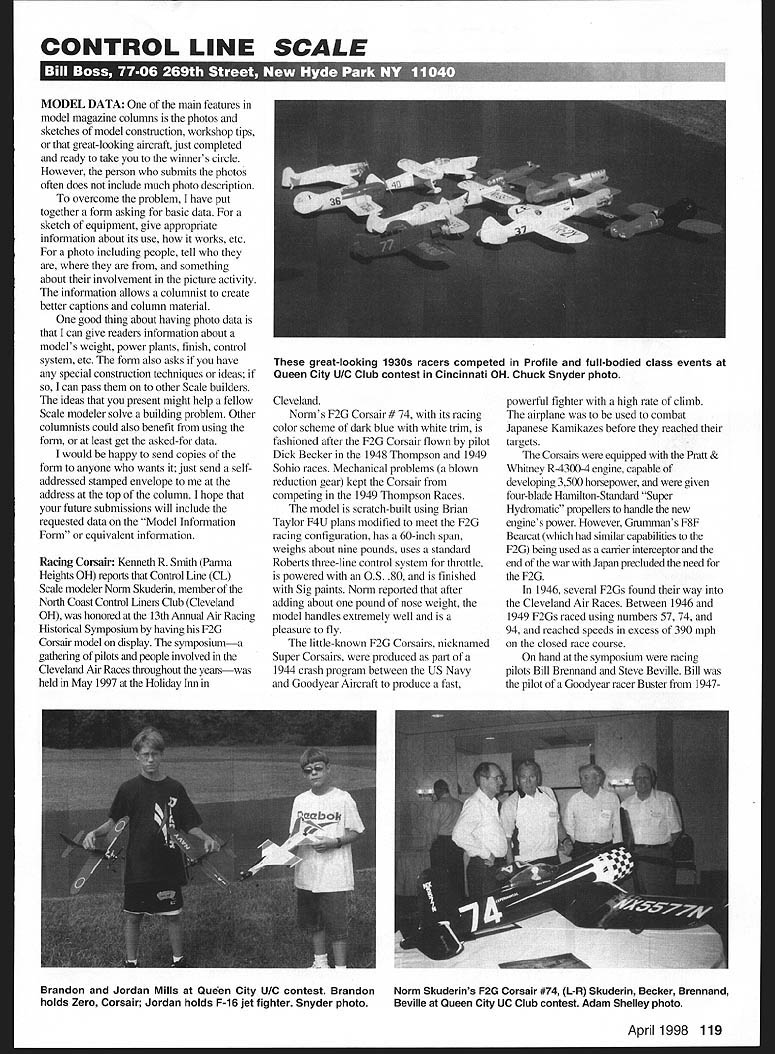
Chuck Snyder of the Queen City U-Control Club, Cincinnati, Ohio, reports that the club's Golden Age Racing and Profile Scale contest was held Labor Day weekend 1997. Golden Age Racing took place on Saturday with competition among six of the club's members and Clayton Smith, of North Carolina, flying 1930s racers.
The models had 36-inch wingspans and were entered in two classes—profile and full-bodied—and engine type and propeller size were restricted. Profile and full-bodied "Stock" class models had to be equipped with O.S. Max .40FPs, and "Unlimited" models were permitted to be equipped with any .40-size engine that cost less than $150, but were required to swing 11-inch props. It must have been a pleasant sight for spectators to see three of these scale-configured 1930s racers in the air at the same time.
Sunday was the Scale competition; the club had a special Junior category, with two entrants. While the overall number of juniors was disappointing to the club, two entries for the Scale event is two more than many contests have, and a great start on which to build.
Brothers Brandon and Jordan Mills, 13 and 11 years old respectively, flew airplanes built from Sterling/Estes kits. Brandon flew a Zero powered by a NorVel .061. The model had wing guns, radio mast, belly tank, and was documented using an Aircraft in Profile kit. Jordan flew an F-16 equipped with a Cox .049 engine.
Between static and flying scores, the models tied for first-place honors. Dave Willis, who presented the boys with club awards, noted that they are hooked on the hobby, and that he will be expecting better things from them in the future.
Workshop Hint:
While the following tip was given in relation to covering and strengthening the center section of a wing, the principle involved can be used on larger areas.
The question is: How do you get creases or lumps out of fiberglass cloth during its application?
Prior to applying the cloth to the desired area of the model, iron the cloth with a clothes iron to remove any wrinkles, making it smooth and flat.
Place the glass cloth over the surface to be covered and tack it down with a "drop" of CA (cyanoacrylate) adhesive in each corner, top and bottom of the area being covered. You might have to pull the cloth slightly in one direction or another as you tack it down. The result should be a piece of cloth resting smoothly over the area to be covered.
Now apply the resin over the cloth. If you encounter pulls or puckers during the application of the resin, they can be fixed easily. Remember that you only "tacked" the cloth in place, so it can be easily lifted, pulled taut as required, and re-tacked. This procedure should help give you smoother fiberglass cloth coverings and less sanding and finishing problems.
This item was found in the newsletter of the Indy Sportsmen CL Club, and had its origin in The Flightline, Tom Monger, Editor.
Support The World Championship Teams:
In the February column I told you about 1997 FAI (Fédération Aéronautique Internationale) competition in which Steve Ashby, Jack Sheeks, and Ralph Burnstine were selected as the 1998 U.S. Control Line Scale Team. A recent NASA (National Association of Scale Aeromodellers) newsletter announced that the team will be competing at the Swartkop Air Force Base, Pretoria, South Africa, April 26–May 2, 1998.
This is a long way for the team to travel, and expenses will probably be great. You can help support the team's efforts through the purchase of NASA Scale Team items:
- NASA Scale Team pins — $5 each plus $0.50 shipping and handling
- Scale Team logo T-shirts — $12 each (sizes S, M, L, XL, XXL)
- NASA raffle tickets — six for $5 (raffle prizes include a radio by JR, a Dick Hansen video, a Dave Brown Flight Simulator, and many others)
To support the Scale team's efforts, contact Darlene Frederick, F4B/F4C Team Manager, 5634 Crystal Court, Santa Rosa, CA 95404. Your help is greatly appreciated.
Please send ideas, notice of upcoming CL Scale events, contest reports, and especially photos of CL Scale activity to me at the address at the very top of this column.
Transcribed from original scans by AI. Minor OCR errors may remain.

