
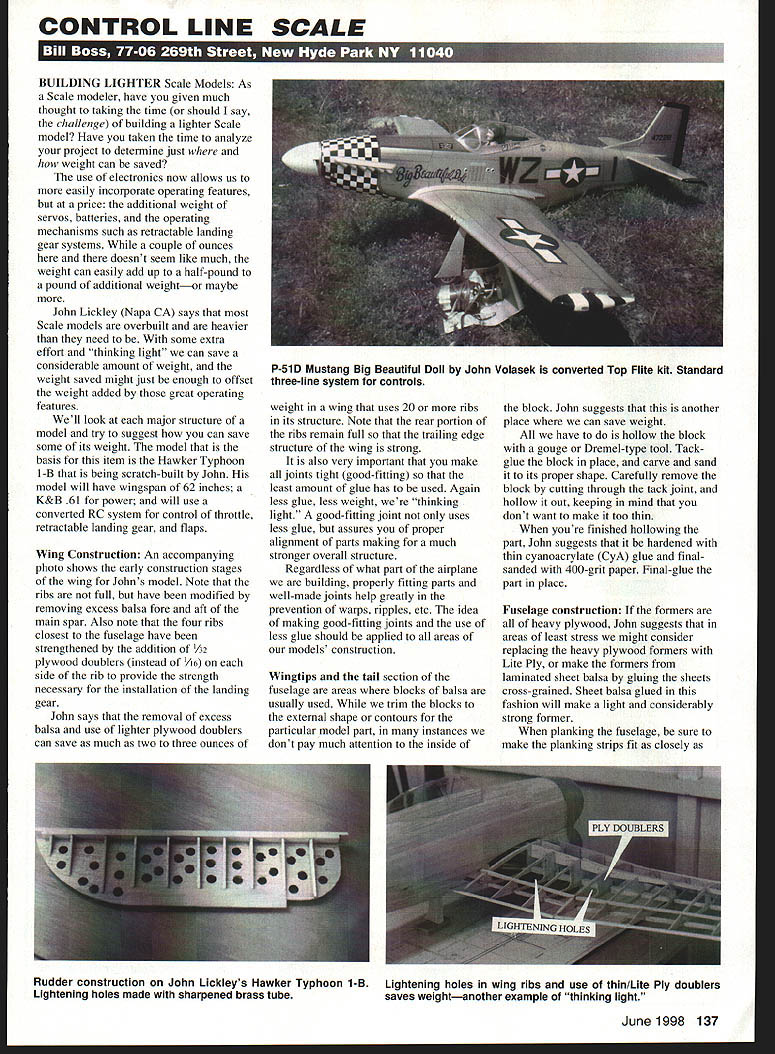
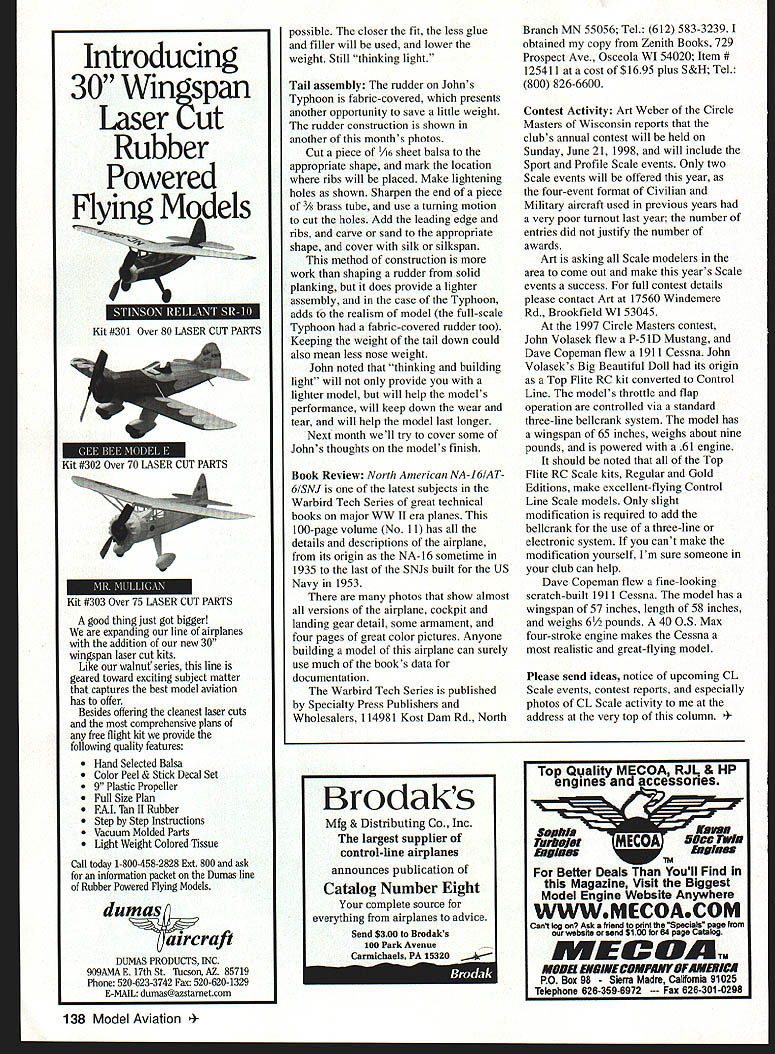
BUILDING LIGHTER Scale Models
As a scale modeler, have you given much thought to the challenge of building a lighter scale model? Have you analyzed your project to determine where and how weight can be saved?
The use of electronics now allows us to more easily incorporate operating features, but at a price: the additional weight of servos, batteries, and operating mechanisms such as retractable landing gear systems. While a couple of ounces here and there doesn't seem like much, the weight can easily add up to a half-pound to a pound—or more.
John Lickley (Napa, CA) says that most scale models are overbuilt and heavier than they need to be. With some extra effort and "thinking light" we can save a considerable amount of weight, and the weight saved might just be enough to offset the weight added by those operating features.
The model used as the basis for this article is the Hawker Typhoon 1-B that John is scratch-building. His model will have a 62-inch wingspan, a K&B .61 for power, and will use a converted RC system for control of throttle, retractable landing gear, and flaps.
Wing Construction
An accompanying photo shows the early construction stages of John's wing. Note that the ribs are not full but have been modified by removing excess balsa fore and aft of the main spar. Also note that the four ribs closest to the fuselage have been strengthened by the addition of 1/32" plywood doublers (instead of 1/16") on each side of the rib to provide the strength necessary for the installation of the landing gear.
John says that removing excess balsa and using lighter plywood doublers can save as much as two to three ounces of weight in a wing that uses 20 or more ribs. The rear portion of the ribs remains full so that the trailing-edge structure of the wing is strong.
It is very important to make all joints tight and well-fitting so that the least amount of glue must be used. Less glue means less weight. A good-fitting joint not only uses less glue but also assures proper alignment of parts, producing a much stronger overall structure. Properly fitting parts and well-made joints help greatly in the prevention of warps and ripples; apply this principle to all areas of the model.
Wingtips and Tail Blocks
Wingtips and tail blocks are often carved from solid balsa, but the inside of the block is frequently ignored. Hollowing these blocks is another place to save weight.
Steps:
- Tack-glue the block in place and carve or sand it to the external shape.
- Carefully remove the block by cutting through the tack joint.
- Hollow the block with a gouge or Dremel-type tool, keeping the walls reasonably thick so the part remains strong.
- Harden the hollowed part with thin cyanoacrylate (CyA) glue and final-sand with 400-grit paper.
- Final-glue the part in place.
Be careful not to make the walls too thin; the goal is to reduce weight while maintaining required strength.
Fuselage Construction
If formers are heavy plywood, consider replacing those in low-stress areas with Lite Ply, or make formers from laminated sheet balsa by gluing sheets cross-grained. Sheet balsa glued in this fashion will make a light and reasonably strong former.
When planking the fuselage, make the planking strips fit as closely as possible—closer fit means less glue and less filler, which lowers weight. Good fitting is part of "thinking light."
Tail Assembly
The Typhoon's rudder is fabric-covered, which presents another opportunity to save weight. John builds it as shown in a photo.
Method:
- Cut a piece of 1/16" sheet balsa to the rudder outline and mark rib locations.
- Make lightening holes in the sheet where appropriate.
- Sharpen the end of a piece of 3/32" brass tube and use a turning motion to cut the holes cleanly.
- Add the leading edge and ribs, carve or sand to shape, and cover with silk or Silkspan.
This method is more work than shaping a rudder from solid planking but yields a lighter assembly and, in the Typhoon's case, greater realism (the full-scale Typhoon had a fabric-covered rudder). Keeping tail weight down can also reduce the required nose weight.
John notes that "thinking and building light" will not only provide a lighter model but will help performance, reduce wear and tear, and help the model last longer.
Next month we'll cover some of John's thoughts on the model's finish.
Transcribed from original scans by AI. Minor OCR errors may remain.

