
CONTROL LINE SCALE
Bill Boss, 77-06 269th Street, New Hyde Park, NY 11040
Scale scratch-building from paper may seem like a far-out way to construct a Control Line (CL) Scale model for competition, but that is what Ken Long of Whittier, California does.
If you have been following this column, you might have seen photos of Ken's "cardboard" Ju 87D Stuka dive-bomber that is built almost entirely of various types of paper. Balsa was used only in places such as the tips of the wing, rudder, or elevators that would have been extremely difficult to shape out of cardboard. Ken's Stuka has served him well; it has been flown more than 50 times and has been in the winner's circle of local, regional, and national competitions.
Ken notes that the basic construction is pretty much the same as building from balsa, except that he substituted the fuselage formers, wing ribs, and other major sections of a model with corrugated paper box material, then covered the structure with paper of various thicknesses.
Some advantages of paper construction are:
- It is relatively inexpensive.
- You can put surface detail on your model as you build it, such as panel lines, rivets, and access panels.
- It makes a durable model that is stronger in many ways than many other forms of construction.
Ken relates that once while he was flying the Stuka, the engine quit while at slow speed at about 15 feet of altitude. The model hit the concrete, bending the steel landing gear back and poking holes in the underside of the wing. If the model had been made of balsa, Ken would have expected serious structural damage requiring extensive repair. All that he needed in this case was to repair the landing gear and add a couple of paper panels to cover the holes.
A model constructed of good paper materials will flex and bend without cracking or shattering. It is possible to build a good-looking, strong, competitive Scale model using paper.
Paper comes in various weights and types. Light and heavy corrugated type cardboard is used for construction of the fuselage formers and ribs and comes in various strengths. Covering the wings, fuselage and tail assembly, and adding scale detail can be accomplished with several weights of card stock.
The corrugated paper box weight and strength can be determined by looking at the "box maker's certificate" stamp (it's usually round) that can be found on the bottom of most corrugated boxes. For purposes of model construction, consider light material as 150- to 200-pound test, and heavy material as 250- to 300-pound test. Heavy-weight paper box material is generally used for packaging items such as refrigerators and large televisions. Light-weight corrugated material can generally be obtained from the large master cartons used for light products such as potato chips and paper towels.
The card stock used for covering, panel lines, access panels and hatches, air intakes, etc., can be obtained for about $8 per ream (usually 250 to 500 sheets) from most paper supply stores. The card stock paper that Ken uses most is 69-pound stock and is about .016-inch thick.
Putting together a paper box model requires the following items:
- A good pair of scissors
- A supply of white paper glue such as Elmer's
- 5-minute and 30-minute epoxy
- A metal straightedge
- A Stanley or box knife
- An X-Acto knife and #11 blades
- Other tools you might normally use in model construction
Choosing your model subject carefully is important. Ken chose the Stuka for his first paper sport Scale project because of its straight lines. It has a 60-inch wingspan — a good CL model size. Its flying characteristics and weight (slightly over six pounds finished) are suitable, and it is usually powered by a .15–.30 engine.
Select a subject that has a high percentage of straight-line curves and a low percentage of compound curves. An example of a poor subject is the P-47 with its barrel-shaped fuselage. On the other hand, the Hellcat would make an excellent subject. Aluminum-skinned aircraft, civilian or military, lend themselves to paper model construction.
This Month's Photos:
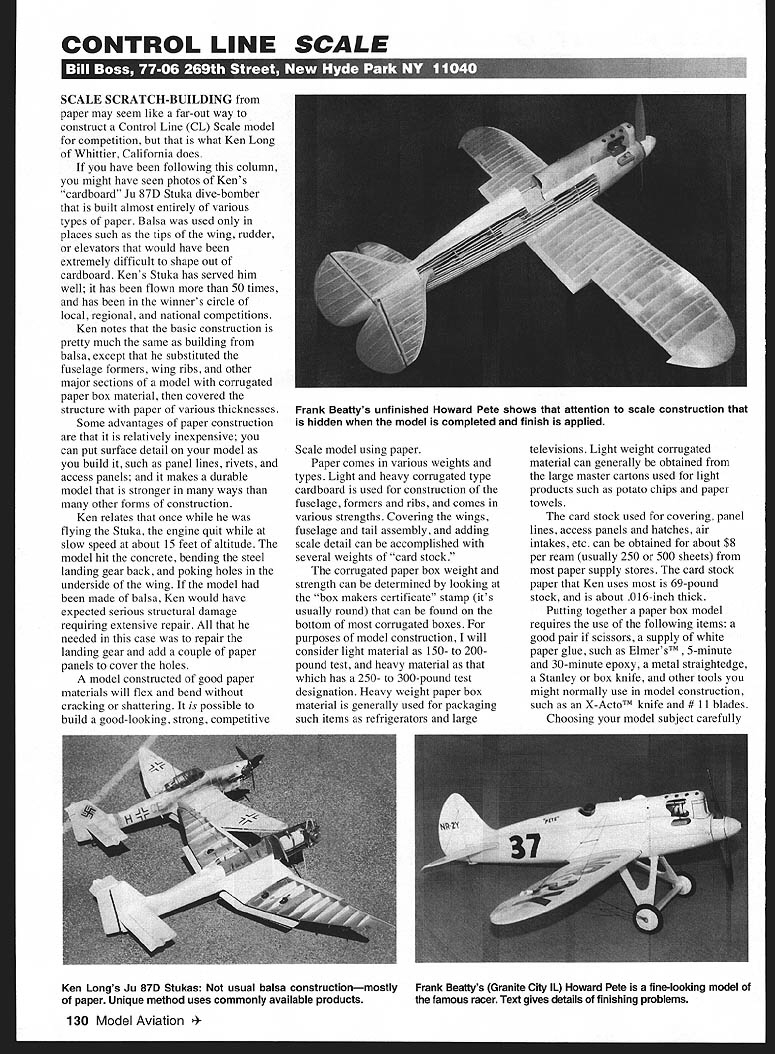
The "made of paper" Stukas are the work of Ken Long. He has been flying the sport Scale model in the rear for a couple of years, and the partially constructed model pictured will be a Precision Scale model. The new model will have a 60-inch span and be .60-powered.
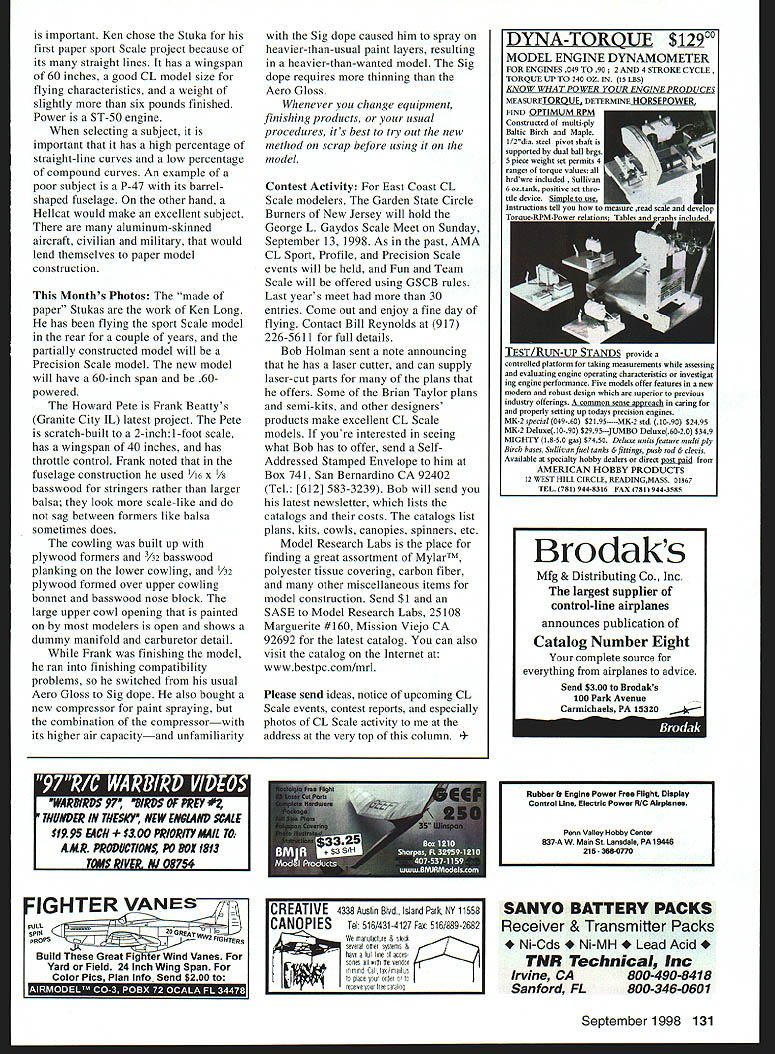
The Howard Pete is Frank Beatty's (Granite City, IL) latest project. The Pete is scratch-built to a 2-inch-to-1-foot scale, has a wingspan of 40 inches, and has throttle control. Frank noted that in the fuselage construction he used 1/16 x 1/8 basswood for stringers rather than larger balsa; they look more scale-like and do not sag between formers like balsa sometimes does.
The cowling was built up with plywood formers and 3/32 basswood planking on the lower cowling, and 1/32 plywood formed over the upper cowling, bonnet and basswood nose block. The large upper cowl opening that is painted on by most modelers is on this model and shows a dummy manifold and carburetor detail.
While Frank was finishing the model, he ran into finishing compatibility problems, so he switched from his usual Aero Gloss to Sig dope. He also bought a new compressor for paint spraying, but the combination of the compressor — with its higher air capacity — and unfamiliarity with the Sig dope caused him to spray on heavier-than-usual paint layers, resulting in a heavier-than-wanted model. The Sig dope requires more thinning than the Aero Gloss.
Whenever you change equipment, finishing products, or your usual procedures, it's best to try out the new method on scrap before using it on the model.
Contest Activity:
For East Coast CL Scale modelers, The Garden State Circle Burners of New Jersey will hold the George L. Gaydos Scale Meet on Sunday, September 13, 1998. As in the past, AMA CL Sport, Profile, and Precision Scale events will be held, and Fun and Team Scale will be offered along with GSCB rules. Last year's meet had more than 30 entries. Come out and enjoy a fine day of flying. Contact Bill Reynolds at (917) 226-5611 for full details.
Bob Holman sent a note announcing that he has a laser cutter and can supply laser-cut parts for many of the plans that he offers. Some of the Brian Taylor plans and semi-kits, and other designers' products make excellent CL Scale models. If you're interested in seeing what Bob has to offer, send a Self-Addressed Stamped Envelope to him at Box 741, San Bernardino, CA 92402 (Tel.: [612] 583-3239). Bob will send you his latest newsletter, which lists the catalogs and their costs. The catalogs list plans, kits, cowls, canopies, spinners, etc.
Model Research Labs is the place for finding a great assortment of Mylar, polyester tissue covering, carbon fiber, and many other miscellaneous items for model construction. Send $1 and an SASE to Model Research Labs, 25108 Marguerite #160, Mission Viejo, CA 92692 for the latest catalog. You can also visit the catalog on the Internet at www.bestpc.com/mrl.
Please send ideas, notice of upcoming CL Scale events, contest reports, and especially photos of CL Scale activity to me at the address at the very top of this column.
Transcribed from original scans by AI. Minor OCR errors may remain.

