
Control Line: Scale
Mike Gretz
GREETINGS! In case you didn't notice, this is a different Mike writing this month. And I feel somewhat like the person who gets on TV for the first time and can't resist waving to mom. What I mean is, even though I know it may bore some of you, I want to use this first opportunity to write about a couple things that you won't be able to look at, cut, sand, or glue.
Every year, statistics from the Nats show that CL Scale (and Scale in general) was one of the most popular events among contestants and spectators alike. And the number of sanctioned CL contests each year that include Scale also indicates a lot of interest and activity. Now the task that I've accepted is to convince all of you busy CL Scale builders to quit sanding and eyeballing enough to help fill this monthly column space with newsworthy and constructive items. Of course, I know what I would like to see every month when Model Aviation arrives in the mailbox—lots of pictures of completed scale models (for inspiration) and several construction hints (for help). But if I have to rely on my own experiences and ideas for material, this column will soon lose its value. If you have any interests—past, present, or future—in CL Scale, please note that you too have a stake in this column. Model Aviation has set aside this space to promote our enjoyment of scale. In the broadest sense, we should use this space to entertain, inspire, and provoke.
Have you ever gotten enthused about the possibilities of building a scale model of a certain full-size airplane only to be intimidated by some scale feature you aren't sure how to handle? If you're looking at your first scale project, the question may be something as basic as hooking up and adjusting a three-line bellcrank and throttle-equipped engine. Or how to duplicate scale lettering and markings. If you are a more experienced scaler, it may be a problem of how to operate two, three, or more mechanical options off of a three-line system. (It's a little more complicated than just getting a more expensive radio outfit.) Questions like these need to be answered in print. Can you contribute?
If you have any photos of CL scale models you have built—old or new, they are always fun to look at—send them to me. Any building methods that you used could be helpful to someone else—don't take them for granted as being too basic—send them in. Pros and cons on current AMA rules and your ideas for possible changes can be aired here. Send them in! Contest announcements, contest results—send them in too. For added encouragement, Model Aviation will even pay you for any picture, ideas, or hints that appear in print. Please, let's hear from you!
More Noise About Mufflers
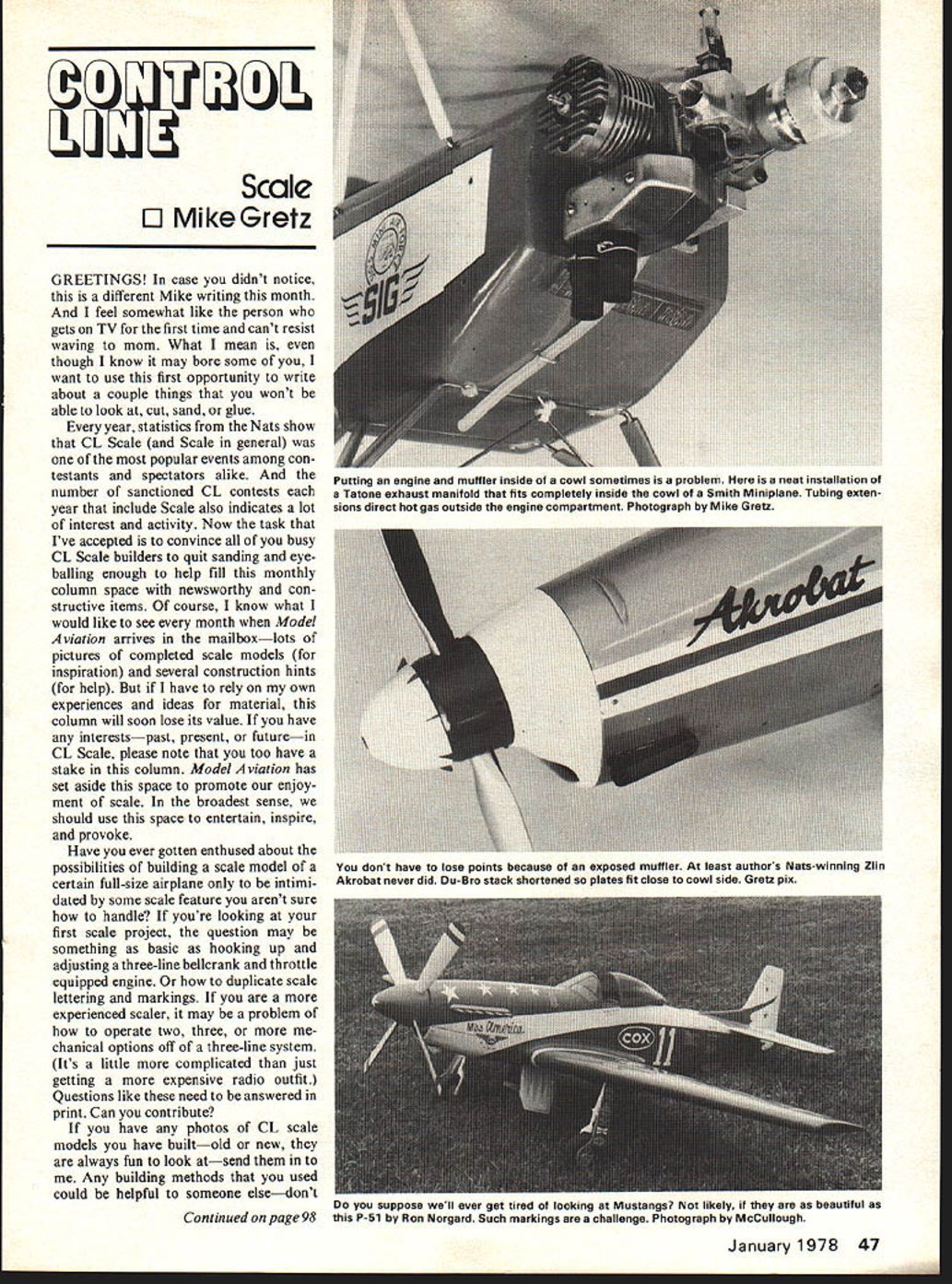
Several rules change proposals for CL AMA Scale were recently passed by the Scale Contest Board for use at 1978 sanctioned contests. All of the CL Scale proposals that passed were initially published in Dec. '76 MA. The most controversial change requires the use of a muffler or noise limiting device on all AMA Scale models. CL Sport Scale rules already require a muffler, as do RC Sport Scale, and CL and RC FAI Scale rules. I think that the Scale Board made a responsible, fair-sighted decision. It seems appropriate that competition modelers (especially scale builders, who are experts at being realistic) should lead the way in this area, and thus development of silencers.
No matter which part of the country you live in or what type of model you build, using a muffler for the first time usually tends to rub you the wrong way. (Old Saying #1: It's hard to teach an old dog new tricks.)
Transcribed from original scans by AI. Minor OCR errors may remain.

