
CONTROL LINE SCALE
Bill Boss 77-06 269th Street, New Hyde Park NY 11040
New Electronic CL Handle
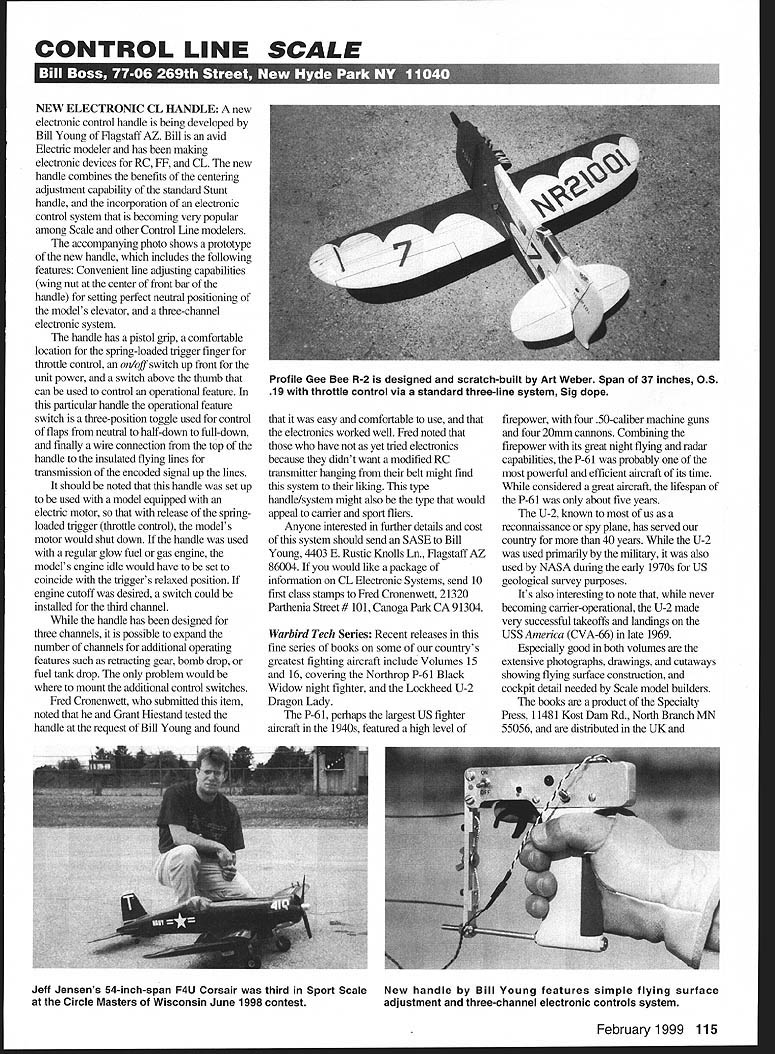
A new electronic control handle is being developed by Bill Young of Flagstaff, AZ. Bill is an avid electric modeler and has been making electronic devices for RC, FF, and CL. The new handle combines the centering adjustment capability of the standard stunt handle with an electronic control system that is becoming popular among Scale and other control-line modelers.
The prototype includes these features:
- Convenient line-adjusting capability (wing nut at the center of the front bar of the handle) for setting perfect neutral positioning of the model’s elevator.
- A three-channel electronic system.
- Pistol grip with a comfortable, spring-loaded trigger for throttle control.
- An on/off switch at the front for unit power.
- A switch above the thumb for an operational feature (the prototype uses a three-position toggle for flaps: neutral, half-down, full-down).
- A wire connection from the top of the handle to the insulated flying lines for transmission of the encoded signal up the lines.
Notes on operation:
- The prototype was set up for use with an electric motor so that releasing the spring-loaded trigger shuts the motor down.
- For glow-fuel or gas engines, engine idle must be set to match the trigger’s relaxed position. If engine cutoff is desired, a switch could be installed on the third channel.
- Although designed for three channels, the system can be expanded for additional functions (retractable gear, bomb drop, fuel tank drop). The main limitation is where to mount extra control switches.
Test impressions:
- Fred Cronenwett (who submitted this item) and Grant Hiestand tested the handle at Bill Young’s request and found it easy and comfortable to use, with the electronics performing well.
- This type of handle may appeal to modelers who avoided electronics because they didn’t want a modified RC transmitter hanging from their belt, and may also interest carrier and sport fliers.
For more details and cost:
- Send an SASE to Bill Young, 4403 E. Rustic Knolls Ln., Flagstaff AZ 86004.
- For a package of information on CL electronic systems, send 10 first-class stamps to Fred Cronenwett, 21320 Parthenia Street #101, Canoga Park CA 91304.
Warbird Tech Series
Recent releases in this series include Volumes 15 and 16, covering the Northrop P-61 Black Widow night fighter and the Lockheed U-2 Dragon Lady.
- P-61 Black Widow: Perhaps the largest U.S. fighter aircraft in the 1940s, it featured heavy armament (four .50-caliber machine guns and four 20mm cannons) and excellent night-flying and radar capabilities. Despite its strengths, the P-61 had a relatively short operational lifespan of about five years.
- U-2 Dragon Lady: Best known as a reconnaissance/spy plane, the U-2 has served for more than 40 years. It was used by the military and by NASA during the early 1970s for geological surveys. Though never carrier-operational, the U-2 made successful takeoffs and landings on the USS America (CVA-66) in late 1969.
Both volumes are especially useful for scale model builders because of extensive photographs, drawings, and cutaways showing flying-surface construction and cockpit detail.
Publisher and distribution:
- Specialty Press, 11481 Kost Dam Rd., North Branch MN 55056.
- Distributed in the UK and Europe by Airlife Publishing, Ltd.
- Copies obtained from Zenith Books, Box 1, Osceola, WI 54020-0001.
Brodak Models
Following a July 1998 request by John Brodak of Brodak Mfg. & Dist. Co., Inc. for reader suggestions on model kits, about 20 responses were received naming 50 different aircraft (none repeated). John, with help from Frank Beatty in producing kit plans, has decided to produce a Sport Scale kit of the Ryan PT-21, the U.S. Army primary trainer used in 1941.
Kit details:
- Wingspan: 45-1/2 inches.
- Scale: 1-1/2 inches to the foot.
- Designed for .35–.40 engines and three-line control systems.
- Size chosen for easy transport in an average automobile and home storage without a removable wing.
John is open to suggestions for future projects and would like to see a single, popular aircraft suggested by multiple readers. Send suggestions to the address at the head of this column or directly to: John Brodak 100 Park Ave., Carmichaels, PA 15320
Glow Plug Problems
Glow plug life is unpredictable, but several common causes of premature failure and their solutions are:
- Overheating:
- Problem: The plug’s coil will melt if it gets too hot. Running the engine at high RPM with too-lean a mixture while the plug heater is still attached can melt the heating element. Power panels may surge when first turned on, applying higher-than-needed voltage.
- Solution: Don’t run the engine too lean at high RPM with the heater voltage attached. Dial in a lower voltage on the power panel before attaching it to the plug.
- Vibration and flooding:
- Problem: If the engine is not rigidly mounted, vibration can fatigue and break the plug coil. Cranking a flooded engine can force fuel into the plug’s coil chamber and short the coil.
- Solution: Ensure the engine is firmly mounted and minimize vibration. Avoid cranking a flooded engine.
- Heat retention:
- Problem: Heat-retention properties of a plug affect performance. If the plug cools too much when throttled back, the engine may quit.
- Solution: Select the correct plug heat range for your engine.
Additional notes:
- Glow plugs have 1/2-32 threads. “Short” plugs have about 7/32" thread length and are normally used for .15-size or smaller engines. “Long” plugs have about 1/2" thread length.
- Different manufacturers produce plugs in various heat ranges. Consult experts at your local hobby shop, the engine instructions, or the engine manufacturer for the correct plug choice.
(This item was found in the Indy Sportsliner CL MAC Newsletter, taken from NOTAM. Lewis Jordan, editor.)
Please send ideas, notices of upcoming CL Scale events, contest reports, and especially photos of CL Scale activity to the address at the top of this column.
Transcribed from original scans by AI. Minor OCR errors may remain.

