
CONTROL LINE SCALE
The Control Line World Championships, held at Swartkop Air Force Base in South Africa in April/May 1998, ended with quite a surprise: a single-engine low-wing model finished in first place. The domination of the event by multiengine models has been broken.
Steve Ashby, one of last year's US World Championship team members, provided a look and some insight into how this all came about.
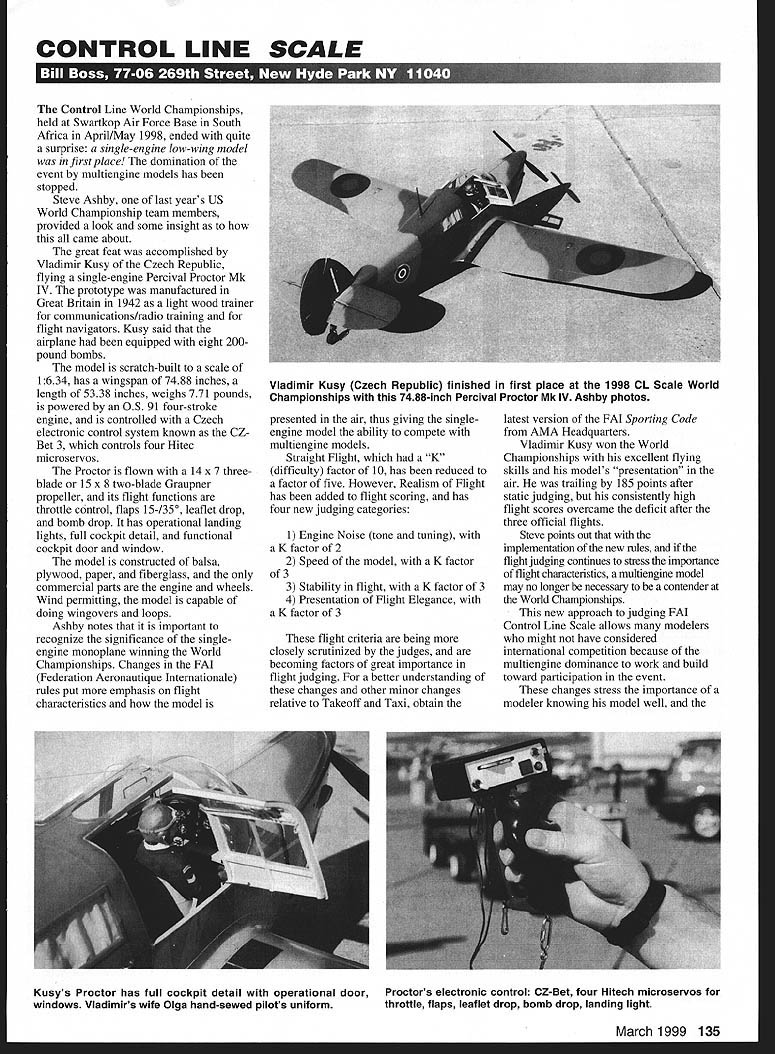
The great feat was accomplished by Vladimir Kusy of the Czech Republic, flying a single-engine Percival Proctor Mk IV. The prototype was manufactured in Great Britain in 1942 as a light-wood trainer for communications/radio training and for flight navigators. Kusy said that the airplane had been equipped with eight 200-pound bombs.
The model is scratch-built to a scale of 1:6.34, has a wingspan of 74.88 inches, a length of 53.38 inches, weighs 7.71 pounds, is powered by an O.S. 91 four-stroke engine, and is controlled with a Czech electronic control system known as the CZ-Bet 3, with controls for Hitec microservos.
The Proctor is flown with a 14 x 7 three-blade or 15 x 8 two-blade Graupner propeller, and its flight functions are throttle control, flaps (15°/35°), leaflet drop, and bomb drop. It has operational landing lights, full cockpit detail, and a functional cockpit door and window.
The model is constructed of balsa, plywood, paper, and fiberglass, and the only commercial parts are the engine and wheels. Wind permitting, the model is capable of doing wingovers and loops.
Ashby notes that it is important to recognize the significance of a single-engine monoplane winning the World Championships. Changes in the FAI (Federation Aeronautique Internationale) rules place more emphasis on flight characteristics and how the model is presented in the air, thus giving the single-engine model the ability to compete with multiengine models.
Straight Flight, which had a "K" (difficulty) factor of 10, has been reduced to a factor of five. However, Realism of Flight has been added to flight scoring, and has four new judging categories:
- Engine Noise (tone and tuning), with a K factor of 2
- Speed of the model, with a K factor of 3
- Stability in flight, with a K factor of 3
- Presentation of Flight Elegance, with a K factor of 3
These flight criteria are being more closely scrutinized by the judges, and are becoming factors of great importance in flight judging. For a better understanding of these changes and other minor changes relative to Takeoff and Taxi, obtain the latest version of the FAI Sporting Code from AMA Headquarters.
Vladimir Kusy won the World Championships with his excellent flying skills and his model's presentation in the air. He was trailing by 185 points after static judging, and his consistently high flight scores overcame the deficit after the three official flights.
Steve points out that with the implementation of the new rules, and if flight judging continues to stress the importance of flight characteristics, a multiengine model may no longer be necessary to be a contender at the World Championships.
This new approach to judging FAI Control Line Scale allows many modelers who might not have considered international competition because of multiengine dominance to work and build toward participation in the event.
These changes stress the importance of a modeler knowing his model well and the need for good flight practice — practice, practice.
Spring Checkup
It's that time of year when most of the country is coming out of the winter doldrums, and modelers are itching to get out to the flying field and put that dormant model back into the air.
While I realize that most of you have been told about safety many times, it is especially important when taking a model out to the flying field after a long winter's rest. I found the following tips in the Rocky Mountain CL News, newsletter of the Rocky Mountain Aeromodelers.
While the following pertains to all forms of model flying, they're especially important to the Scale modeler because of the many hours it takes to develop a good Scale aircraft. You don't want to lose it or get hurt because of an unsafe practice.
- Do not attempt to fly your model before completely checking all installed components.
- Keep hands a safe distance from the propeller when making adjustments to the carburetor, and when disconnecting the glow plug wire.
- In case of difficulty, the safest and easiest way to stop an engine is to pinch off the fuel line or remove it from the carburetor. Never throw anything into the propeller (rags, etc.) to stop the engine; it's possible that the propeller might throw off splinters, which are dangerous to the eyes and other parts of the body.
- When starting an engine, never lean over the propeller; don't start or adjust an engine on dirt or sand that can be sucked up by the spinning propeller; and keep all loose objects (eyeglasses, pencils, etc.) out of shirt pockets. Any object falling into a spinning propeller can be extremely dangerous. It's also a good idea to wear eye protection when starting or adjusting an engine.
- Never clamp your engine in a vise for test-runs. Mount it securely in a model or commercial test stand.
- Never run the engine indoors or in an enclosed area. Engines produce dangerous exhaust gases and must be run outdoors only.
- Store model fuel in tightly sealed metal or plastic containers—never glass. Model fuel is poisonous and flammable. Always keep fuel away from heat, flames, and out of the reach of children.
- Use a muffler as required, and fly only in designated flying areas.
- Never operate any model near overhead electric and telephone wires. If a model gets caught in overhead lines, do not attempt to retrieve it; call the appropriate utility for proper assistance.
Remember that your engine is not a toy. It's a precision piece of machinery and must be treated as such. Also keep in mind that safe operation of your model and engine is your responsibility. Safe operation not only keeps you from injury, but will allow you to fully enjoy this great hobby of model flying.
Workshop Hint
Have you had problems with lightweight fillers adhering to fillets and around corners? According to George Lieb, on a brand of filler George checked there was a note at the bottom of the directions: "When applying butyrate dope over Micro-Fill, filler must be thoroughly dry and sealed with any polyester resin or epoxy finishing resin prior to applying dope."
George said that the reason he has not encountered the problem might be because he usually uses epoxy paints. The solution for anyone who uses butyrate paint would be to cover the filler with a thin coat of five-minute epoxy. If you use that method, be sure that the epoxy has cured fully. And remember, temperature plays a part in how long any epoxy takes to cure.
The moral of this Workshop Hint is to read all instructions; the solution to a problem may be found before the problem occurs. This item was found in the Orbiting Eagles (Omaha, NE) newsletter.
Please send ideas, notice of upcoming CL Scale events, contest reports, and especially photos of CL Scale activity to me at the address at the very top of this column.
Transcribed from original scans by AI. Minor OCR errors may remain.

