
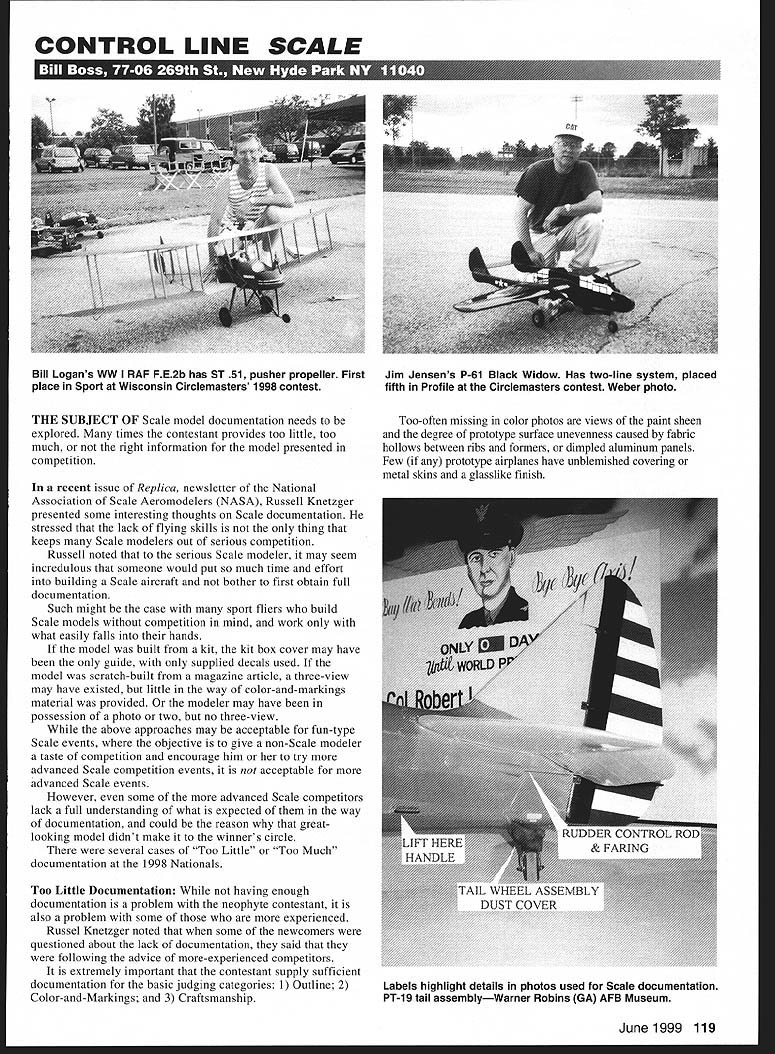
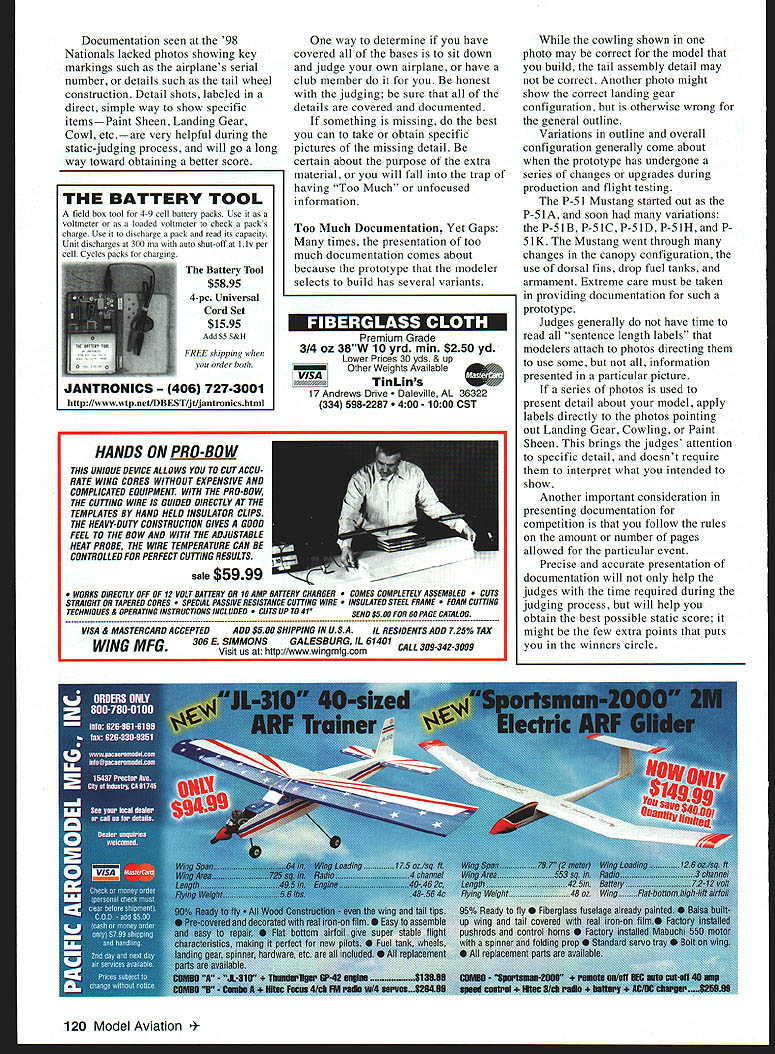
CONTROL LINE: SCALE
Bill Boss — 77-06 269th St., New Hyde Park, NY 11040
The subject of scale model documentation needs to be explored. Many times a contestant provides too little, too much, or not the right information for the model presented in competition.
In a recent issue of Replica, the newsletter of the National Association of Scale Aeromodelers (NASA), Russell Knetzger presented some useful thoughts on scale documentation. He stressed that lack of flying skills is not the only thing that keeps many scale modelers out of serious competition. To the serious scale modeler, it may seem incredulous that someone would put so much time and effort into building a scale aircraft and not first obtain full documentation.
Such situations often arise with sport fliers who build scale models without competition in mind and work only with what easily falls into their hands. If the model was built from a kit, the kit box cover may have been the only guide and only supplied decals used. If scratch-built from a magazine article, a three-view may have existed but little in the way of color-and-markings material was provided. Or the modeler may have had a photo or two but no three-view.
Those approaches may be acceptable for fun-type scale events, where the objective is to give a non-scale modeler a taste of competition and encourage them to try more advanced events. However, for advanced scale events proper documentation is essential. Some advanced competitors still lack a full understanding of what is expected in documentation, which can be why a great-looking model doesn't make the winners' circle.
Too Little Documentation
Having too little documentation is a common problem for neophyte contestants and can also affect some experienced competitors. Knetzger noted that some newcomers, when questioned about their lack of documentation, said they had followed the advice of more-experienced competitors.
It is extremely important that the contestant supply sufficient documentation for the basic judging categories:
- Outline
- Color-and-markings
- Craftsmanship
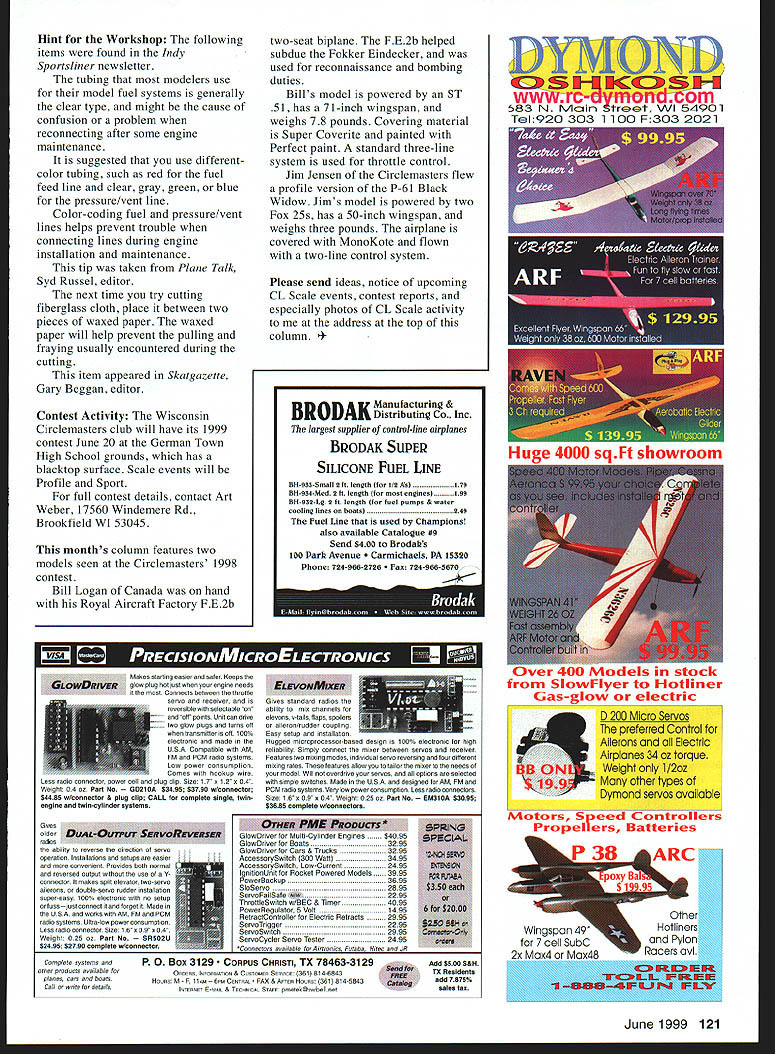
Photos used for documentation should include assemblies and details such as tail assemblies, landing gear, and cowlings. Often missing are views that show paint sheen and the degree of prototype surface unevenness caused by fabric hollows between ribs and formers, or dimpled aluminum panels. Few prototype airplanes have unblemished covering or metal skins with a glasslike finish.
Detail shots, labeled simply and directly, show specific items — Paint Sheen, Landing Gear, Cowl, etc. — and are very helpful during static judging. They will go a long way toward obtaining a better score.
One way to determine you have covered the bases is to sit down with a judge or an honest club member and make sure details are covered and documented. If something is missing, obtain specific pictures of the missing detail. Be certain about the purpose of extra material and avoid the trap of providing unfocused information.
Too Much Documentation
At times, presentation of too much documentation comes about because the prototype selected has several variants. Variations in outline and overall configuration generally occur when a prototype has undergone changes or upgrades during production or testing. The P-51 Mustang, for example, started as the P-51A and later had many variants (P-51B, P-51C, P-51D, P-51H, P-51K) with changes in canopy configuration, use of dorsal fins, drop tanks, and armament. Extreme care must be taken to provide documentation consistent with the specific version represented by the model.
Judges generally do not have time to read sentence-long labels attached to photos that say "use some, but not all, information presented here." If a series of photos is used to present detail about your model, apply labels directly to the photos pointing out Landing Gear, Cowling, Paint Sheen, etc. This brings the judges' attention to the intended detail and doesn't require them to interpret what you meant.
Another important consideration is to follow the rules on the amount or number of pages allowed for the particular event. Precise and accurate presentation of documentation will not only help judges manage their time during judging but will help you obtain the best possible static score — those few extra points that put you in the winners' circle.
Practical Tips for Good Documentation
- Include a clear three-view or outline showing scale and major dimensions.
- Provide color photos that show markings, paint schemes, and paint sheen.
- Add close-ups of areas where the prototype shows surface texture: fabric hollows, dimpled panels, rivet lines, etc.
- Label photos directly and simply to call out the element you want judged (e.g., "Landing Gear — Prototype Detail").
- Avoid conflicting photos from different variants of the same prototype. If you must include variant photos, clearly state which features apply to your model.
- Check documentation limits for the event and organize material to stay within those limits.
- Have a knowledgeable club member or judge review your documentation before the event and obtain any missing photos in advance.
Complete, precise, and focused documentation helps judges and improves your static score. Do the homework up front — it can make the difference between a good model and a winning model.
Transcribed from original scans by AI. Minor OCR errors may remain.

