

CONTROL LINE: SCALE
Bill Boss 77-06 269th Street, New Hyde Park, NY 11040
Biplanes
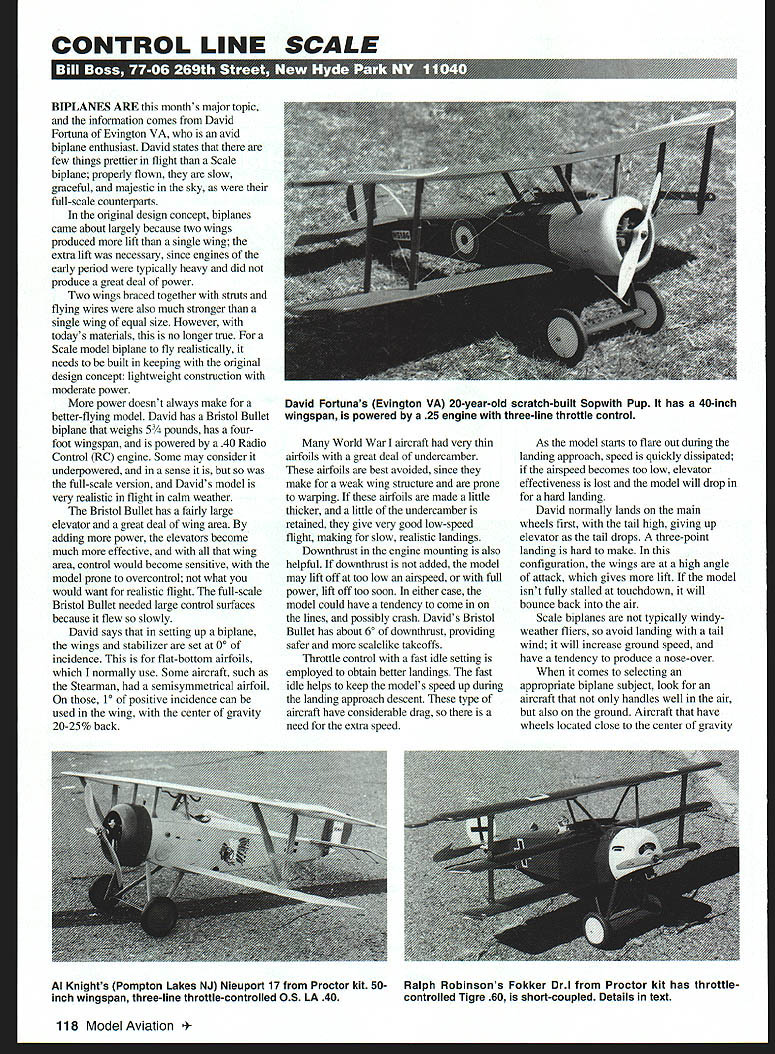
Biplanes are this month's major topic. The information comes from David Fortuna of Evington, VA, an avid biplane enthusiast. David states that there are few things prettier in flight than a scale biplane; properly flown, they are slow, graceful, and majestic in the sky, as were their full-scale counterparts.
In the original design concept, biplanes were developed largely because two wings produced more lift than a single wing; the extra lift was necessary since engines of the early period were typically heavy and did not produce a great deal of power. Two wings braced together with struts and flying wires were also much stronger than a single wing of equal size. With today's materials this is no longer strictly true. For a scale model biplane to fly realistically, it needs to be built in keeping with the original design concept: lightweight construction with moderate power.
More power doesn't always make for a better-flying model. David has a Bristol Bullet biplane that weighs 5 3/4 pounds, has a four-foot wingspan, and is powered by a .40 RC engine. Some may consider it underpowered, and in a sense it is, but so was the full-scale version, and David's model is very realistic in flight in calm weather.
The Bristol Bullet has a fairly large elevator and a great deal of wing area. By adding more power, the elevators become much more effective, and with all that wing area, control would become sensitive, with the model prone to overcontrol — not what you would want for realistic flight. The full-scale Bristol Bullet needed large control surfaces because it flew so slowly.
David says that in setting up a biplane, the wings and stabilizer are set at 0° incidence. This is for flat-bottom airfoils, which the author normally uses. Some aircraft, such as the Stearman, had a semisymmetrical airfoil; on those, 1° of positive incidence can be used in the wing, with the center of gravity 20–25% back.
Many World War I aircraft had very thin airfoils with a great deal of undercamber. These airfoils are best avoided, since they make for weak wing structures and are prone to warping. If these airfoils are made a little thicker and a little of the undercamber is retained, they give very good low-speed flight and slow, realistic landings.
Downthrust in the engine mounting is also helpful. If downthrust is not added, the model may lift off at too low an airspeed, or with full power lift off too soon. In either case, the model could have a tendency to come in on the lines and possibly crash. David's Bristol Bullet has about 6° of downthrust, providing safer and more scale-like takeoffs.
Throttle control with a fast idle setting is employed to obtain better landings. The fast idle helps keep the model's speed up during the landing approach descent. These types of aircraft have considerable drag, so there is a need for the extra speed. As the model starts to flare during the landing approach, speed is quickly dissipated; if the airspeed becomes too low, elevator effectiveness is lost and the model will drop in for a hard landing.
David normally lands on the main wheels first, with the tail high, and then gives up elevator as the tail drops. A three-point landing is hard to make; in that configuration the wings are at a high angle of attack, which gives more lift. If the model isn't fully stalled at touchdown, it will bounce back into the air.
Scale biplanes are not typically windy-weather fliers, so avoid landing with a tailwind; it increases ground speed and can produce a nose-over.
When selecting an appropriate biplane subject, look for an aircraft that handles well both in the air and on the ground. Aircraft with wheels located close to the center of gravity, or with very short noses, may require a great deal of nose weight to obtain proper balance, thereby adding considerable weight to the model. Other things that can contribute to poor ground handling include a high gear stance, a short-coupled fuselage, or a short wing-tail moment.
Some World War I types with long tails and appropriate proportions handle well both in the air and on the ground. Also, 1920s and 1930s aircraft designs, with refinements and heavier engines, often flew with better proportions and handling. Classic biplane types favored for good handling include the WACO Cabin biplane and the Beechcraft Staggerwing; manufacturers reached a zenith of biplane development in speed, comfort, and all-around handling qualities that are a far cry from many World War I biplanes, which often had thin, frail wings and were underpowered.
David hopes the information he provided will help those interested in Control Line (CL) scale biplane building and flying get their models into the air more successfully and enjoy the beauty of biplane flight.
CL Scale on the Internet
Fred Cronenwett, a member of the 101st Squadron Screaming Eagles of California and a frequent contributor to this column, has established the Southern California Control Line Association website, dedicated primarily to CL scale biplane information.
The site can be accessed at: http://www.geocities.com/CapeCanaveral/Cockpit/3188/ControlLine.html
Site features include:
- Information about CL scale competition and documentation, how-to articles, and photographs of models.
- A CL contest calendar for Southern California and Arizona with details about annual contests and maps to flying sites.
- A photo gallery of CL scale models, with information about the model and the builder; clicking a small photo brings up a full-screen view.
- Additional galleries for Stunt, Reno Air Racers, and the Oshkosh EAA Fly-In.
- A forthcoming section dedicated to CL electronics controls, electric power flying, conversion of RC kits to CL use, and competition documentation (under construction as of mid-February 1999).
The first page of the site provides links to a dozen or more organizations and resources, including:
- National Association of Scale Aeromodelers (NASA)
- Academy of Model Aeronautics (AMA)
- Precision Aerobatics Model Pilots Association
- Fédération Aéronautique Internationale (competition)
- Brodak Manufacturing
- RSM Distribution
- Carrier (United Kingdom)
- Several other related sites
Fred has done a credible job assembling the site; the information is useful even in the early stages. Comments can be directed to Fred via email at clscale@gateway.net.
Contest Activity
- The Garden State Circle Burners will be offering Profile and Fun Scale, and Carrier events at their June 27 contest at the club field. For full details, contact Mike Ostella, 340 Mountain Ave., North Caldwell, NJ 07006; Tel.: (973) 364-1105.
Please send ideas, notice of upcoming CL scale events, contest reports, and especially photos of CL scale activity to the address at the top of this column.
Transcribed from original scans by AI. Minor OCR errors may remain.

