
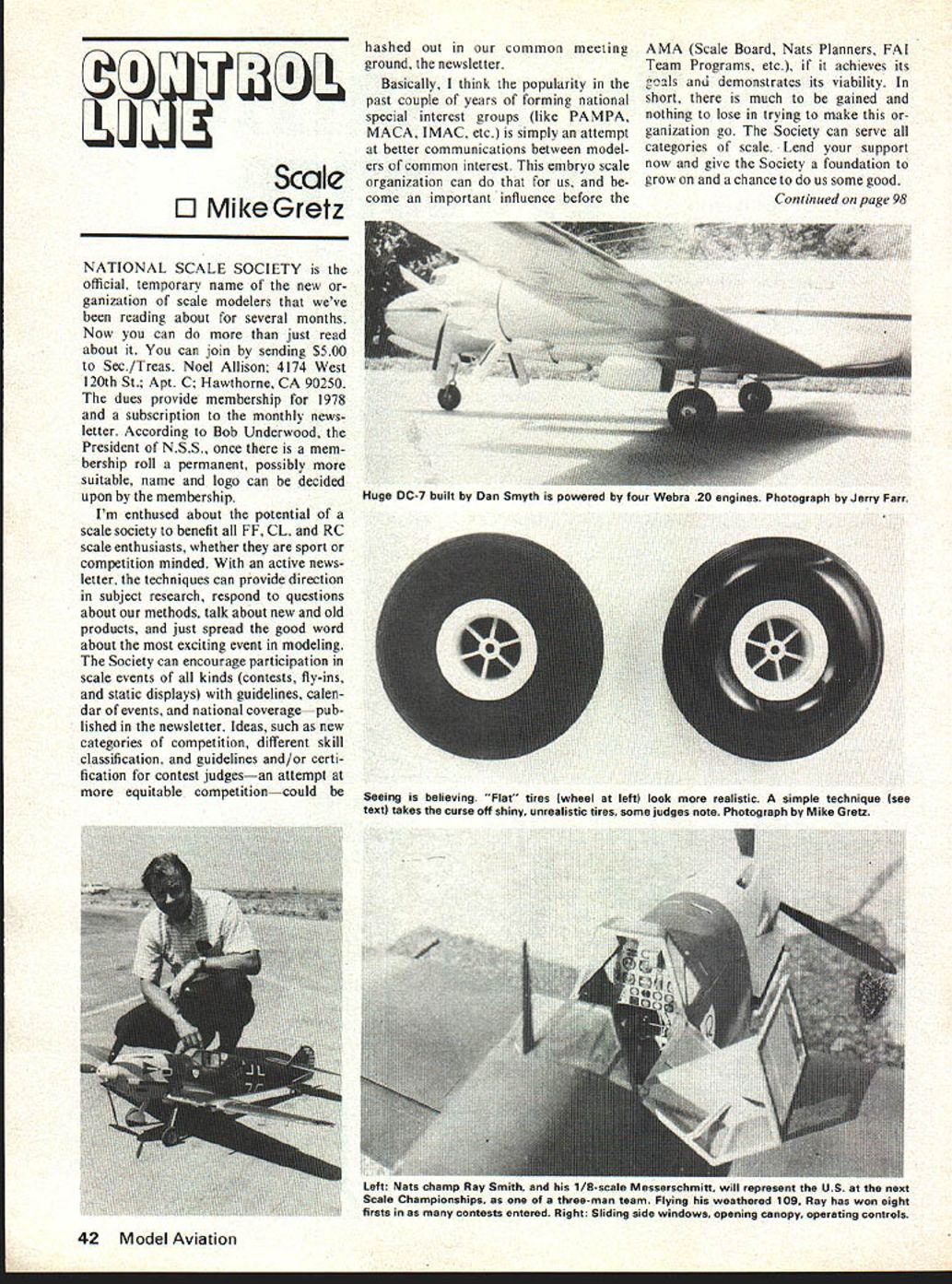
Control Line: Scale
Mike Gretz
NATIONAL SCALE SOCIETY is the official, temporary name of the new organization of scale modelers that we've been reading about for several months. Now you can do more than just read about it. You can join by sending $5.00 to Sec./Treas. Noel Allison: 4174 West 120th St.; Apt. C; Hawthorne, CA 90250. The dues provide membership for 1978 and a subscription to the monthly newsletter. According to Bob Underwood, the President of N.S.S., once there is a membership roll a permanent, possibly more suitable, name and logo can be decided upon by the membership.
I'm enthused about the potential of a scale society to benefit all FF, CL, and RC scale enthusiasts, whether they are sport or competition minded. With an active newsletter, the techniques can provide direction in subject research, respond to questions about our methods, talk about new and old products, and just spread the good word about the most exciting event in modeling. The Society can encourage participation in scale events of all kinds (contests, fly-ins, and static displays) with guidelines, calendar of events, and national coverage published in the newsletter. Ideas, such as new categories of competition, different skill classification, and guidelines and/or certification for contest judges—an attempt at more equitable competition—could be hashed out in our common meeting ground, the newsletter.
Basically, I think the popularity in the past couple of years of forming national special interest groups (like PAMPA, MACA, IMAC, etc.) is simply an attempt at better communications between modelers of common interest. This embryo scale organization can do that for us, and become an important influence before the AMA (Scale Board, Nats Planners, FAI Team Programs, etc.), if it achieves its goals and demonstrates its viability. In short, there is much to be gained and nothing to lose in trying to make this organization go. The Society can serve all categories of scale. Lend your support now and give the Society a foundation to grow on and a chance to do us some good.
CL Scale/Gretz continued from page 42
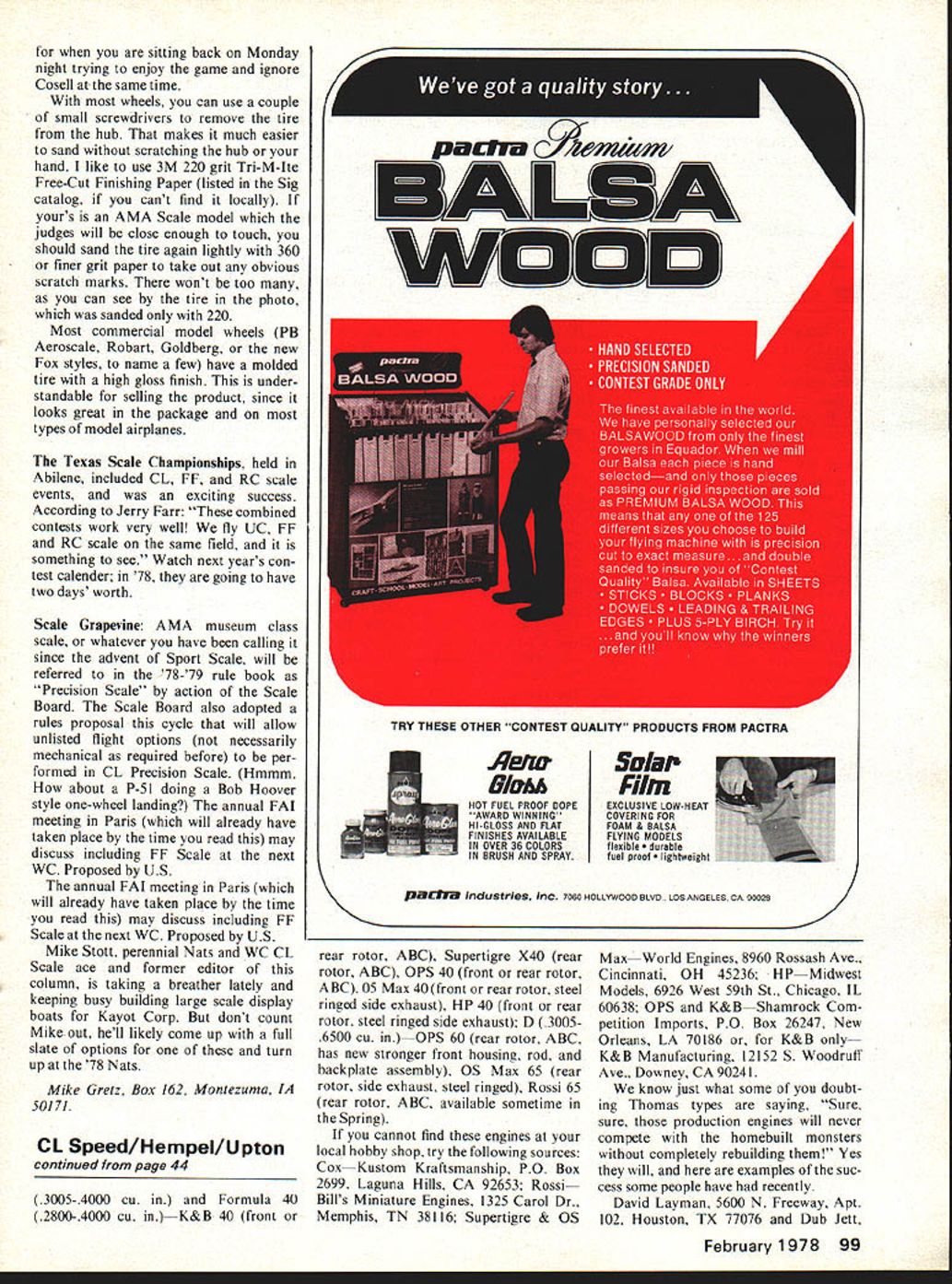
Super Team: Ray Smith of Los Alamitos, California is the highest ranking member of our 1978 FAI CL Scale Team, having won first in both Open AMA Scale and the team selection program at the '77 Nats in Riverside. Ray plans to add more detail to his already outstanding, Nats winning, Messerschmitt BF-109E and use it in the World Championships. The World Championships is tentatively scheduled for early August in England. Dimensionally, Ray's scratch-built Messerschmitt is 1 1/2 in. to 1 ft. scale with a 48 11/16 in. wing span. It's powered by an OS Max 60 and a Top Flite 12-6 prop. The weight, ready to fly with full fuel and bomb load, is 7 1/2 pounds.
Ray's ingenious scale building reflects his technical background. He has been building and flying model airplanes for 40 of his 48 years, and works as a Laboratory Machine Shop Supervisor for Aerospace Corp. He said his main interests in modeling are currently (and understandably) CL and RC scale, although he also competes in CL Combat, Stunt, Rat Race, and Carrier.
The beauty of AMA's team programs over the years, has been that the team members are selected purely on their contest performance; not, as in some of the other countries, on whom they know, or how much they can afford to spend on the trip overseas. Ray Smith and the other members of the '78 CL Scale Team are all first time FAI competitors, who earned their positions in an open competition.
You can help maintain this ideal selection process by buying an FAI stamp for $1 when you send in your '78 AMA membership fee. This money provides vital support for all of our FAI teams. In the future, perhaps a more direct approach to Scale Team funding can be one of the projects of the National Scale Society. Patch sales, Nats and WC movie or slide program rentals, could be considered among other things.
Flat Tires:
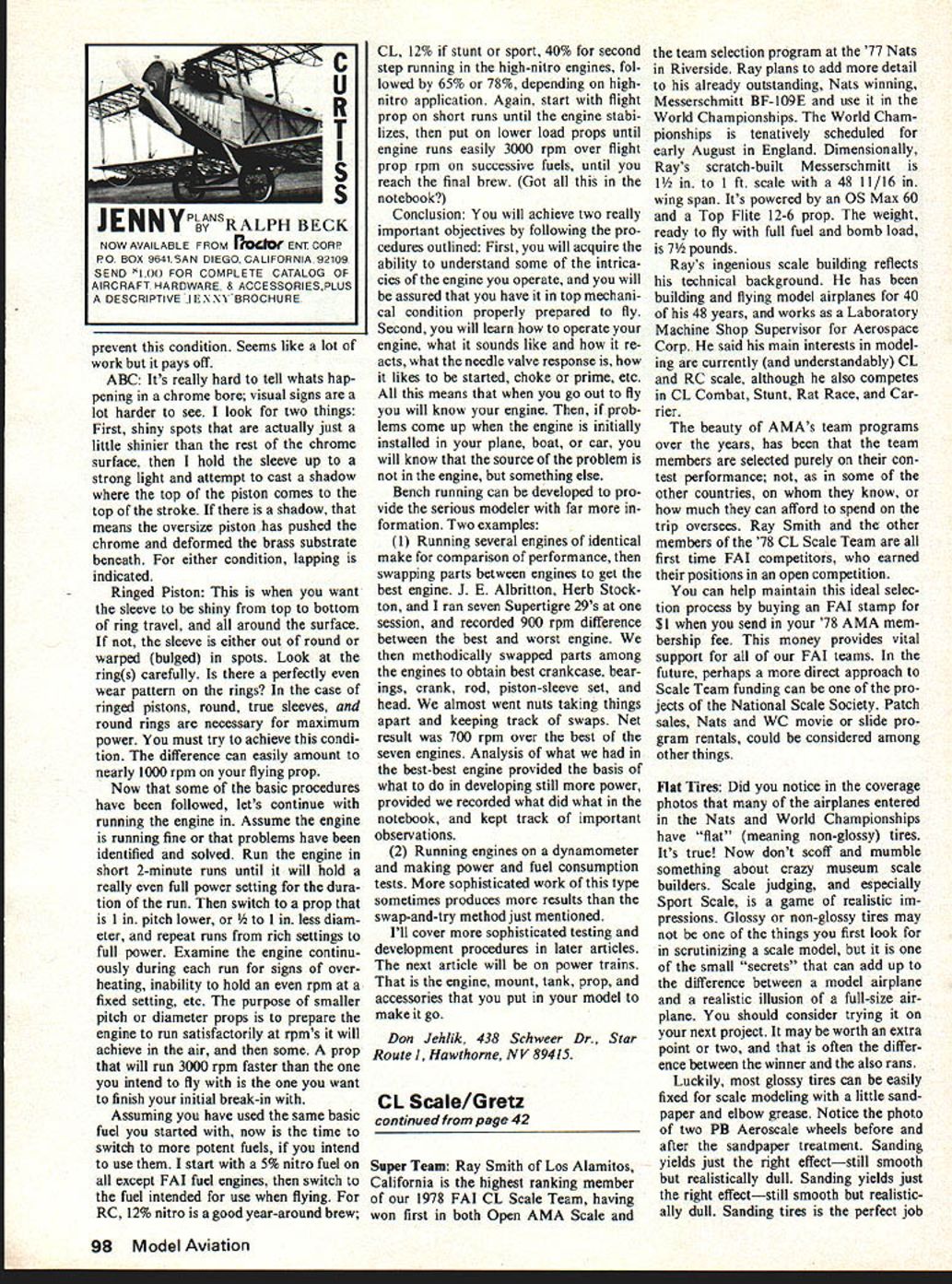
Did you notice in the coverage photos that many of the airplanes entered in the Nats and World Championships have "flat" (meaning non-glossy) tires. It's true! Now don't scoff and mumble something about crazy museum scale builders. Scale judging, and especially Sport Scale, is a game of realistic impressions. Glossy or non-glossy tires may not be the one of the things you first look for in scrutinizing a scale model, but it is one of the small "secrets" that can add up to the difference between a model airplane and a realistic illusion of a full-size airplane. You should consider trying it on your next project. It may be worth an extra point or two, and that is often the difference between the winner and the also ran.
Luckily, most glossy tires can be easily fixed for scale modeling with a little sandpaper and elbow grease. Notice the photo of two PB Aeroscale wheels before and after the sandpaper treatment. Sanding yields just the right effect—still smooth but realistically dull. Sanding tires is the perfect job for when you are sitting back on Monday night trying to enjoy the game and ignore Cosell at the same time.
With most wheels, you can use a couple of small screwdrivers to remove the tire from the hub. That makes it much easier to sand without scratching the hub or your hand. I like to use 3M 220 grit Tri-M-Ite Free-Cut Finishing Paper (listed in the Sig catalog, if you can't find it locally). If yours is an AMA Scale model which the judges will be close enough to touch, you should sand the tire again lightly with 360 or finer grit paper to take out any obvious scratch marks. There won't be too many, as you can see by the tire in the photo, which was sanded only with 220.
Most commercial model wheels (PB Aeroscale, Robart, Goldberg, or the new Fox styles, to name a few) have a molded tire with a high gloss finish. This is understandable for selling the product, since it looks great in the package and on most types of model airplanes.
The Texas Scale Championships, held in Abilene, included CL, FF, and RC scale events, and was an exciting success. According to Jerry Farr: "These combined contests work very well! We fly CL, FF and RC scale on the same field, and it is something to see." Watch next year's contest calendar; in '78, they are going to have two days' worth.
Scale Grapevine: AMA museum class scale, or whatever you have been calling it since the advent of Sport Scale, will be referred to in the '78-'79 rule book as "Precision Scale" by action of the Scale Board. The Scale Board also adopted a rules proposal this cycle that will allow unlisted flight options (not necessarily mechanical as required before) to be performed in CL Precision Scale. (Hmmm. How about a P-51 doing a Bob Hoover style one-wheel landing?) The annual FAI meeting in Paris (which will already have taken place by the time you read this) may discuss including FF Scale at the next WC. Proposed by U.S.
Mike Stott, perennial Nats and WC CL Scale ace and former editor of this column, is taking a breather lately and keeping busy building large scale display boats for Kayot Corp. But don't count Mike out—he'll likely come up with a full slate of options for one of these and turn up at the '78 Nats.
Mike Gretz, Box 162, Montezuma, IA 50171.
Transcribed from original scans by AI. Minor OCR errors may remain.

