
CONTROL LINE SCALE
Bill Boss 77-06 269th Street, New Hyde Park NY 11040
DOCUMENTATION
In the June column I wrote about scale documentation based on comments by Russell Knetzger in Replica, the newsletter of the National Association of Scale Aeromodelers (NASA).
I discussed having too little or too much documentation, the need to provide static scale judges with the proper amount of documentation, and being accurate in what is included in the presentation.
One item I did not include in that column is a subject in itself: Russell's suggestion to "doctor" three-view drawings so they match the balance of documentation where it is obvious the three-views are obscure or inaccurate compared to the prototype.
Altering the three-views involves the removal of lines considered wrong and replacement with lines that are right. The reasoning for this procedure is that if photos and three-view drawings presented for the model differ, the three-views can be corrected.
While Russell did not state it, the suggestion of correcting three-views might be based on the fact that there is no reference to the subject in the current rules for RC (Radio Control) Sport or Designer Scale, or CL (Control Line) Sport or Profile events.
The CL Precision Scale event does refer you to the Unified Scale Regulations, Section 4, Proof of Scale, Paragraphs 4b and 4c, which cover the provision of proper documentation with respect to photos and three-view drawings.
In the January/February Replica, Claude McCullough, AMA Scale Board member, pointed out that the omission of the reference to the Unified Scale Regulation paragraphs was inadvertent when the CL and RC Designer Scale events were established. Claude plans to submit a proposal in the next rules cycle to have the reference included in RC/CL scale events. It was never the intention of the Scale Board to exempt the scale events from this rule.
Claude also noted that the rule came about when it was learned that contestants were making self-serving "corrections" in drawings. Paragraphs 4b and 4c as they exist today were first published in the AMA Competition Regulations in 1973.
Paragraph 4b includes what type of plans are acceptable and where they might be found or come from; it also states:
"Homemade plans or non-published drawings, or drawings of flying models, are not acceptable unless approved by an authoritative source such as the AMA Technical Director, a Scale Contest Board Member, the Manufacturer or builder or other competent authority. Suitable photos, historical background, and supporting data must accompany the drawings for approval to permit verification."
Based on that, changes in drawings would be permitted, but would require a great deal of effort on the part of the modeler and would have to be approved as noted above.
Dave Platt, Scale Board chairman, informed me that a good number of scale builders have submitted drawings and documentation to board members or to the AMA for approval.
If modelers were allowed to indiscriminately change drawings to match photos (without some competent means of approval), there would be some weird-looking models. Who could say that a change made was accurate? What was the angle of the camera when the photo was taken? How do you interpret size change?
The most sensible avenue would be to start a model's construction with a bona fide set of three-views and appropriate photos for the chosen subject. If you're building from a kit and some portion of the model doesn't conform to the three-views, don't change the three-views; modify that portion of the model to conform to the three-views if you know them to be accurate and from a proper source.
The best approach is for the scale modeler to present the model at a contest with a presentation (book/folder) containing the right amount of accurate documentation (three-views, photos, notes, etc.), and in accordance with the rules of the event.
This Month's Photos
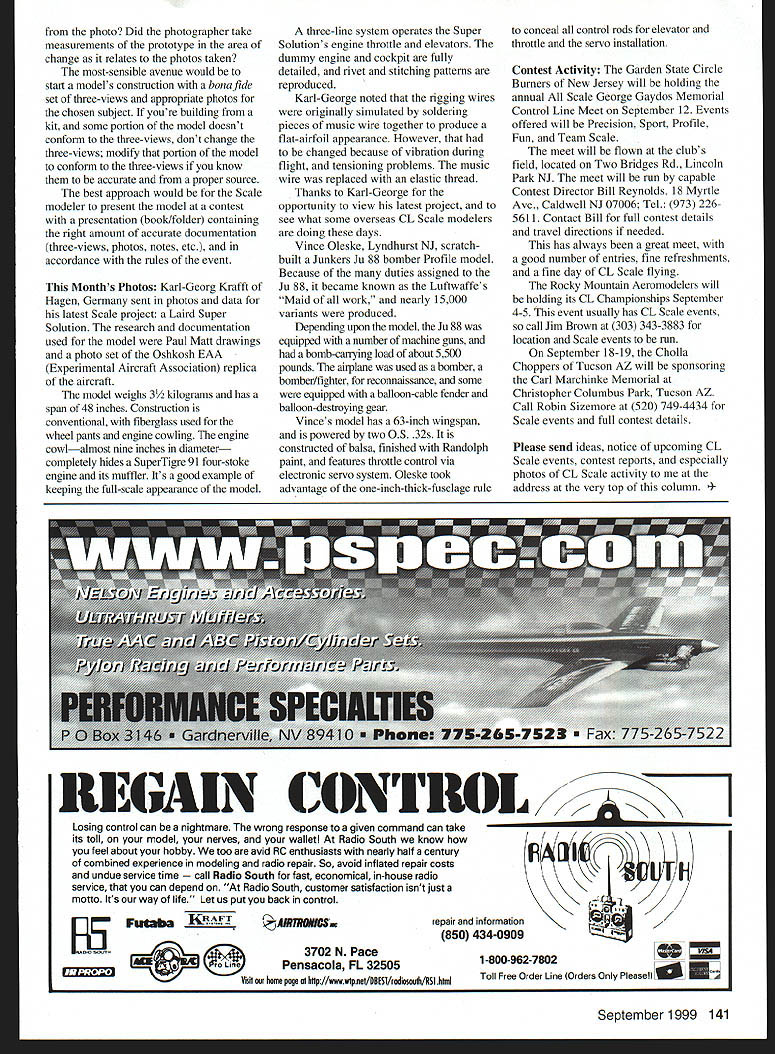
Karl-Georg Krafft of Hagen, Germany sent photos and data for his latest scale project: a Laird Super Solution. The research and documentation used for the model were Paul Matt drawings and a photo set of the Oshkosh EAA (Experimental Aircraft Association) replica of the aircraft.
The model weighs 3-1/2 kilograms and has a 48-inch span. Construction is conventional, with fiberglass used for the wheel pants and engine cowling. The engine cowl—almost nine inches in diameter—completely hides a SuperTigre 91 four-stroke engine and its muffler. It's a good example of keeping the full-scale appearance of the model.
A three-line system operates the Super Solution's engine throttle and elevators. The dummy engine and cockpit are fully detailed, and rivet and stitching patterns are reproduced.
Karl-Georg noted that the rigging wires were originally simulated by soldering tiny pieces of music wire together to produce a flat-airfoil appearance. However, that had to be changed because of vibration during flight and tensioning problems. The music wire was replaced with an elastic thread.
Thanks to Karl-Georg for the opportunity to view his latest project and to see what some overseas CL scale modelers are doing these days.
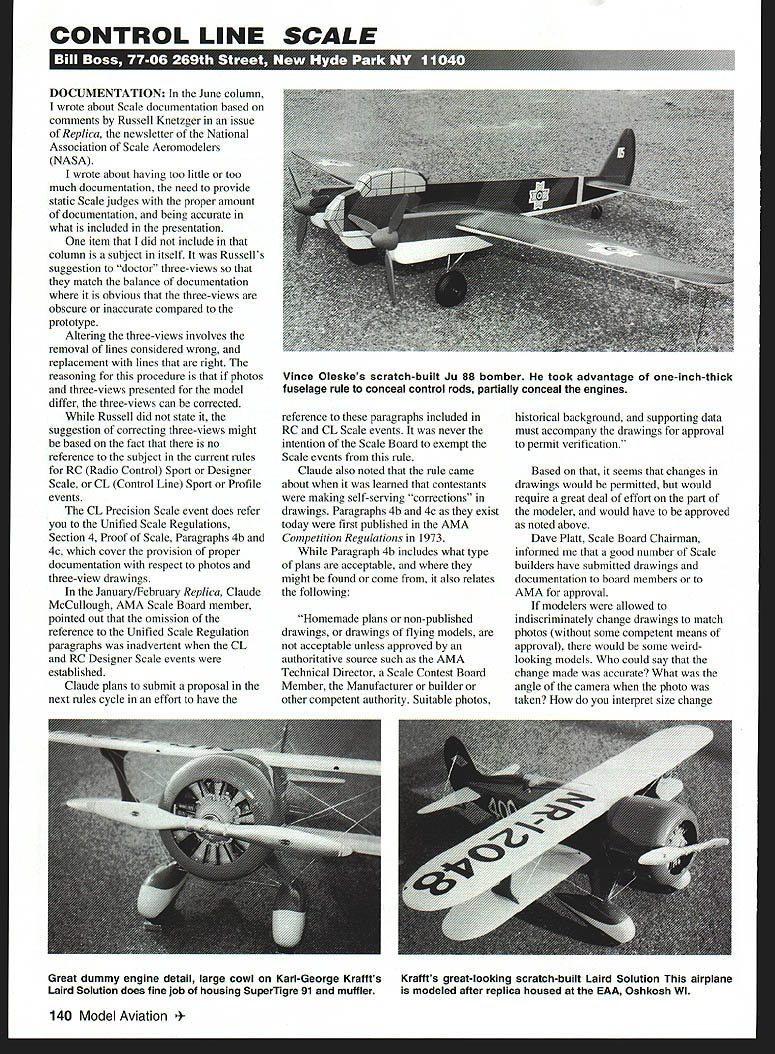
Vince Oleske of Lyndhurst, NJ scratch-built a Junkers Ju 88 bomber profile model. Because of the many duties assigned to the Ju 88, it became known as the Luftwaffe's "maid of all work," and nearly 15,000 variants were produced.
Depending upon the version, the Ju 88 was equipped with a number of machine guns and had a bomb-carrying load of about 5,500 pounds. The airplane was used as a bomber, bomber-fighter, for reconnaissance, and some were equipped with a balloon-cable fender and balloon-destroying gear.
Vince's model has a 63-inch wingspan and is powered by two O.S. .32 engines. It is constructed of balsa, finished with Randolph paint, and features throttle control via an electronic servo system. Oleske took advantage of the one-inch-thick-fuselage rule to conceal all control rods for elevator and throttle and the servo installation.
CONTEST ACTIVITY
- Garden State Circle Burners of New Jersey will hold the annual Al Scale George Gaydos Memorial Control Line Meet on September 12. Events offered will include:
- Precision
- Sport
- Profile
- Fun
- Team Scale
The meet will be flown at the club's field on Two Bridges Rd., Lincoln Park, NJ. The meet will be run by Contest Director Bill Reynolds, 18 Myrtle Ave., Caldwell, NJ 07006; Tel.: (973) 226-5611. Contact Bill for full contest details and travel directions.
- The Rocky Mountain Aeromodelers will hold their CL Championships September 4-5. This event usually includes CL scale events. Call Jim Brown at (303) 343-3883 for location and event details.
- On September 18-19, the Cholla Choppers of Tucson, AZ will sponsor the Carl March Memorial at Christopher Columbus Park, Tucson, AZ. Call Robin Sizemore at (520) 749-4434 for scale events and full contest details.
Please send ideas, notices of upcoming CL scale events, contest reports, and especially photos of CL scale activity to me at the address at the very top of this column.
Transcribed from original scans by AI. Minor OCR errors may remain.

