
CONTROL LINE: SCALE
Steve Ashby — 4771 Cinnamon Dr., Indianapolis, IN 46237
The International Aeromodeling Center was the "happenin' place" for the 1999 Control Line Scale National Championships, hosted by the National Association of Scale Aeromodelers (NASA). The beautiful 1,000-acre flying facility, provided by the Academy of Model Aeronautics at Muncie, Indiana, was meticulously groomed and well prepared. The centrally located L-shaped flying site, known as the L-pad, provided an extremely smooth surface, giving each model the opportunity for a smooth takeoff and a greased landing.
Each year the National Championships grow in numbers, excitement, quality, and efficiency. Mike Welshans, NASA vice president, provided expert, experienced leadership as event director. Mike has guided CL Scale for three years in a row, and four of the last eight years. The competitors were beneficiaries of his invaluable experience and of his corps of capable, well-versed volunteers.
Organization and format
To accommodate the number of contestants, the four categories were flown in two circles this year. This increased efficiency compared to last year's single circle and eased the workload of the flying judges. Competitors were assigned to fly on circle "A" or circle "B"; the flying judges rotated circles after the first two rounds, giving contestants the opportunity to fly in front of two sets of judges.
Mike directed both flying circles with the precision of a movie director, calling each sequence precisely. The competition in nearly all events was up for grabs, with outcomes remaining in doubt until the last round — making for very close and intense competition. The variety of models was like walking through the history of aviation, from Bill Logan's 1915 F.E.2b to Charlie Bauer's turbine-powered U-2.
Static judging
The competition began bright and early Friday, July 9, at the Horizon Convention Center in Muncie. The parking lot was transformed into a huge pit area as competitors assembled aircraft and tried to calm the jitters before static judging.
Static judging is where each model is closely inspected for accuracy of outline, accuracy of color, and quality of craftsmanship. The convention center provided a comfortable, well-lit area for the static portion of the four categories: Sport Scale, AMA Precision Scale, F4B (an international class), and Profile Scale. Each category has its own rules, but the fundamental goal is the same: to replicate an accurate representation of a full-scale aircraft.
Flying days
The flying portion began Saturday morning, July 10. The pit area quickly filled as airplanes were prepared for the day's flights. The skies were clear, though a gusting north wind presented some concern Saturday. Sunday developed into a flier's dream, with very slight winds.
Sport Scale and Profile Scale tied for the strongest-attended Control Line Scale events at the Nationals, with 10 contestants each. The quality of flying continues to improve, and the competition gets stronger; Sport Scale has become a venue for very close and intense contests.
Sport Scale
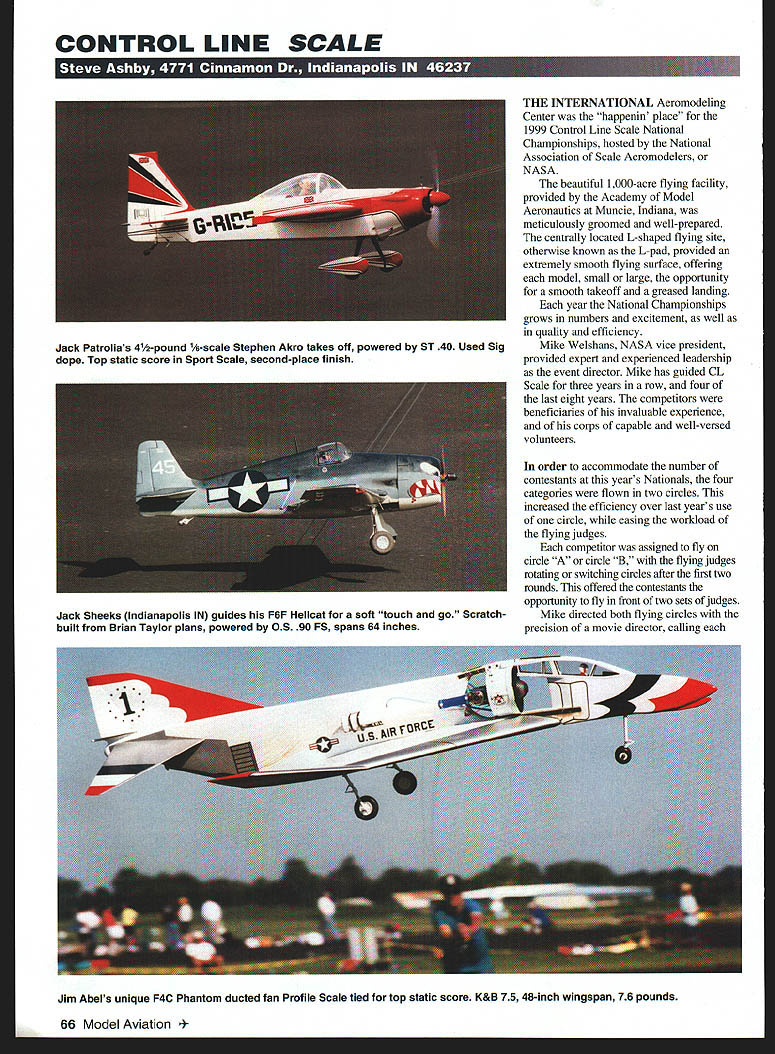
Jack Patrolla, with his 1/6-scale Stephens Akro, had the top static score with 93.34 points. The first round ended with 2.49 points separating the first three positions. Bill Logan, flying a new five-pound Ercoupe, posted an early lead of 0.83 point over challenger and last year's winner Jack Patrolla. Third by a mere 2.49 points was newcomer Walt Brownell, flying an Extra 300S.
Those three competitors flew extremely smooth flights, and the outcome was in doubt until the last landing of the last flight. Their positions interchanged during the middle rounds, but Bill Logan prevailed, winning by just 1.42 points.
AMA District VI Vice President Charlie Bauer, always on the cutting edge of design, thrilled the field when he fired up his new 10½-pound, 80-inch turbine-powered U-2. When Charlie spooled up the turbine, the realistic whine of the RAM 750 added to the excitement. Charlie indicated he needed very little throttle to keep the docile-but-fast U-2 airborne, and he garnered the NASA Flight Achievement Award for his efforts.
Profile Scale
Since implementation, Profile Scale has grown and seen strong participation with very close competition. Profile Scale allows modelers to construct a one-inch-wide fuselage strip; for multiengine aircraft, nacelles can also be one-inch wide. This construction is less complex than building a full fuselage and provides an excellent entry into Scale competition.
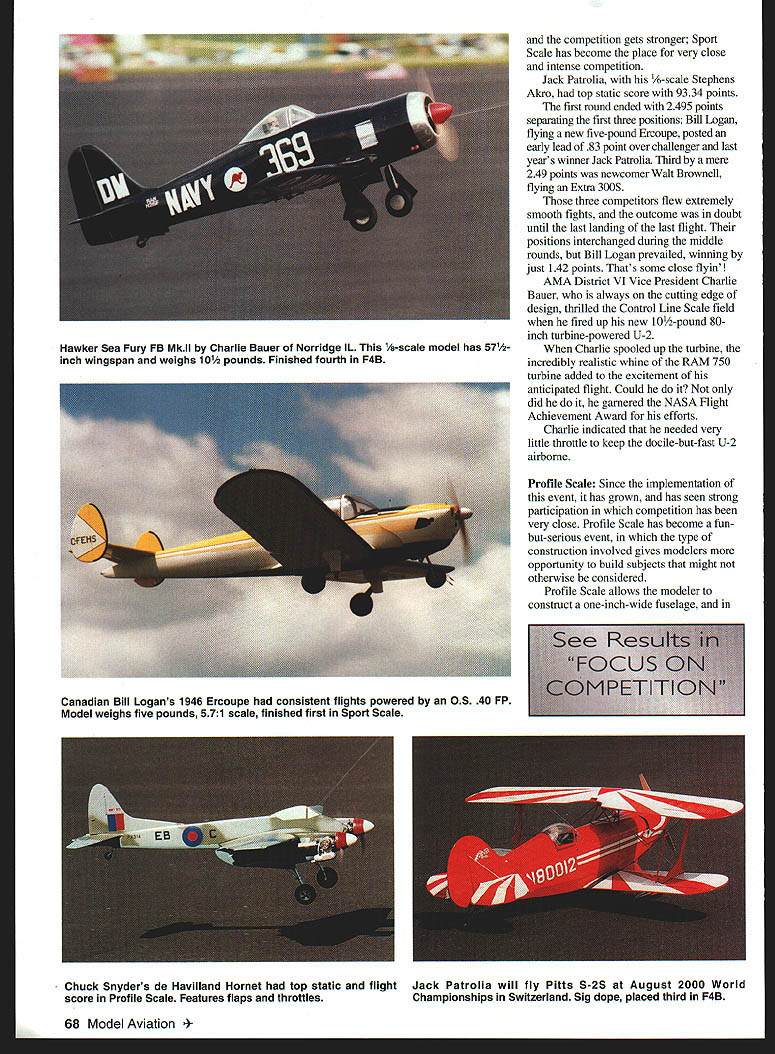
The top static score was a tie between Jim Abel's unique F4C Phantom ducted-fan design and Chuck Snyder's de Havilland Hornet, both with 86.17 points. Chuck Snyder quickly established a small cushion in the first round and pulled out to a comfortable lead while flying extremely smoothly and scoring the top flight points. Top static and top flight is a tough combination to beat.
George McGinnis, with his new Wedell-Williams racer, and Bill Logan, with his Smith Miniplane, gave chase, but Chuck Snyder held on for first place. George finished second, and Bill followed by just 1.25 points — another result too close to call until the final landing.
AMA Precision Scale
In AMA Precision Scale, aircraft are judged more critically and must be more detailed than in Sport or Profile Scale. This year's top static score went to Bill Logan's 62-inch F.E.2b pusher, with 388.43 points. Bill flies this elegant aircraft with finesse and finished first with very slow, realistic flights.
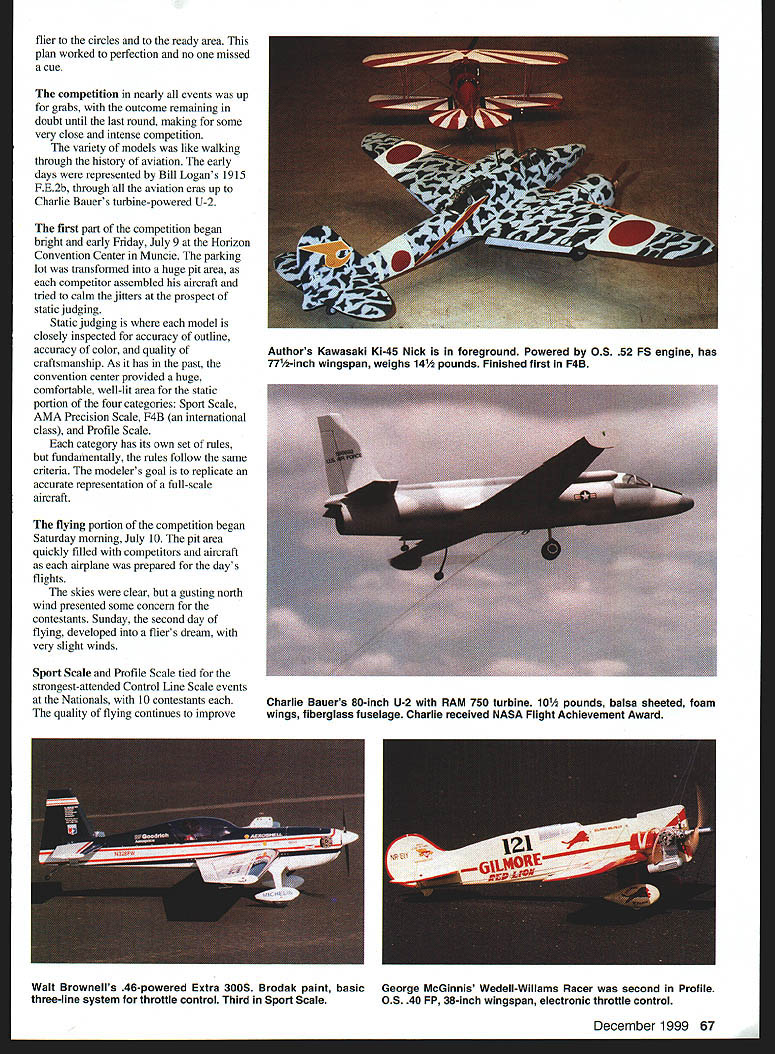
Second place went to Jack Sheeks' 1/8-scale F6F Hellcat. Jack had the top flight score and previously flew this impressive Navy fighter as a member of the US Control Line Scale Team at last year's world championships in Pretoria, South Africa. Finishing third was Frank Beatty with a Howard Pete.
F4B (international class)
F4B is the category governed by rules designed for international competition. AMA will send a three-member F4B Control Line Scale Team to Switzerland for the 2000 World Championships in August.
I entered a new 77½-inch Kawasaki Ki-45 "Nick" and finished in first place, with top static and the high flight score. I will be taking this aircraft to Switzerland.
Canadian Bill Logan finished second, bringing an international flavor with his huge de Havilland 10 — the largest Control Line Scale entry at this year's Nationals. This behemoth spans 104 inches but flies exceptionally well; Bill's realistic, slow flights were very impressive.
Third place went to Jack Patrolla, flying his new Pitts S-2S. Jack will represent the US as a member of the Control Line Scale team at the 2000 World Championships.
Banquet and awards
The NASA banquet on Saturday night was a big hit. After a great meal, NASA president Stan Alexander called a short meeting to order and recognized the banquet's special guest, Don Koranda, president of the National Aeronautic Association (NAA); AMA is an associate member of NAA.
Stan presented awards, including new High Static plaques given to the contestants with the top static scores in F4B (myself), Sport Scale (Jack Patrolla), and AMA Precision Scale (Bill Logan). In addition, Stan announced that cash and merchandise prizes would be included as part of this year's Nationals. Nearly every contestant left with something, whether a $100 first-place prize or bottles of ZAP cyanoacrylate glue.
These new awards were made possible by sponsors:
- Bob Violett Models
- The Zap Gang
- Byron Fuels
- Red Max Model Fuels
- Scale Model Research
- Jerry Bates Plans
Another surprise was a raffle in which five lucky wives received handmade Dolly Wischer bears. These bears have become quite popular; Dolly has made thousands of them through the years.
Closing
The 1999 Nationals will be remembered not only for great weather and fantastic competition, but for the great times shared by participants. It's a time for serious competition but also for lending a helping hand to fellow contestants. The Nationals are about making new friends and renewing old ones.
Some went home national champions, and others experienced frustrations and the "agony of defeat" — but many will come back next year to try again. The efforts of those who competed will live as memories, never to die, only to be embellished with time.
A huge thanks to AMA, NASA, Mike Welshans, and all the volunteers, judges, and scorekeepers who worked so hard to make the final Nationals of the 20th century a tremendous success.
What's in store for the Y2K Nationals? Be there and find out!
Transcribed from original scans by AI. Minor OCR errors may remain.

