
Control Line: Scale
Mike Gretz
A MONTH AGO, somewhere between first long-hand draft and the typewritten copy, I misplaced a page of data on Ray Smith's Nats winning ME-109. To an unquenchable scale addict like myself, that was an unpardonable crime. Lest Ray think that I don't appreciate his taking time to fill us in, here is what you should have read last month.
Ray built his own J-Roberts type control system. It uses four lines, three of them electric, to operate his model's operational features. The options he uses are throttle control (mechanical), retractable landing gear (electric), flaps (electric), bomb drop (mechanical), and fuel shutoff (mechanical). Also, all controls in the cockpit work with the control surfaces, both the main and tail landing gear have full working oleos, and the oil cooler doors open and close. Ray uses a 12-5 prop, instead of a 12-6 as I said last month.
The Messerschmitt structure is built-up balsa. The sheeting is covered with Japanese tissue for light weight, and finished with sanding sealer and Aero Gloss dope. Ray notes that, after the sealer coats are sanded, he puts on a coat of silver dope to provide an even base for the final colors. In case this sounds unusual to you, it is a tried-and-true technique that has been employed by top modelers for almost as long as dope finishes have been used. It is especially helpful when light colors, such as yellow, are going to be used. In fact, I've found that the coverage you get with just two coats of yellow, when put over a base color coat, cannot be equalled in brightness and uniform tone with even five coats of yellow dope without an opaque base.
My only difference with Ray's method is that I prefer to use white dope for the base coat. Silver, being metallic, is somewhat harder to use. Metallic dope must be sprayed for best results, whereas a white base coat can be applied even if you are brushing on the finish. I also feel that the final color coats adhere better to white than to silver, and white adds extra brilliance to almost any color that is put over it.
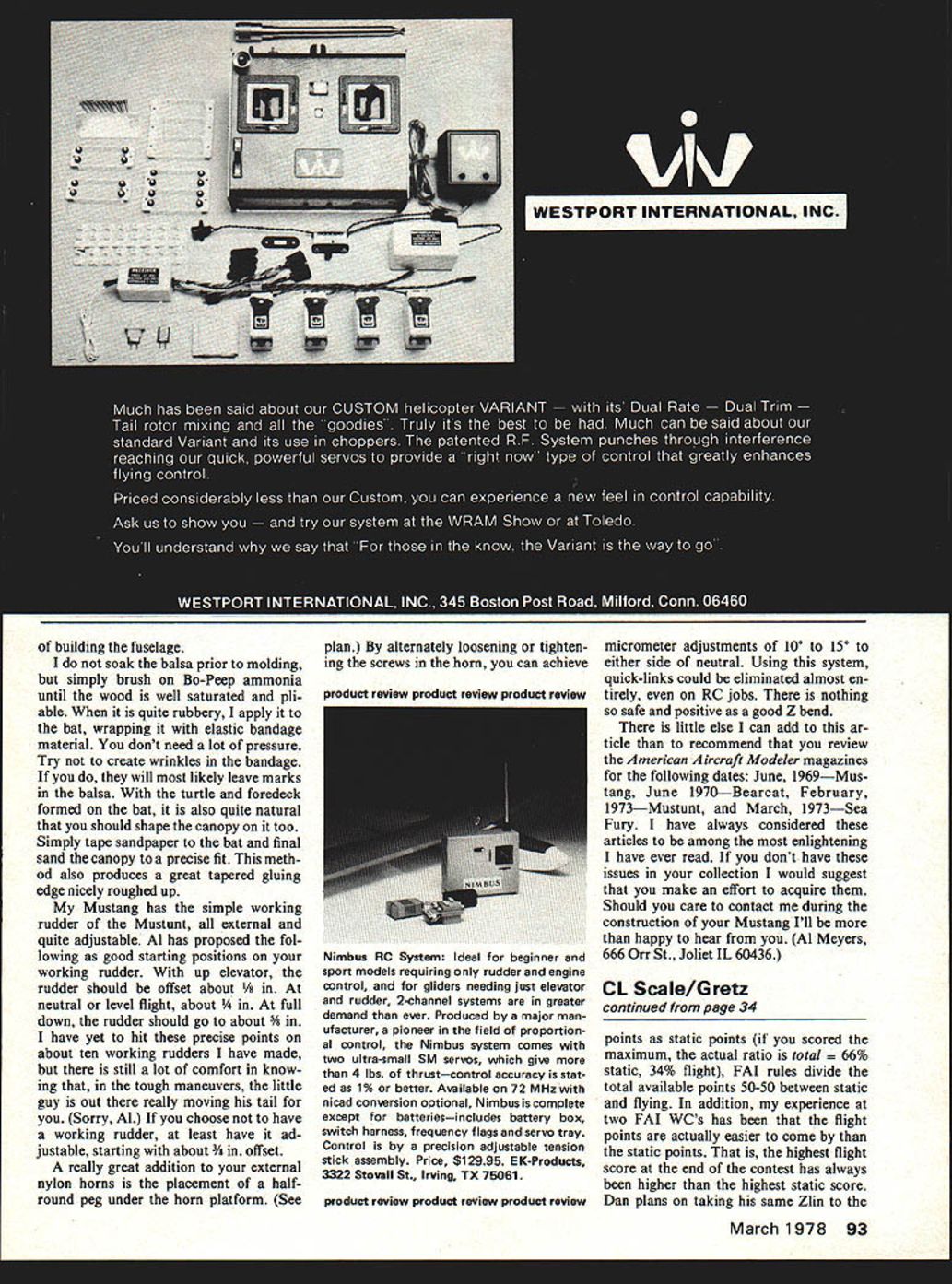
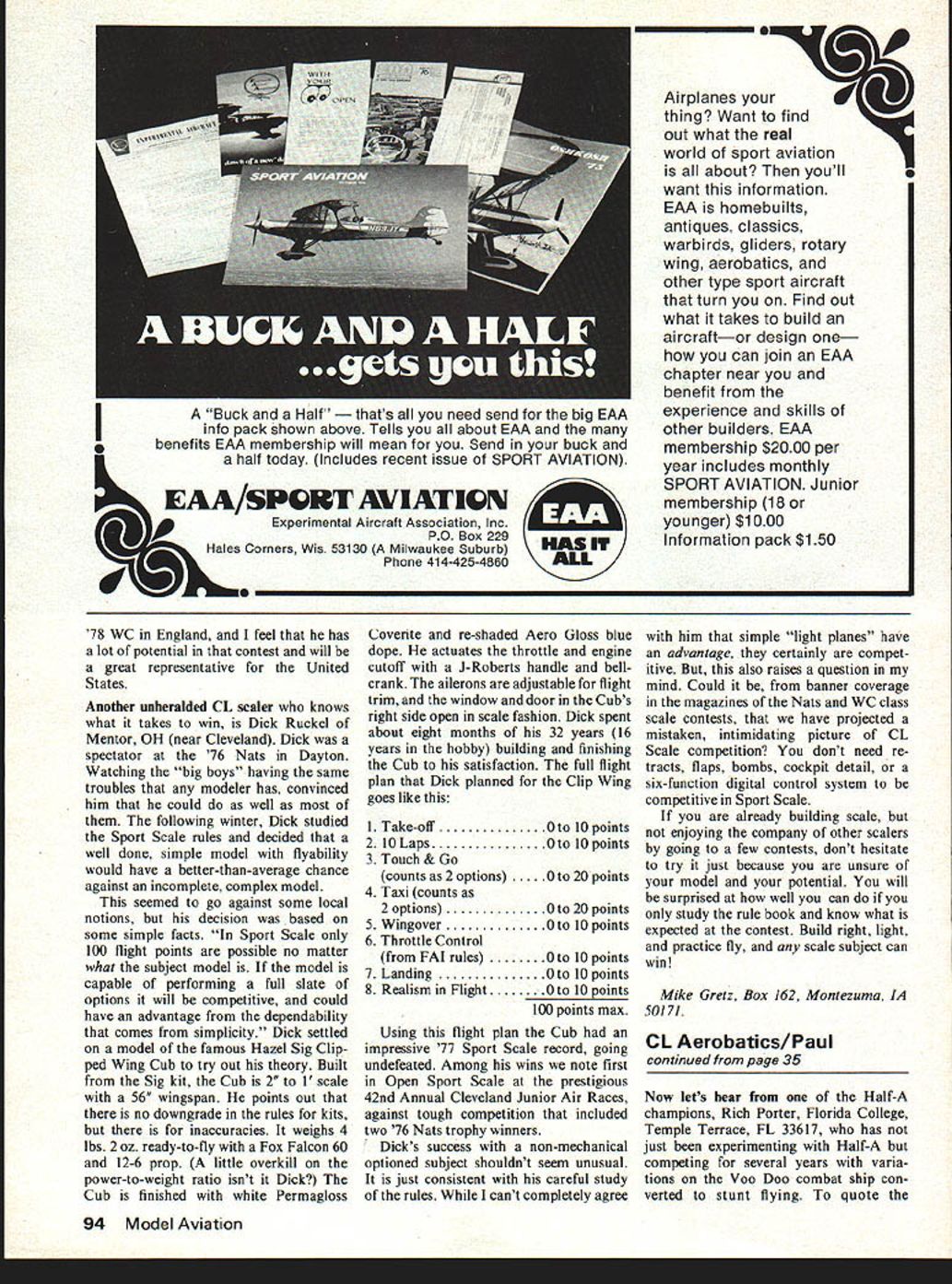
The second member of our rookie '78 FAI CL Scale Team is 18-year-old Dan Osdoba, of Mankato, MN. Dan turned some heads at the Riverside Nats by placing second in Open AMA Precision Scale, even though he is actually in the Senior age group. His win comes as no surprise to me, as Dan is an experienced competitor in several CL events. His past contest wins include Nats trophies in Stunt, Scale Racing, and Sport Scale. In addition to his Precision Scale win at Riverside this year, he was the first place Senior entrant in CL Sport Scale, with an AT-6. Dan is a student at Mankato State University and a member of an active modeling family. His father and three brothers all build and fly CL models, and most of them have also won Nats trophies in the past.
His team-place winning model is a Zlin 526A Akrobat. It is 2 in. to 1 ft. scale and is based on the Sig kit. The construction is basic balsa and plywood, covered with silk (on fuse and tail) and Silkspan (everywhere else), and painted with Sig butyrate dope. It's powered by an OS 60 and Top Flite 12-6 prop. Dan used the same digital proportional type control system used by Mike Stott, Bill Harney, and myself, over the past few years, to actuate the throttle, retracts (Rom-Air), flaps, and fuel shutoff. The Zlin was chosen as his first Precision Scale subject because of its proven flight potential.
Dan realized that, while AMA scale rules provide for only half as many flight of building the fuselage.
I do not soak the balsa prior to molding, but simply brush on Bo-Peep ammonia until the wood is well saturated and pliable. When it is quite rubbery, I apply it to the bat, wrapping it with elastic bandage material. You don't need a lot of pressure. Try not to create wrinkles in the bandage. If you do, they will most likely leave marks in the balsa. With the turtle and foredeck formed on the bat, it is also quite natural that you should shape the canopy on it too. Simply tape sandpaper to the bat and final sand the canopy to a precise fit. This method also produces a great tapered gluing edge nicely roughed up.
My Mustang has the simple working rudder of the Mustunt, all external and quite adjustable. Al has proposed the following as good starting positions on your working rudder. With up elevator, the rudder should be offset about 1/8 in. At neutral or level flight, about 1/4 in. At full down, the rudder should go to about 3/8 in. I have yet to hit these precise points on about ten working rudders I have made, but there is still a lot of comfort in knowing that, in the tough maneuvers, the little guy is out there really moving his tail for you. (Sorry, Al.) If you choose not to have a working rudder, at least have it adjustable, starting with about 3/8 in. offset.
A really great addition to your external nylon horns is the placement of a half-round peg under the horn platform. (See plan.) By alternately loosening or tightening the screws in the horn, you can achieve micrometer adjustments of 10° to 15° to either side of neutral. Using this system, quick-links could be eliminated almost entirely, even on RC jobs. There is nothing so safe and positive as a good Z bend.
There is little else I can add to this article than to recommend that you review the American Aircraft Modeler magazines for the following dates: June, 1969—Mustang, June 1970—Bearcat, February, 1973—Mustunt, and March, 1973—Sea Fury. I have always considered these articles to be among the most enlightening I have ever read. If you don't have these issues in your collection I would suggest that you make an effort to acquire them. Should you care to contact me during the construction of your Mustang I'll be more than happy to hear from you. (Al Meyers, 666 Orr St., Joliet IL 60436.)
points as static points (if you scored the maximum, the actual ratio is total = 66% static, 34% flight). FAI rules divide the total available points 50-50 between static and flying. In addition, my experience at two FAI WC's has been that the flight points are actually easier to come by than the static points. That is, the highest flight score at the end of the contest has always been higher than the highest static score.
Dan plans on taking his same Zlin to the Nats. He feels that with a little work on the scale detailing, the Zlin, as is, can be made to be highly competitive in Precision Scale. '78 WC in England, and I feel that he has a lot of potential in that contest and will be a great representative for the United States.
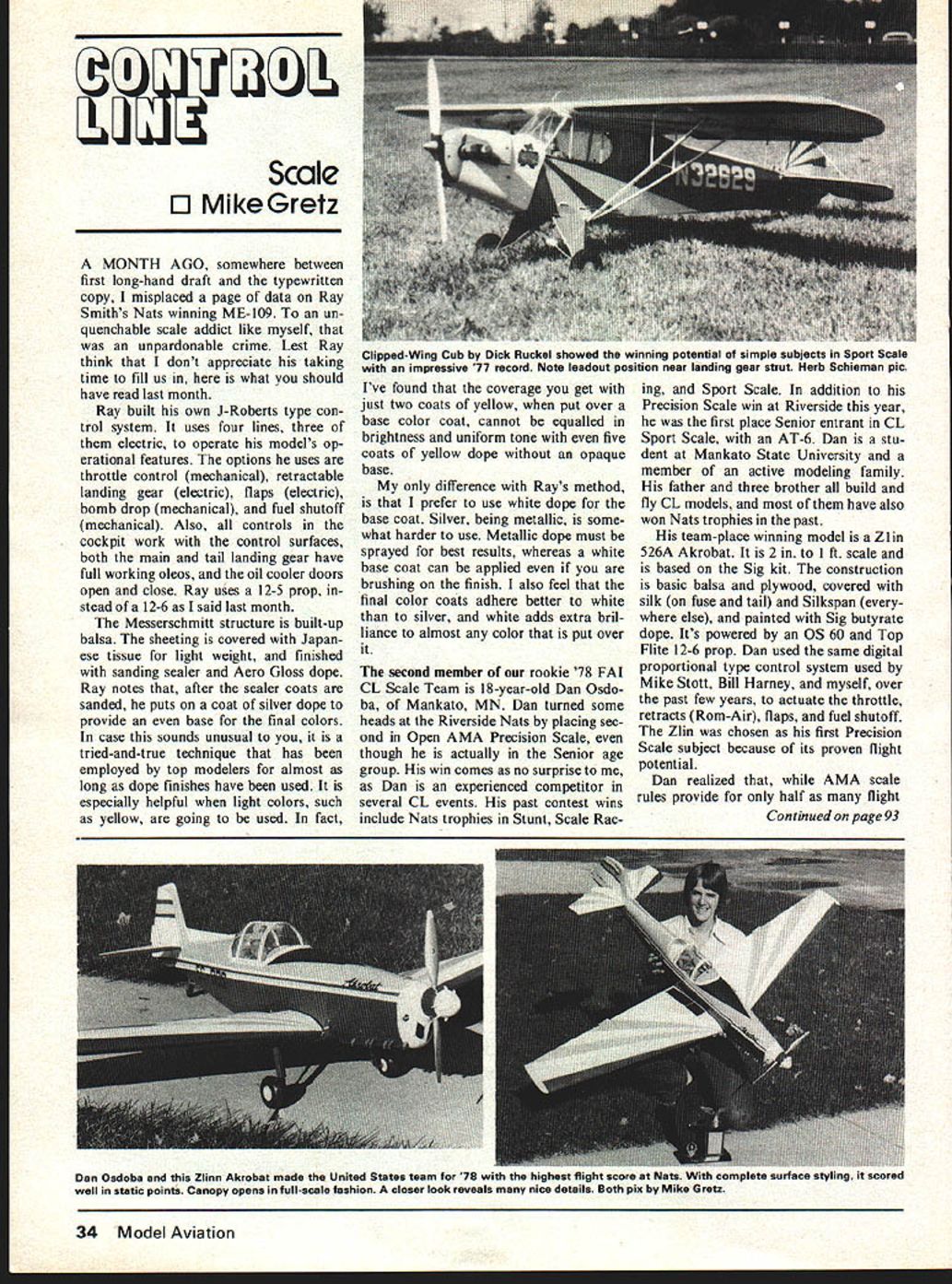
Another unheralded CL scaler who knows what it takes to win, is Dick Ruckel of Mentor, OH (near Cleveland). Dick was a spectator at the '76 Nats in Dayton. Watching the "big boys" having the same troubles that any modeler has, convinced him that he could do as well as most of them. The following winter, Dick studied the Sport Scale rules and decided that a well done, simple model with flyability would have a better-than-average chance against an incomplete, complex model.
This seemed to go against some local notions, but his decision was based on some simple facts. "In Sport Scale only 100 flight points are possible no matter what the subject model is. If the model is capable of performing a full slate of options it will be competitive, and could have an advantage from the dependability that comes from simplicity." Dick settled on a model of the famous Hazel Sig Clipped Wing Cub to try out his theory. Built from the Sig kit, the Cub is 2' to 1' scale with a 56" wingspan. He points out that there is no downgrade in the rules for kits, but there is for inaccuracies. It weighs 4 lbs. 2 oz. ready-to-fly with a Fox Falcon 60 and 12-6 prop. (A little overkill on the power-to-weight ratio isn't it Dick?) The Cub is finished with white Permagloss Coverite and re-shaded Aero Gloss blue dope. He actuates the throttle and engine cutoff with a J-Roberts handle and bellcrank. The ailerons are adjustable for flight trim, and the window and door in the Cub's right side open in scale fashion. Dick spent about eight months of his 32 years (16 years in the hobby) building and finishing the Cub to his satisfaction. The full flight plan that Dick planned for the Clip Wing goes like this:
- Take-off .............. 0 to 10 points
- 10 Laps ............... 0 to 10 points
- Touch & Go (counts as 2 options) . . . 0 to 20 points
- Taxi (counts as 2 options) .......... 0 to 20 points
- Wingover ................ 0 to 10 points
- Throttle Control (from FAI rules) .. 0 to 10 points
- Landing .................. 0 to 10 points
- Realism in Flight ...... 0 to 10 points
100 points max.
Using this flight plan the Cub had an impressive '77 Sport Scale record, going undefeated. Among his wins we note first in Open Sport Scale at the prestigious 42nd Annual Cleveland Junior Air Races, against tough competition that included two '76 Nats trophy winners.
Dick's success with a non-mechanical optioned subject shouldn't seem unusual. It is just consistent with his careful study of the rules. While I can't completely agree with him that simple "light planes" have an advantage, they certainly are competitive. But, this also raises a question in my mind. Could it be, from banner coverage in the magazines of the Nats and WC class scale contests, that we have projected a mistaken, intimidating picture of CL Scale competition? You don't need retracts, flaps, bombs, cockpit detail, or a six-function digital control system to be competitive in Sport Scale.
If you are already building scale, but not enjoying the company of other scalers by going to a few contests, don't hesitate to try it just because you are unsure of your model and your potential. You will be surprised at how well you can do if you only study the rule book and know what is expected at the contest. Build right, light, and practice fly, and any scale subject can win!
Mike Gretz, Box 162, Montezuma, IA 50171.
Transcribed from original scans by AI. Minor OCR errors may remain.

