
Control Line: Scale
Mike Gretz
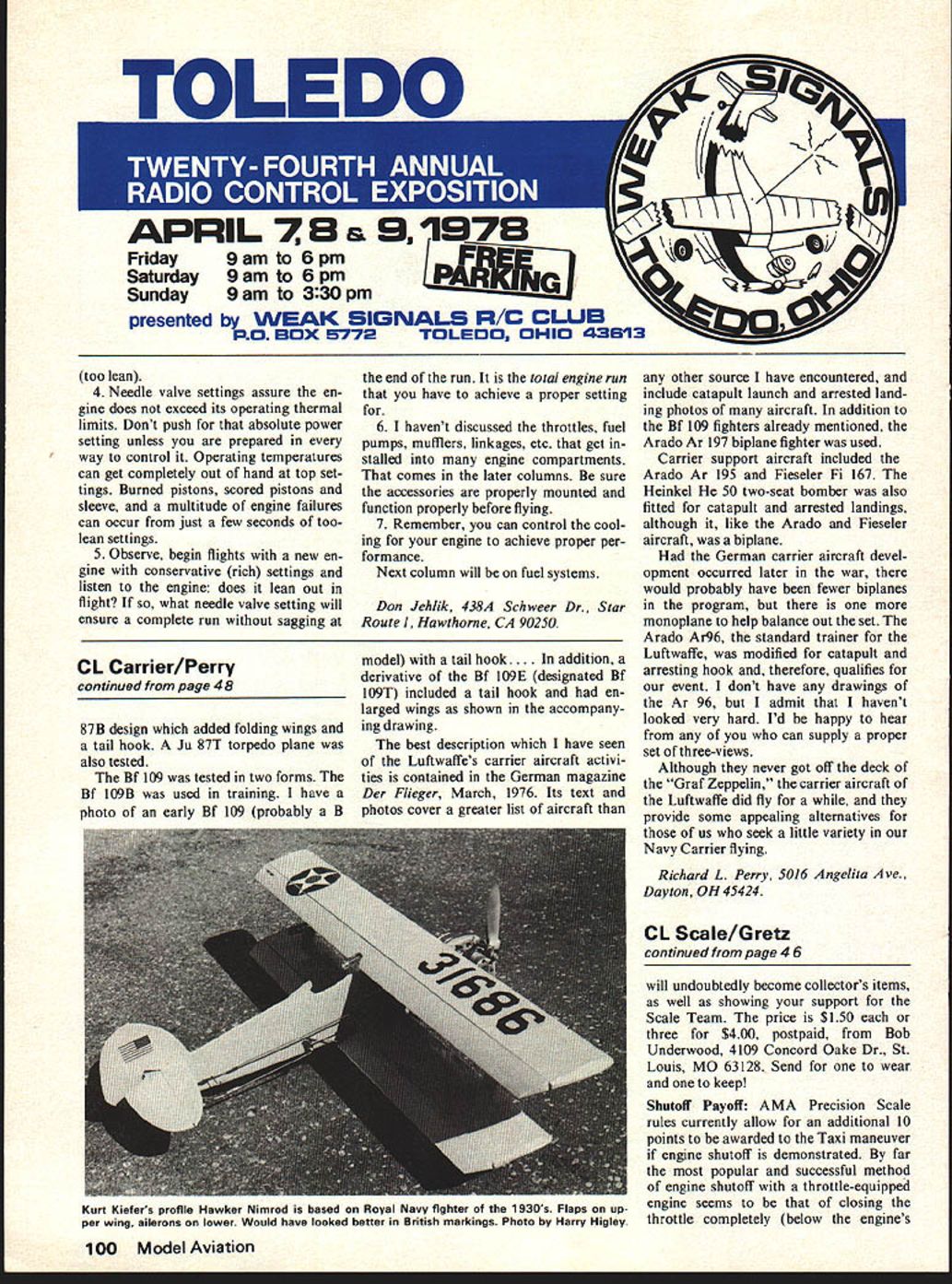
AIR FORCE Major Roland Baltes of San Pedro, California was the third qualifier for the 1978 U.S. CL Scale Team, flying an impressive 65-in. span Junkers JU-88 at the Riverside Nationals. The German JU-88 was a twin-engined medium bomber used extensively (only the Me-109 and Fw-190 were produced in greater numbers) by the Luftwaffe throughout World War II. It gained a reputation as being the nearest thing to an all-purpose airplane that had ever been built, and it was by far the best of the Luftwaffe’s rather mediocre bomber fleet. Its unique adaptability found different versions fighting on all the German fronts in the diverse roles of day fighter; night fighter; level, dive, and torpedo bomber; balloon destroyer; mine layer; ground attack aircraft; reconnaissance and communications aircraft; and, towards the end of the war, a flying bomb.
The JU-88’s lethal, menacing appearance in military camouflage makes it a good choice for an eye-catching, winning scale model. Roland’s original-design model JU-88 is 1-in. to 1-ft. scale, weighs 7½ pounds, and is powered by two Super Tigre G-40s, turning 3‑bladed 10-6 props. The construction is typical ply formers with balsa sheeting, and the finish is Silkspan and Aero Gloss Flat Dope. The engine throttles are controlled by a standard J-Roberts 3-line bellcrank and handle.
Roland notes this about his 3-year-old model: “The JU-88 was built while I was stationed at Wright-Patterson AFB (Dayton, Ohio) where the full-size version is on display. I used actual measurements and data on file in the (Air Force) Museum archives, since a good set of 3‑views on this version JU-88 D-1 does not exist.”
Concerning the upcoming World Championships in England, Roland adds: “I’m planning to build a DH Mosquito. Hope to be able to complete it in time since I don’t feel that my JU-88 is up to the level needed. Primary drawback is lack of retractable landing gear, so this will be a must feature in the Mosquito.”
Major Baltes is currently stationed at the Space and Missile Systems Organization, Los Angeles Air Force Station. He has been building model airplanes for over 20 years, and his active competition interests have mainly been CL Scale and Navy Carrier. Roland’s numerous contest wins are highlighted by a first in Class I Carrier, 1967 Nationals.
Patchwork: A fund raising project to support the 1978 U.S. CL & RC Scale Teams, by selling embroidered souvenir patches, has recently been set up. Distinctive 3-in. diameter cloth patches (see pattern) have been produced in red, white, and blue, and they feature the emblem traditionally used on the back of the Scale Team shirts. The patches are very limited production. They will undoubtedly become collector's items, as well as showing your support for the Scale Team. The price is $1.50 each or three for $4.00, postpaid, from Bob Underwood, 4109 Concord Oaks Dr., St. Louis, MO 63128. Send for one to wear and one to keep!
Shutoff Payoff: AMA Precision Scale rules currently allow for an additional 10 points to be awarded to the Taxi maneuver if engine shutoff is demonstrated. minimum idle speed), until the engine quits running due to lack of air, or flooding. This method is dependable and easy, requiring no extra linkages or mechanism inside of the model, but it must be made adequately fool-proof to avoid premature engine failure during Landing, Touch-and-Go, or Taxi.
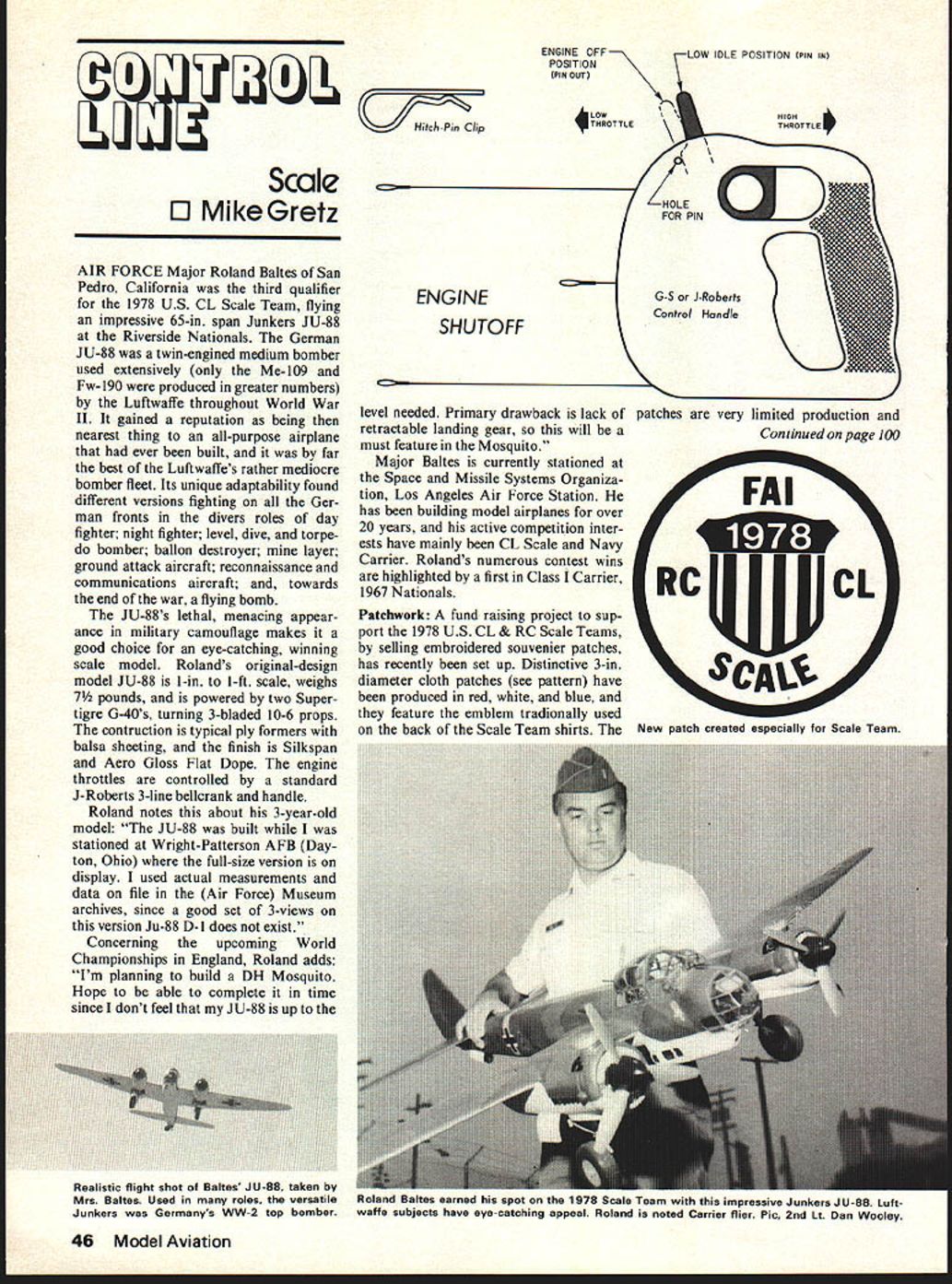
Many gadgets can be devised to limit the low-end travel of the throttle linkage at the control handle to a safe, dependable, idle setting. When engine shutoff is wanted at the end of the Taxi, the gadget is removed or displaced, allowing the throttle to completely close, killing the engine. One of the easiest gadgets, preferred by Dick Ruckel of the Prop Busters Club of Cleveland, is a pin through the control handle in front of the top throttle lever, as shown in the accompanying drawing. A "hitch pin clip" as shown can be used, or something similar can be fashioned out of music wire. The main idea is that the pin must provide a firm, immovable stop that can be easily removed when desired.
- Advance the throttle lever about 1/4-in. up from the fully closed position, and locate the pin position to hold the lever at this spot. Remember that the pin should be on the low-throttle side of the lever!
- To adjust your engine and control handle operation before flight testing, it is best to completely set up the entire control system (model, three control lines, and handle) exactly as you intend to use for flight. Adjust the engine throttle, setting the low idle to the pin stop. You should use an adjustable RC link at the end of your throttle pushrod so that the safe, low idle can be fine tuned exactly to the pin position. In fact, if you haven't tried one, the best type of throttle pushrod to use is a flexible nylon tubing/steel cable type such as Sig #SH-559 or Du-Bro #165.
- When the pin is pulled out, and the throttle lever is bottomed out, the throttle should close completely, killing the engine. When using this set-up, the throttle's idle stop screw should be backed out far enough, so that it doesn't interfere with the complete closing of the throttle barrel.
- Needle valve settings assure the engine does not exceed its operating thermal limits. Don't push the absolute power setting unless prepared to control it. Operating temperatures can get completely out of hand; at top settings burned pistons, scored pistons, sleeve damage and a multitude of engine failures can occur in just a few seconds with too-lean settings.
- Begin flights on a new engine with conservative (rich) settings. Listen to the engine as it leans out in flight to determine what needle valve setting will ensure a complete run without sagging.
- I haven't discussed throttles, fuel pumps, mufflers, linkages, etc. Engine compartments will be covered in later columns. Be sure accessories are properly mounted and function properly before flying.
- Remember you can control cooling and engine timing to achieve proper performance.
Next column will be on fuel systems.
Don Jehlik 438A Schweer Dr. Star Route 1 Hawthorne, CA 90250
Recommended Reading: The Smithsonian Institution, in Washington, D.C., obviously is one of the best sources of scale reference materials in this country, as it houses our National Aeronautical Collection, probably the most significant such collection in the world. The Smithsonian has recently published an 8-1/2 x 11" book entitled Aircraft of the National Air and Space Museum, which contains a wealth of information, b&w photos, and small size 3-view drawings on each of the 64 historic aircraft that are on display in the Air and Space Museum building at its opening July 4, 1976. It also lists the remainder of the Museum's 275 aircraft collection, which is either in storage, or loaned to other museums.
Among the airplanes described in the book are obviously the nation's most prestigious pacesetters: the original 1903 Wright Flyer, the Spirit of St. Louis, the Bell X-1 (broke the sound barrier in 1947), and one of the 1924 Douglas World Cruisers. Also described are many other inspiring record setters that would make well-documented, appealing scale subjects: Wiley Post's Winnie Mae; the Fokker T-2 (first nonstop transcontinental flight, 1923); Charles Lindbergh's Lockheed Sirius; three-time Thompson winner Turner Meteor; Al Williams' Gulfhawk II; Vee Howard's Bucker Jungmeister; a Bonanza "Waikiki Beach" which, in 1949, flew the first solo woman around the world (succeeding where all previous attempts, including Amelia Earhart's fatal flight, failed); Piper Super Cruiser "City of Washington"; and many more.
For $2.00 the book is an unbeatable bar-
Control Line: Scale
Mike Gretz
Air Force Major Roland Baltes, San Pedro, California, third qualifier for the 1978 U.S. CL Scale Team, is flying an impressive 65-inch span Junkers JU-88 at the Riverside Nationals. The German JU-88 twin-engined medium bomber, used extensively by the Luftwaffe throughout World War II, gained a reputation as being the nearest thing to an all-purpose airplane ever built. Far better than the Luftwaffe's rather mediocre bomber fleet, its unique adaptability found different versions fighting German fronts in diverse roles — day fighter, night fighter, level bomber, dive bomber, torpedo bomber, balloon destroyer, glider tug, ground-attack aircraft, reconnaissance and communications aircraft. Towards the end of the war some JU-88s were converted to flying bombs. The JU-88's lethal, menacing appearance and military camouflage make it a good choice for an eye-catching, winning scale model.
Roland's original-design model JU-88 is 1 inch to 1 foot scale, weighs 7 pounds and is powered by two Super Tigre G-40s turning 3-bladed 10-6 props. Construction is typical — ply formers with balsa sheeting; finish is Silkspan and Aero Gloss Flat Dope. Engine throttles are controlled by a standard J-Roberts 3-line bellcrank handle. Roland notes the JU-88 is about three years old and was built while he was stationed at Wright-Patterson AFB, Dayton, Ohio. The full-size version's measurements were taken from the Air Force Museum archives. A good set of three-views for the Ju-88 D-1 does exist.
Concerning the upcoming World Championships in England, Roland adds, "I'm planning to build a DH Mosquito. Hope to be able to complete in time since I don't feel the JU-88 is up to it." A primary drawback of the Mosquito will be the need for retractable landing gear.
Major Baltes, now assigned to the Space and Missile Systems Organization, Los Angeles Air Force Station, has been building model airplanes for over 20 years. His active competition interests have mainly been CL Scale and carrier events. Roland's numerous contest wins include first place Carrier at the 1967 Nationals.
Transcribed from original scans by AI. Minor OCR errors may remain.

