
Control Line: Scale
Mike Gretz
THIS IS the first column I've been able to put together entirely along the format, or concept, that I originally envisioned as being the most beneficial and enjoyable to a wide range of CL Scale modelers. This issue has contributions from several readers from different parts of the country and different levels of scale experience. Some names are possibly familiar to you, some not. What they have in common are interesting ideas or techniques that they want to pass on for your future reference and possible use. I thank these fellows for taking the time to write, and encourage others to do the same.
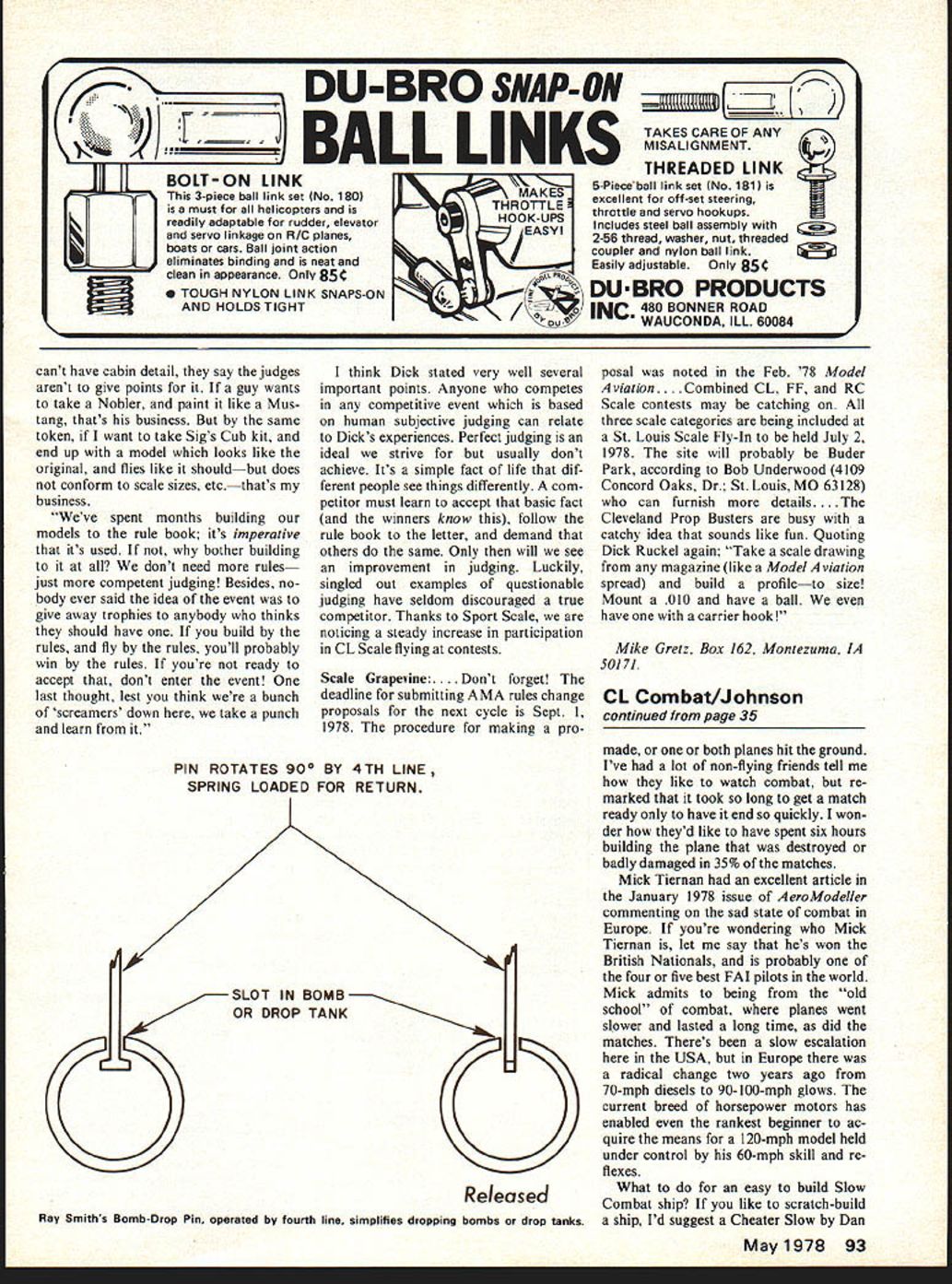
1977 Nats Champ Ray Smith (see Feb. '78 MA CL Scale) sent data on one of his earlier scale ships, a Douglas A-26 Invader. Historically, the full-size Invader is significant in that it is generally acknowledged as the best, most destructive of WW2's lightweight piston-powered twin-engined bombers. The A-26 proved to be the last important operational aircraft produced in the Attack category (officially abandoned by the AAF in 1948), and it embodied all that the Air Corps had learned about attack aircraft in the 30's and 40's. Its awesome predecessors included the A-20 Havoc, the B-26 Marauder, and the B-25 Mitchell. The attack category called for designs suitable for ground attack, precision bombing from low and medium altitudes, night fighting, and reconnaissance duties. Heavily armoured for protection, carrying a crew of three, the Invader's powerful offensive armament could include in different combinations, up to 18 .50-caliber machine guns, cannons, 6,000 lbs of bombs, 16 rockets, or extra fuel tanks. The A-26 was called the B-26 after 1948, and served effectively through the Korean War.
Ray's scale Invader "...has a wing span of 72 in., and has two Fox Eagle 60 engines for power. The model weighs 15 pounds, and has retracting landing gear. The nose wheel rotates 90° when it goes up. It has working flaps and bomb bay doors, with a bomb drop. I built a blinking red light for the rudder, but it is hard to see in the sun light. About a year ago, I hung it up in one of the local hobby shops. I've had very good luck with it."
Ray also sent a sketch of the bomb drop pin he uses. The bomb drop is mechanical and is triggered ... by the use of a fourth line. I have a pin which is in the bottom of the wing and enters the bomb. It can't be seen until the bomb is dropped. It in turn is spring loaded so it will always return to the same place.
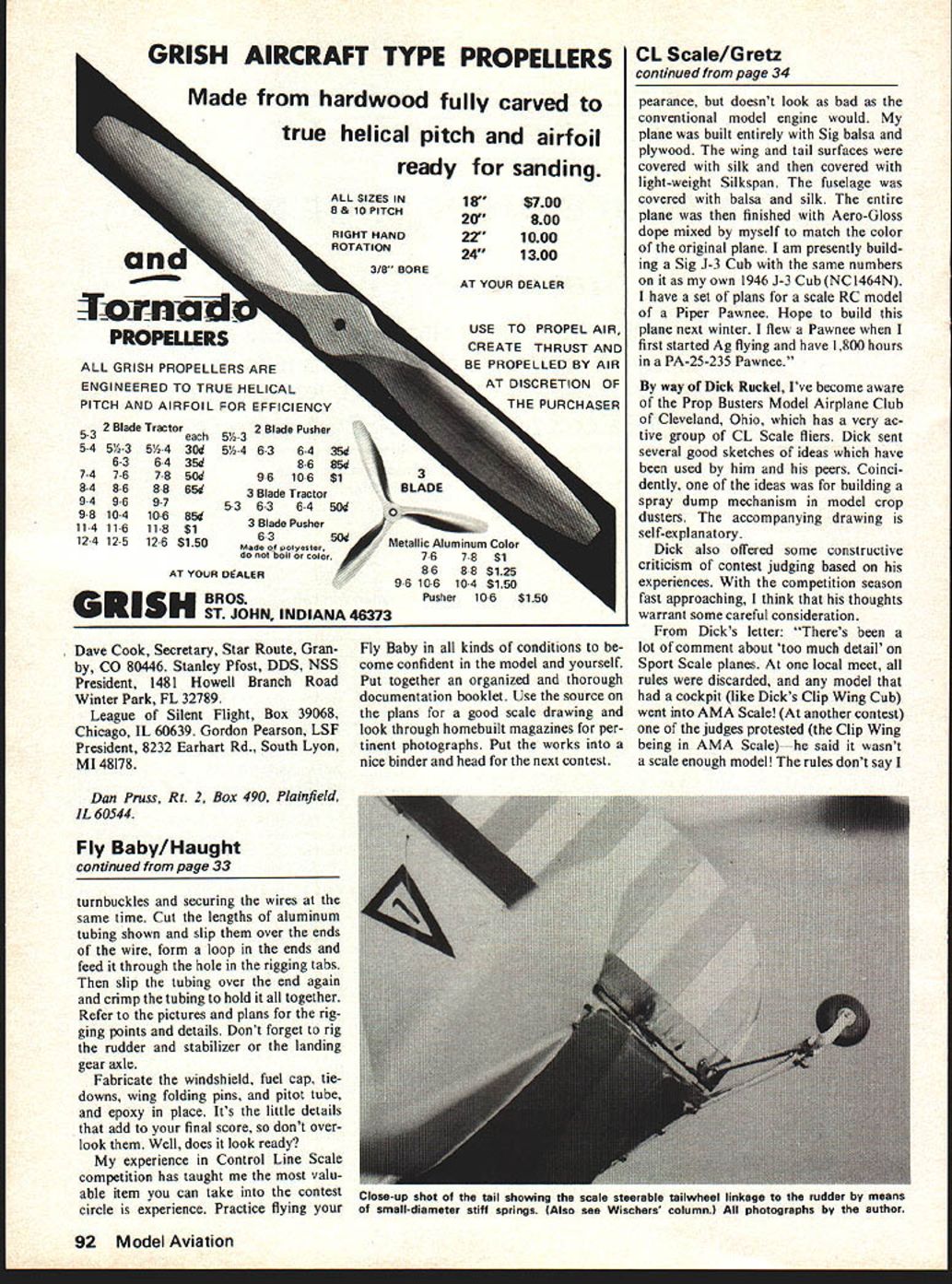
Ag planes that really spray "crops" become possible with Dick Ruckel's Spray Dump Mechanism. The spray itself is only water tinted with food coloring. The diagram makes it clear enough.
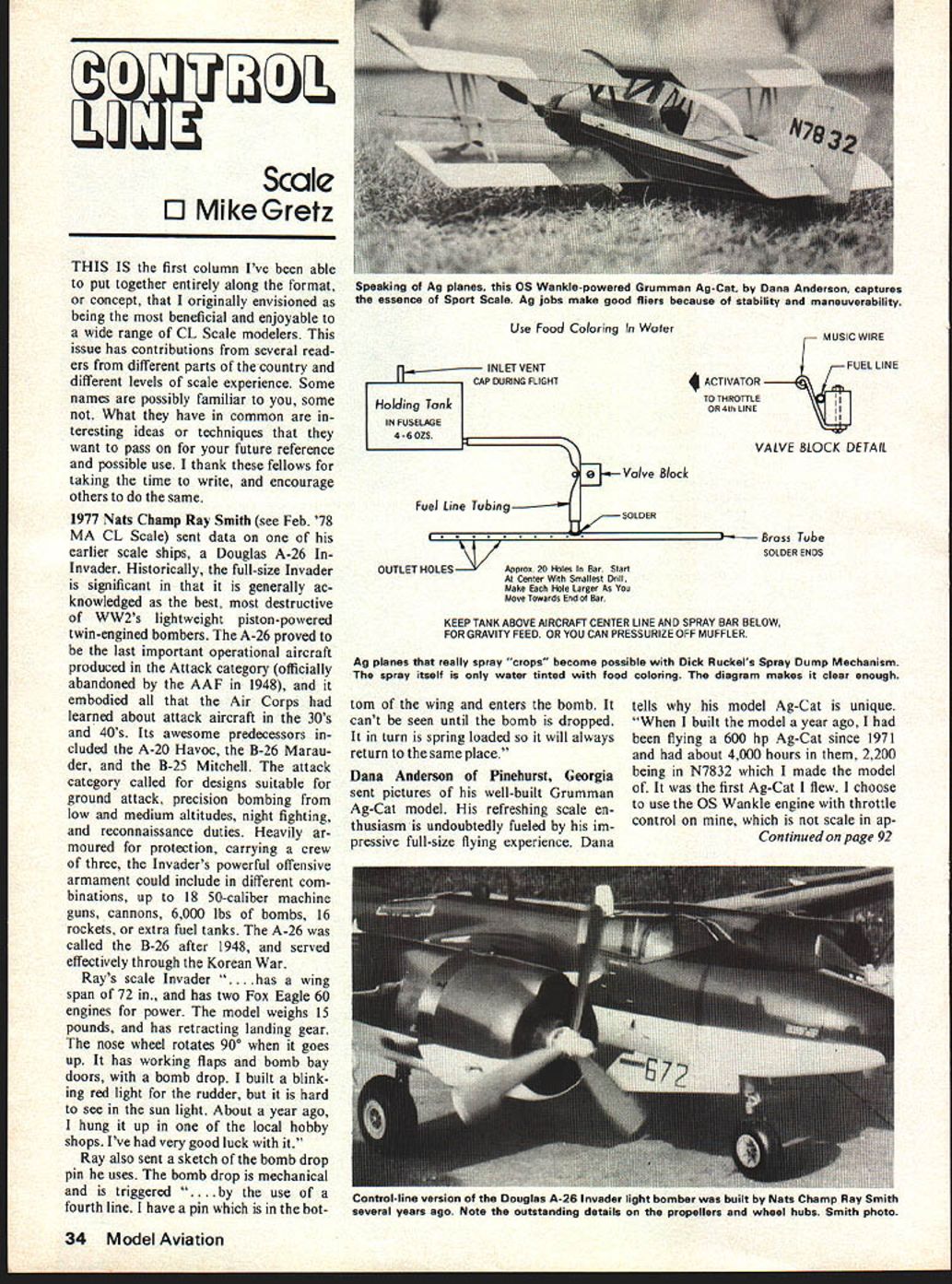
Dana Anderson of Pinehurst, Georgia sent pictures of his well-built Grumman Ag-Cat model. His refreshing scale enthusiasm is undoubtedly fueled by his impressive full-size flying experience. Dana tells why his model Ag-Cat is unique. "When I built the model a year ago, I had been flying a 600 hp Ag-Cat since 1971 and had about 4,000 hours in them, 2,200 being in N7832 which I made the model of. It was the first Ag-Cat I flew. I chose to use the OS Wankle engine with throttle control on mine, which is not scale in appearance." By way of Dick Ruckel, I've become aware of the Prop Busters Model Airplane Club of Cleveland, Ohio, which has a very active group of CL Scale fliers. Dick sent several good sketches of ideas which have been used by him and his peers. Coincidentally, one of the ideas was for building a spray dump mechanism in model crop dusters. The accompanying drawing is self-explanatory.
Dick also offered some constructive criticism of contest judging based on his experiences. With the competition season fast approaching, I think that his thoughts warrant some careful consideration.
From Dick's letter: "There's been a lot of comment about 'too much detail' on Sport Scale planes. At one local meet, all rules were discarded, and any model that had a cockpit (like Dick's Clip Wing Cub) went into AMA Scale! (At another contest) one of the judges protested (the Clip Wing being in AMA Scale) — he said it wasn't a scale enough model! The rules don't say I can't have cabin detail, they say the judges aren't to give points for it. If a guy wants to take a Nobler, and paint it like a Mustang, that's his business. But by the same token, if I want to take Sig's Cub kit, and end up with a model which looks like the original, and flies like it should—but does not conform to scale sizes, etc.—that's my business.
"We've spent months building our models to the rule book; it's imperative that it's used. If not, why bother building it at all? We don't need more rules—just more competent judging! Besides, nobody ever said the idea of the event was to give away trophies to anybody who thinks they should have one. If you build by the rules, and fly by the rules, you'll probably win by the rules. If you're not ready to accept that, don't enter the event! One last thought, lest you think we're a bunch of 'screamers' down here, we take a punch and learn from it."
I think Dick stated very well several important points. Anyone who competes in any competitive event which is based on human subjective judging can relate to Dick's experiences. Perfect judging is an ideal we strive for but usually don't achieve. It's a simple fact of life that different people see things differently. A competitor must learn to accept that basic fact (and the winners know this), follow the rule book to the letter, and demand that others do the same. Only then will we see an improvement in judging. Luckily, singled out examples of questionable judging have seldom discouraged a true competitor. Thanks to Sport Scale, we are noticing a steady increase in participation in CL Scale flying at contests.
Scale Grapevine:
Don't forget! The deadline for submitting AMA rules change proposals for the next cycle is Sept. 1, 1978. The procedure for making a proposal was noted in the Feb. '78 Model Aviation. Combined CL, FF, and RC Scale contests may be catching on. All three scale categories are being included at a St. Louis Scale Fly-In to be held July 2, 1978. The site will probably be Buder Park, according to Bob Underwood (4109 Concord Oaks Dr.; St. Louis, MO 63128) who can furnish more details. The Cleveland Prop Busters are busy with a catchy idea that sounds like fun. Quoting Dick Ruckel again: "Take a scale drawing from any magazine (like a Model Aviation spread) and build a profile—to size! Mount a .010 and have a ball. We even have one with a carrier hook!"
Mike Gretz, Box 162, Montezuma, IA 50171.
Transcribed from original scans by AI. Minor OCR errors may remain.

