
Control Line.. Scale.. Mike Gretz
ONE ASPECT of scale building that knows no seasons is scale documentation research. While you are building on one project, you can be collecting drawings, photos, magazine articles, etc. for your next subject. It's common among the more prolific scale modelers to be researching several airplanes at a time. Research can involve a years-long effort to document a rare bird for Precision Scale, or can be as quick as locating a kit and the appropriate Profile Publication for a Sport Scale model. It's sometimes frustrating, but always interesting and enjoyable. I've received several letters wanting assistance in locating sources of information on a particular full-size airplane. The help that I've been able to provide comes primarily from two books I'd like to recommend for your own, or your model club's, library.
The first is the "Scale Reference Guide", edited by Herman Luevano and published by R/C Modeler magazine. It lists by aircraft manufacturer, virtually every scale three-view drawing and scale model plan that has been published over the past 40 years in any of the U.S. model magazines, the Profile Publications series, or in the English magazine Aeromodeller. The "Scale Reference Guide" can be ordered for $4.50, plus $1 for postage, from R/C Modeler magazine: P.O. Box 487; Sierra Madre, CA 91024.
The second book is entitled "Museum and Display Aircraft of the United States" by Bruce W. Orriss. It lists each museum's aircraft, whether they are on static display, in storage, or under restoration. Along with the complete address and telephone number of each museum, it also lists their visiting hours, research facilities, and publications. And there are several pages of photos of some of the display aircraft. You can get "Museum and Display Aircraft of the United States" from its publisher, American Aviation Historical Society; Box 99; Garden Grove, CA 92642; for $4.95. Include $1 for postage and handling if you expect prompt delivery.
These two books can help get any scale documentation project off the ground, but they only point out the most likely directions to search. There are many other sources available to the scale researcher. I'll probably never be able to bring them all to your attention, but as I become familiar with them I will let you know what they have to offer.
Collect Air Photos, P.O. Box 14234, Milwaukee, WI 53214, represents the photo collection of aviation photographer, writer, and historian Leo Kohn. It's claimed to be the largest selection of airplane photographs ever cataloged and made available. Their catalog lists all types of airplanes: military, civilian, classic, contemporary, homebuilt, etc. The 2 3/4 x 4 1/4 glossy b&w photos are sold in standard packs according to subject aircraft. The number of photos per pack, and the price, vary. However, the price works out to about 24¢ per print, which is a real bargain. Send $1 for their 16-page catalog.
Control Line: Scale
CA 92345 is another source of economical b&w photos that I've tried. Their selection isn't as extensive as Collect Air Photos' but theirs is a different type of photo service. They have a 14-page catalog which lists the individual photos with specifics, such as the aircraft's registration number and the attitude of the airplane in the photo. A 5 x 7" print costs $1, and an 8 x 10" is $1.50. Their catalog is $1.
An inadvertent transposition is what I did in the April column. Some of you probably noticed in the drawing of Dick Ruckel's engine shutoff, that the directions shown for high and low throttle are opposite that which is commonly used. If you use a standard G-S or J-Roberts handle and matching bellcrank, and your engine's throttle arm is (like most) below the throttle barrel, then normally high throttle will be forward and low throttle will be back towards you. Regardless of which direction you prefer high and low throttle to be at the control handle, just position the pin on the low side of the throttle lever when setting up for engine shutoff.
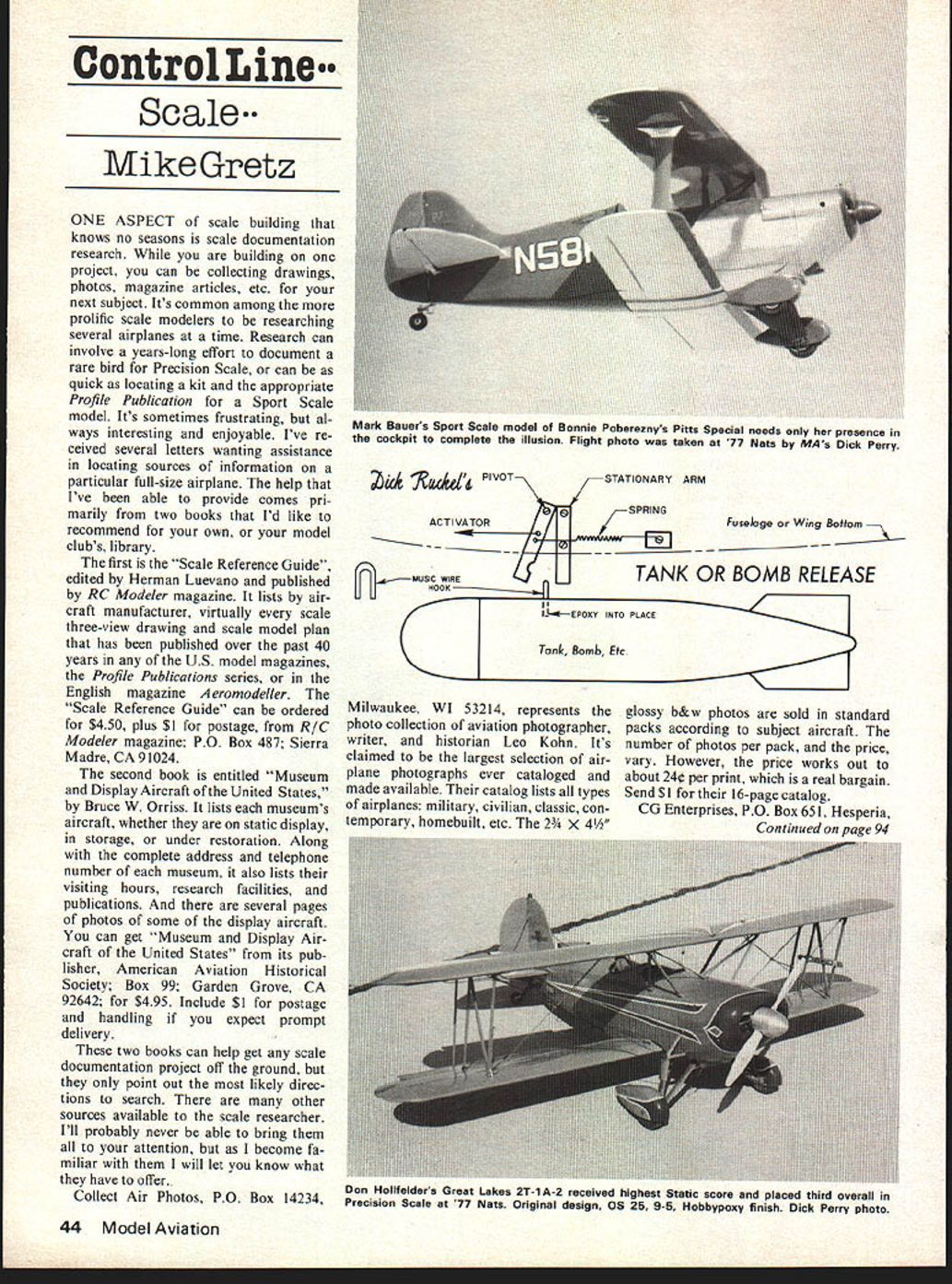
I wish that there were more CL Scale builders like Dick Ruckel, who were as eager to share their ideas by sending them in to this column. This month we've got another idea that Dick passed on from his scale colleagues of the Cleveland Prop Busters Club. It's a mechanical bomb release that can be operated off the engine throttle. Looks to me like it would work especially well for bombs, tanks, etc. that are pylon or shackle mounted under the wing or fuselage. The pylon or shackles would keep the bomb from swinging on the retaining hook. It takes very little movement of the activator to release the bomb, thus making this release ideally suited to operate off the throttle. You could use another pin, similar to that used for engine shutoff, on the extreme high throttle end of the handle movement. When you removed the pin, the bomb would drop.
Back by popular demand is Sig Mfg. Company's line of precision miniature bolts, screws, hex nuts, etc. These little items are indispensable when super detailing a Precision Scale museum type model. Most full-size aircraft, especially pre-1950 and homebuilt types, usually have many such details that are externally visible, and thus need to be reproduced on the model. Sig offers three sizes of bolts (00-90, 0-80, 1-72), each size available in 1/8", 3/16", or 1/4" lengths. There is also a choice of round, hex, flat, or oval fillister heads. In case you aren't aware, Sig also markets a line of 1/32" round and flat head rivets. You can get Round Head Aluminum, Round Head Copper, or Flat Head Copper rivets, all with 1/32" dia. heads, in packages of 100, 500, or 1000. Descriptions and prices for both the miniature bolts and rivets are now in the Sig catalog. The following chart shows some of the possible application of the rivets.
SCALE RIVETS (1/32" dia. head (.031" decimal size))
1½" to 1' scale model: .0234" .0312" 2" to 1' scale model: .0312" .0416"
Full Size Rivet Head Dia. 3/16" 1/4"
(Editor's Note: while MA ordinarily tries to soft-pedal commercial items, we allowed this Sig item to stand due to the highly specialized items, and the scale builder's need to know.)
Bill Pardue, Contest Director, extends his warmest invitation to all CL Sport Scale contest types to attend the United States Control Line Model Airplane Championships, June 17-18, 1978, in Winston-Salem, NC. This is the one and only AMA-recognized AAAA national championship event for CL Scale in 1978. Only the AMA-sponsored Nats carries more official recognition. Last year they drew 158 contestants from 20 states for all of the CL events. The flying site is a 12-acre, smooth asphalt parking lot, and the contest organization is top notch. If the Nats is out of your neck of the woods, consider the Control Line Championships as the place to be in '78. For more information contact Bill Pardue: 1201 Surry Drive; Greensboro, NC 27408.
Mike Gretz, Box 162, Montezuma, IA 50171.
Transcribed from original scans by AI. Minor OCR errors may remain.

