
Control Line: Scale
Mike Gretz
THE FOLLOWING is taken from a letter I just received from Mr. Bill Noonan, of San Diego, CA. "As you may have read or seen on TV, the San Diego Aerospace Museum became a victim of arson on the night of February 22, and sustained a complete loss of its entire collection, considered to be the finest in the U.S. after the Smithsonian's. The fire eliminated such remarkable aircraft examples and displays as a completely re-constructed (not replica) JN-4, Ryan ST, Ryan Fireball, Luscombe Phantom, Consolidated PT-1, Lockheed F-80, Ryan M-1, to name a few original aircraft. The flying replicas included Fokker AE-III, Sopwith Triplane, Spirit of St. Louis, Curtiss A-1, and a number of others."
"One of the most interesting planes they exhibited was a Zero, retrieved from a South Pacific lagoon about six years ago. I think the loss of the research library may be the greatest to scale model builders. The archivist, Bruce Reynolds, was constantly supplying modelers with info for scale stuff. It's tough to think of the complete set of Jane's as a pile of ashes, to say nothing of Model Airplane News, Flying Aces, Popular Aviation, Flight, and a bunch more that dated back to the early 20's. The Director of the museum, Col. Owen Clark, says the new museum will start from scratch."
"The success of the museum will be dependent to a great extent on response to appeals for donations. Col. Clark expressed interest in starting a chronological collection of models, possibly 1" = 1' scale, much as the Smithsonian has. The new building has a floor area in excess of 50,000 square feet, and a sizeable portion will be devoted to model display. Any modelers wishing to contribute may correspond with Col. Owen Clark, San Diego Aerospace Museum, Room 203 Casa del Prado, Balboa Park, San Diego, CA 92101."
"What a senseless tragedy. The Aerospace Museum's full-size collection included dozens of other unique and prominent aircraft which Mr. Noonan didn't list. To me, the museum turned out to be a good source of scale data on the historic Ryan line of airplanes which were built in San Diego. In fact, a couple of years ago my research for data on the Spirit of St. Louis acquainted me with Bruce Reynolds, who impressed me with his eager assistance. He came through with what I needed months before any of the other inquiries I had sent out."
One of the Ryan aircraft destroyed, literally the father of the Spirit of St. Louis, was the sole remaining example of a Ryan M-1 — now lost forever. The best way that most will be able to help is to spread the word that the new museum is looking for donations of full-size aircraft, models, and aviation artifacts to begin their new collection.
Control Line: Scale
Mike Gretz
The Current Sport Scale Rules (sect. 6.5a) allow a contestant to substitute a scale-like propeller for his regular flying prop during static judging. This recognizes that, even though the propeller is not visible in flight, it is just as significant a part of an aircraft's identity as the tail, landing gear, canopy, etc. A 2-bladed 11" dia. flying prop on a P-51 (scale is 4 blades), or on a model Corsair and GeeBee racer with a 9" dia. radial cowl, looks ridiculously inappropriate and can thus diminish the appeal of such subjects. In fact, if you weren't allowed to use a more scale-size and color-display prop, airplanes such as these would be at a distinct disadvantage during static judging.
The follow-up section (6.5b) of the rules requires that the flying spinner be the same size, shape, and color as the spinner presented for static judging. It's based on the premise that to allow a change to a completely different style of spinner — to facilitate using a starter, or for whatever reason — would also be unfair to certain subject choices. Normally, the color and outlines of the spinner are still clearly visible even when it is revolving. Nobody would like to see a J-3 Cub flying around with a 2" spinner hanging on the nose. If your full scale subject didn't use any type of spinner cone — just a prop hub, crankshaft, and a lot of bolts — the rules do require that you use some sort of a rounded "acorn" prop nut for safety. These interrelated rules provide for all different aircraft subjects to be viewed to equal advantage during static and flight judging, which is a problem and goal inherent in all scale events. How much of a burden is it to produce an adequate scale prop to make your Sport Scale model competitive under the current rules?
In almost all cases, the diameter of the flying prop will figure out to be several inches smaller than the diameter needed for an accurate scale prop. In Precision Scale it is usually necessary to meticulously carve a scaled-down replica out of balsa wood. That sort of time-consuming effort isn't called for in Sport Scale. From 10 feet away only the number of blades, the relative size of the blades, and the general colors are noticeable. I've found that most of the time a good Sport Scale prop can be made by modifying a stock commercial wood prop!
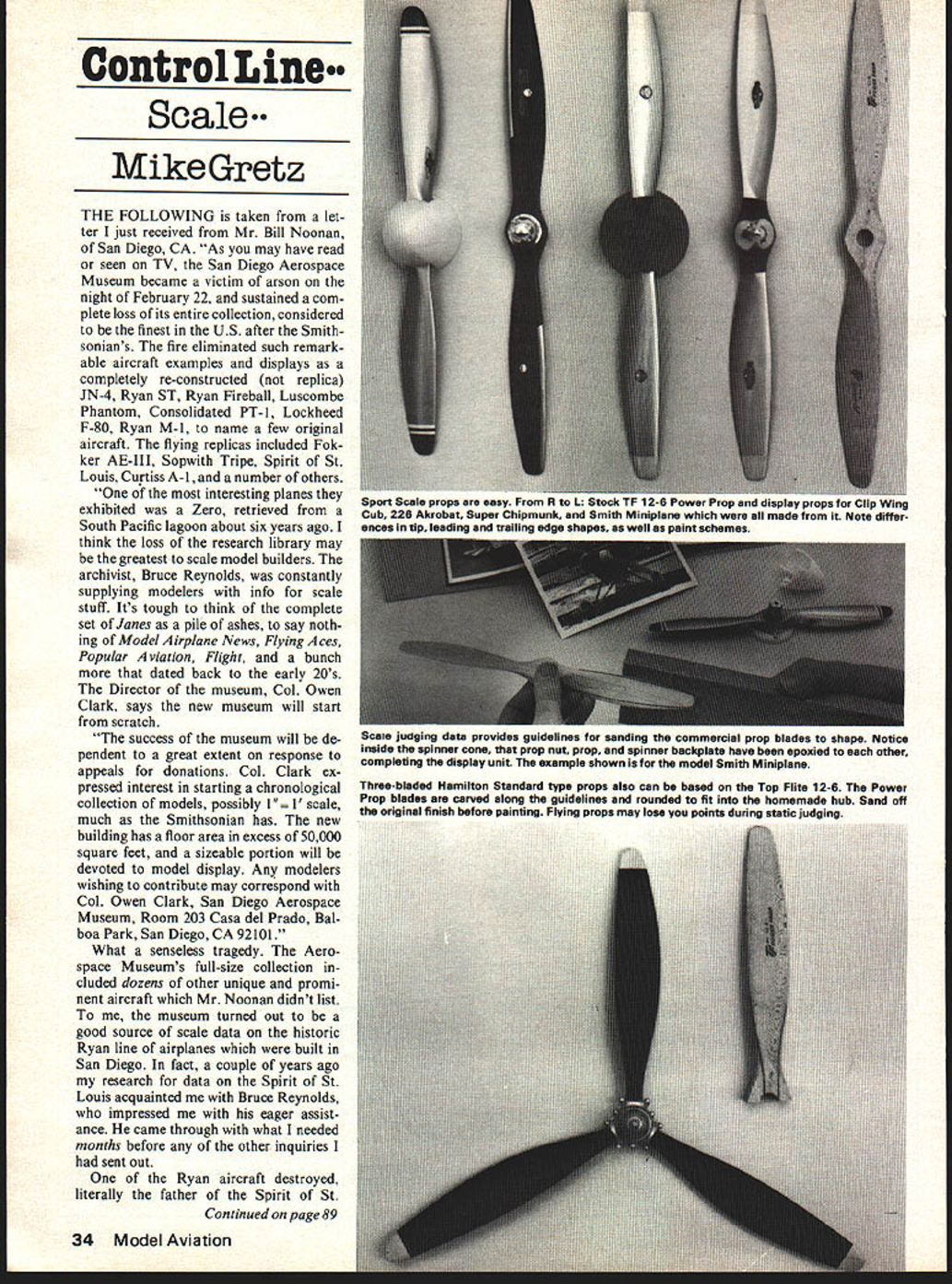
The accompanying photos show some of the possibilities using a Top Flite 12-6 Power Prop. The first step is to decide what size commercial prop best fits your needs. Carefully study the photos and/or drawings you will use in your presentation — this is what the judges will be going by. I've found that props with a pitch of more than 6" will usually appear too thick when painted, but it will depend primarily on the scale of your particular model. Most commercial wood props within a few sizes of each other have essentially the same width and length hub area. If you don't know the actual scale length needed, look for a prop of sufficient diameter to look right, primarily in relation to the cowling and ground line.
Sand all of the finish off the prop with medium grit sandpaper. Now, by modifying the tip shape and adjusting the planform of the blade's leading and trailing edges with a sanding block, the character of many full size propellers can be captured. It's best to draw guidelines on the blades and sand down to them. That makes it easier to get both blades the same. Don't worry about balancing, since this prop will never be used for flying or even running the engine. When satisfied with the shape that you've created, taper and re-round the leading and trailing edges with the sanding block. Then sand the entire prop smooth again with medium grit paper. Brush on 4-6 coats of thinned clear dope, sanding between coats with fine sandpaper. When you have built up a smooth, clear dope base and haven't sanded through to the wood anywhere, you can start painting on the colors.
It's best to spray the color and final coats of dope, especially colors like silver, but a satisfactory job can be done with a brush if you remember these basic rules. (1) Thin the color dope adequately to allow it to flow on smoothly. (2) Always brush from a dry area into a wet area. (3) Keep brush strokes to a minimum. After the colors are dry, spray several coats of clear dope overall. All of the props shown in the photos are painted flat black on the back of the blades, as is scale in each case.
For mounting the display prop, I prefer to epoxy an extra prop nut permanently to the prop hub. If yours includes a spinner, you can hide the prop nut inside of it. If yours has a spinner nut, as the Clip Wing Cub and Super Chipmunk props show, epoxy the nut right onto the front of the hub. Thus, when the ratty, scarred flight prop, spinner, and/or nut are removed, the immaculate display prop assembly is simply spun onto the engine shaft to do its job.
PLEASE DON'T FLY NEAR ELECTRIC POWER LINES!
Mike Gretz, Box 162, Montezuma, IA 50171.
Transcribed from original scans by AI. Minor OCR errors may remain.

