
Control Line..
Scale.. Mike Gretz
"CAUTIOUSLY, a small but proud Frenchman made his way through the crowd of a model airplane World Championships holding his masterpiece high overhead. He strutted out onto the runway, gently setting it down as a ray of early June sun bounced off a glimmering blue and white color scheme. Carefully wiping off a microscopic piece of dust that he thought he saw. All ready to show the captive audience that it flew as good as it looked. He went over to the judge and after what looked to be a short but heated argument, he stormed back to his beauty, wound up his foot, and gave it a good swift kick."
That's the way Jeff Gretz, my brother and pitman at two WCs, described an incident we witnessed in Sweden in 1976. It may sound like make-believe, but it actually happened that way. A more vivid example of how unthinking people can become under pressure would be hard to find. Some of the pressures you'll feel at a contest are normal and even stimulating, while others are entirely man-made and unnecessary. Don't let these man-made pressures turn you into your own worst enemy during competition. Hotheads don't win prizes!
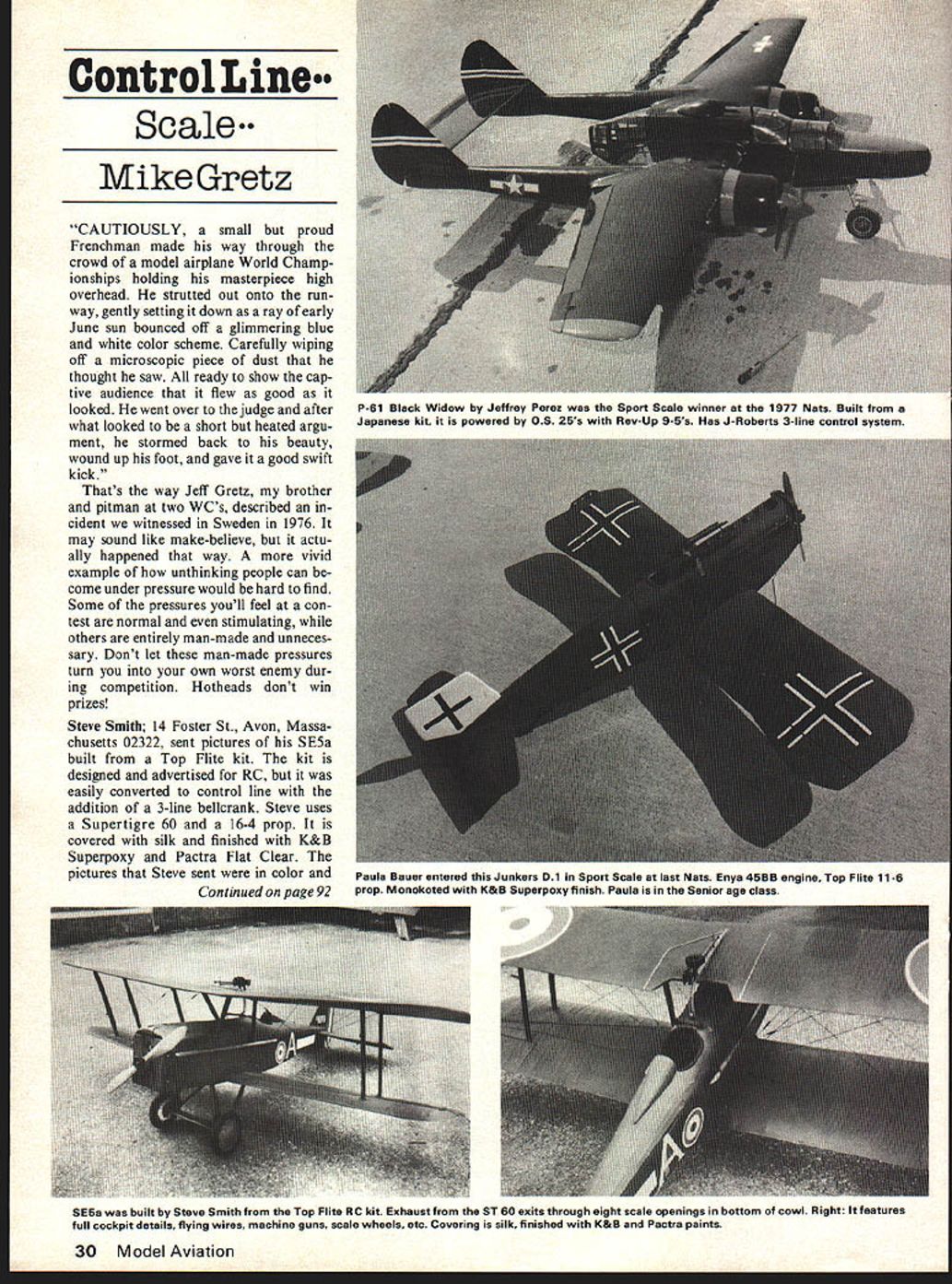
Steve Smith; 14 Foster St., Avon, Massachusetts 02322, sent pictures of his SE5a built from a Top Flite kit. The kit is designed and advertised for RC, but it was easily converted to control line with the addition of a 3-line bellcrank. Steve uses a Supertigre 60 and a 16-4 prop. It is covered with silk and finished with K&B Superpoxy and Pactra Flat Clear. The pictures that Steve sent were in color and had to be rephotographed into black and white, thus losing some sharpness in the process. I hope that what you see here in the magazine adequately conveys the excellence of Steve's workmanship and scale details. Here is part of what Steve wrote in his letter.
"At first it was tough to fly, but with 4 oz. extra nose weight and correct deflection of the ailerons it flies great. I use a Tatone expansion chamber exhausting down into a chamber under the motor mounts. The exhaust leaves the plane from eight openings in the bottom pan. It has a full cockpit and the guns are Williams Brothers. I plan to enter a few contests with this plane—it's fun competing whether you win or lose."
Mine uses a Cox .15. Prop is a 9 x 3 or an 8 x 4 nylon one. The gas tank is mounted very easily by using two screw-eyes (opened up) and rubberbands, centered behind the engine. Check the C.G., adding weight as required. My plane is flown on 52' lines, .015" dia.
Flying: For your first flights use the outer hole in the control horn, since the plane's reactions will be milder than if the inner ones are used. Since the frontal area on a profile plane is small, the model really moves out under power.
After you start the engine and it is running to your satisfaction, move out to the center of the circle and double check the controls. When all is ready, give your partner the signal to release the plane. As it speeds along the ground slowly feed in a small amount of up, and as it takes off and reaches about 10 feet of altitude, level off. Move the handle gently and get the feel of the plane before you start more violent maneuvers. As you know, every model has different characteristics and rates of response. Know your model first before experimenting. When the motor stops, gradually feed in up as you get close to the ground for a perfect three-point landing.
I'm sure you will be thrilled to have and fly this historic and powerful looking model. Fully decorated it looks great.
A Test Flying Problem:
Ah, the thrill of test flying your new scale masterpiece for the first time—but what if something goes wrong? As in this recent case. "Last Sunday was the day. And guess what? I couldn't get off the ground! The Ryan weighs 8 3/4 pounds, Fox 60 with Perry carb and 14-6 prop—lots of power! The plane almost wants to stand on its tail when held vertically with engine running. Wheels roll freely. Balance for UC per the plans. But when the plane is released for take-off with the controls (elevator/flaps) at neutral, the plane noses over immediately and breaks the prop."
Incidentally, the flying field is close-cut grass, smooth enough for 15-size planes on up. I don't want to add weight to the tail to keep it down because of the 8 3/4 plus pounds, and the balance is basically OK. I'd never experienced this before. I talked to an experienced friend last night at the RC field. His solution was to give full up elevator (and with mine, this would also mean flaps down) to keep the tail down on taxi-takeoff until flying speed was almost obtained, then neutralize somewhat and come off and up to fly. Do you have any thoughts or suggestions?
If you've flown a taildragger type scale model before, you probably recognize the problem. Nine times out of ten, there is nothing at all wrong with the model itself. There is a tendency for all taildraggers to nose over at the start of the takeoff run and also at landing. I've done both with my Zlin Akrobat. What is needed is for the pilot to be retrained to more full-scale-like flying techniques.
A scale model has too much weight on its wheels and too high a thrust line and CG to take off as most non-scale control-line models do. If you attempt a "normal" control line style takeoff with full power (high throttle) and a quick release, a scale model will almost invariably end up nosing over. The engine is trying to pull the model forward from a point high above the wheels (as on a long lever), and the model thus starts to rotate around the wheels because of lack of airflow over the tail surfaces. On a paved hard surface runway, where the wheels can move more freely, the problem is lessened but not eliminated. Non-scale CL models can get away with a full power takeoff because they are usually very light, the thrust line and CG are low, and the landing gear can be moved forward without regard to whether or not it is scale.
A full-scale type takeoff is easier and safer for a scale model, as well as being much more impressive. Thus, it is doubly important for a CL scale model to be equipped with a throttable engine. The throttle is more than just an added gimmick to get contest points. It is another responsive and critical control requiring equal attention along with the elevator. Nose-over on takeoff can often be eliminated by: (1) Applying power slowly and smoothly. Note that full-size, high-powered Mustangs, etc., have been known to nose over if the throttle is advanced too quickly. (2) Hold full up elevator at the start of the takeoff roll. (Flaps down usually won't hurt at this point.) Gradually let off of the up as the plane gathers speed. At lift-off, you should hardly be holding any up elevator. Try for a slow, realistic climb-out. (3) Don't takeoff with the wind directly on your back. Start the takeoff down the circle slightly with the wind coming from over your left shoulder.
During landing, a scale model can have a nose-over problem similar to that seen during takeoff. Part of the cause on landing is the model's forward inertia rather than engine thrust, but the effect of each is similar. The CG is a long way above the wheels as is the thrust line. The things I try to remember while landing are: (1) Make a smooth, slightly flared (nose high) touchdown on the main wheels (don't worry about three-point), preferably downwind for best control. (2) At touchdown, you'll need some down "pressure" to keep the main wheels on the ground until the airspeed starts to "bleed off." Then, by experience, you must learn to tell exactly how much up elevator to hold, at first keep the tail from riding too high, and then to get the tail on the ground as quickly as possible without the model ballooning back up into the air.
Elevator position is also critical during the Taxi maneuver (one lap in the rule book). The requirements are the same as for a full-size airplane. While taxiing downwind (wind coming over the model's tail), you should hold down elevator to keep the tail wheel on the ground. Taxiing upwind (wind coming over the model's nose), hold full up elevator to keep the tail down. Taxi should be done at a slow enough speed so that the elevator position isn't overly affected by the model's forward speed. In other words, if you taxi too fast while holding down elevator, the airplane may nose over.
All these hints make it sound more difficult than it really is. Don't worry if you are facing your first CL Scale flight. I dare say that you haven't really enjoyed control line flying until you have held onto a large, responsive scale model. Find out for yourself!
PLEASE DO NOT FLY NEAR POWER LINES!
Mike Gretz, Box 162, Montezuma, IA 50171.
Transcribed from original scans by AI. Minor OCR errors may remain.

