
Control Line: Scale
Mike Gretz
The relatively new CL Sport Scale event seems to be gaining popularity in many parts of the country. When this event was introduced at the Nationals in 1974, it seemed like a colossal dud as there were only two entries. But by the 1976 Nationals in Dayton, Ohio, the entry had zoomed to a total of 36 among the three age classifications. Both experienced modelers and newcomers are discovering that Sport Scale can be just as exciting, while less demanding, and thus more to their liking, than Precision Scale.
I'm sure we will have Precision Scale class competitors and models on a national and international level for quite some time, but it's obvious that very few modelers are willing or able to devote the amount of time and resources that are required for that class of scale model. In reality, I think you'll find that the Sport Scale models (CL & RC) that are winning the local contests and Nats now are in about the same class, as far as amount of detail, as the models that were winning the regular CL and RC scale events about 10 years ago. It's great to see that more and more modelers are discovering the satisfaction and enjoyment of scale building through the Sport Scale event.
Jack Sheeks' Zero
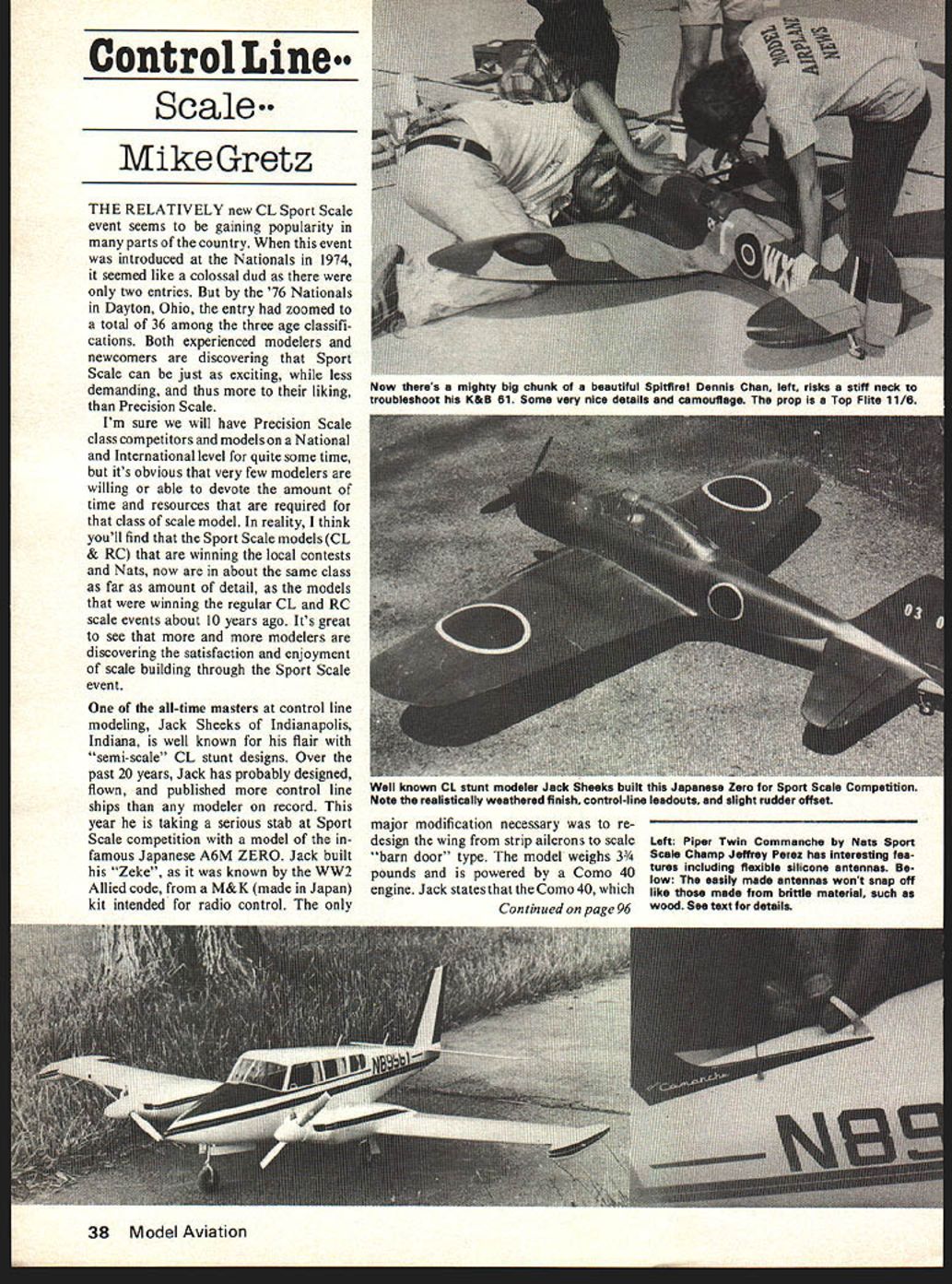
One of the all-time masters at control line modeling, Jack Sheeks of Indianapolis, Indiana, is well known for his flair with "semi-scale" CL stunt designs. Over the past 20 years, Jack has probably designed, flown, and published more control line ships than any modeler on record. This year he is taking a serious stab at Sport Scale competition with a model of the infamous Japanese A6M Zero. Jack built his "Zeke," as it was known by the WWII Allied code, from a M&K (made in Japan) kit intended for radio control. The only major modification necessary was to re-design the wing from strip ailerons to scale "barn door" type.
The model weighs 3¾ pounds and is powered by a Como 40 engine. Jack states that the Como 40, which is an Indy R/C exclusive item, is a very fine running engine equal to many which cost much more. The paint on his Zero is DuPont acrylic lacquer, hand-mixed to match the color 3-views and photos by Monogram Publications that Jack will use in his scale presentation. If you have any questions, contact Jack Sheeks, 8815 East 21st St., Indianapolis, IN 46219.
Championship Preview
As you may remember, the 1977 National Open CL Sport Scale Champion was Jeffrey Perez, of Larned, Kansas, with a P-61 Black Widow. Jeff, 27, is a hobby shop operator.
He recently sent in some information on his latest sport scale model. It is a scratch-built Piper Twin Comanche (PA-39) scaled to 1½" equals 1', which yields a 54" wingspan. It's powered by two OS .25 engines with 9.5" props and weighs about 4½ pounds. The throttle control is operated by one braided cable, with one end linked to each carburetor and the middle of the cable attached to the J-Roberts bellcrank.
The Twin Comanche features a flying stabilator just as on the full-size aircraft, which is based at the Larned airport. As is usually the case, Jeff found the aircraft's owner, Reed Peters, very enthusiastic in helping him get the measurements and photos that he needed. He reports that the Comanche flies very well, and he is currently building another one for his first attempt at Precision Scale.
The Commanche is finished with Silkspan and polyester resin, car primer, and Dulux enamel colors. With the Dulux, Perez prefers to use cellophane tape for masking the paint stripes and numbers. He notes, "The only thing to watch for is that you don't let the whole width of the tape adhere to the paint job or it may lift the paint with it when it is removed. You can use paper under half the tape (like body shops) or just double the tape over itself."
Silicone Antennas — Molding Technique
Another technique that Jeff mentioned in his letter that I find especially ingenious involves the three antennas on the Comanche's fuselage top and the thermometer on the windshield. He made a two-piece mold from polyester fiberglass resin, and then used colored silicone to cast the parts. The rubber antennas look realistic and are flexible so they won't break off every time they are inadvertently touched.
Perez's procedure for making the silicone parts is roughly as follows:
- Carefully shape a wooden plug of the actual scale part.
- Coat the finished plug with Sig Release Agent.
- Lay the plug exactly halfway down in a large pool of polyester resin to form one half of the mold. After the resin cures, pop the plug loose.
- Put the plug back in place in the first half, coat both the plug and the first half with release agent, and cover with more resin to form the second half of the mold. After the second half cures, separate the halves and remove the plug.
- When molding the silicone part, remember that silicone takes a long time to cure when it is thick or solid because it tends to skim over and seal itself off to the outside air. This problem can be beaten by drilling small air escape holes in the mold halves before filling them with silicone.
Mike Gretz, Box 162, Montezuma, IA 50171.
Transcribed from original scans by AI. Minor OCR errors may remain.

