
Control Line: Scale
Mike Gretz
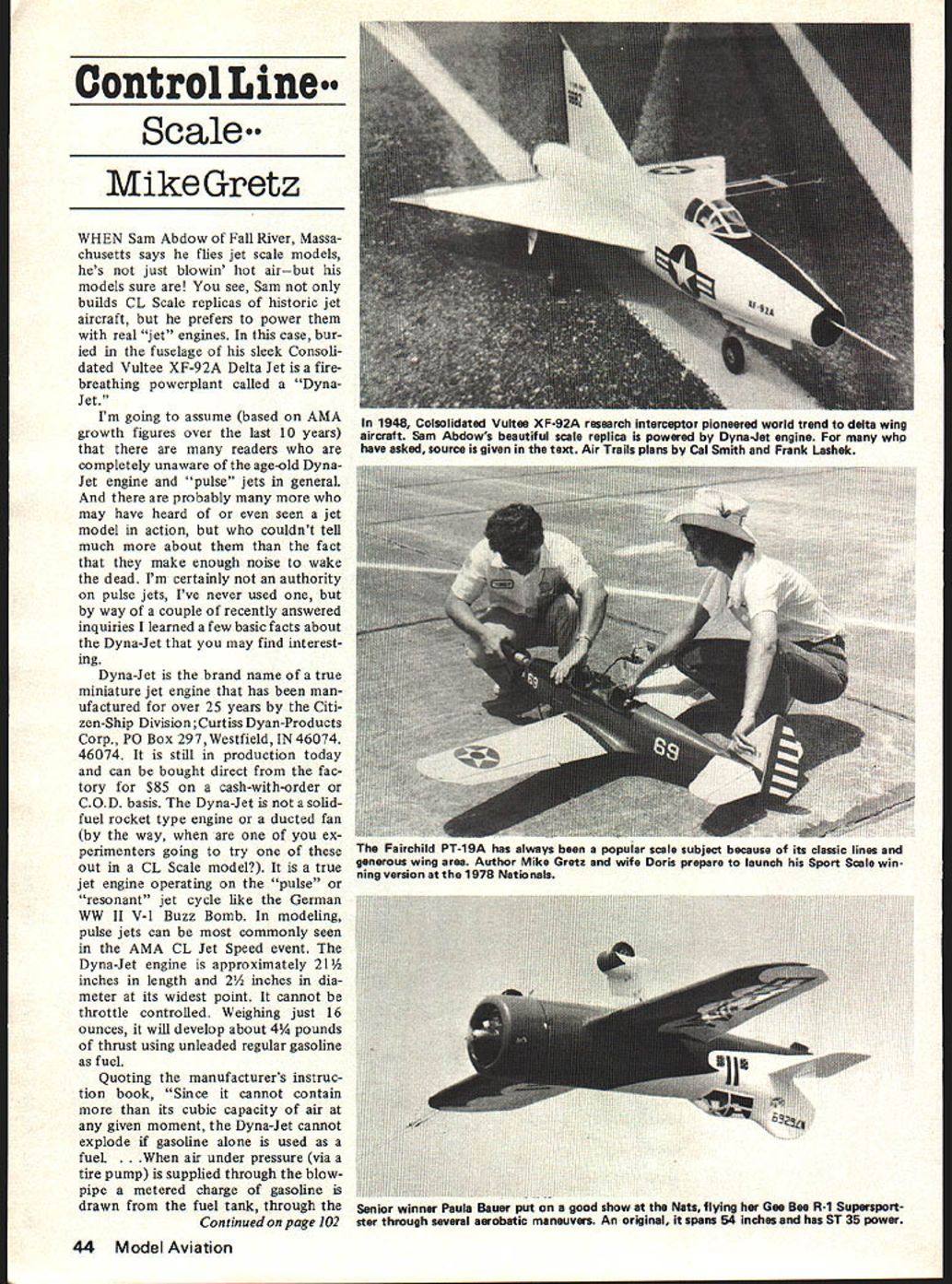
WHEN Sam Abdow of Fall River, Massachusetts says he flies jet scale models, he's not just blowin' hot air — his models sure are! Sam not only builds CL scale replicas of historic jet aircraft, he prefers to power them with real "jet" engines. Buried in the fuselage of his sleek Consolidated Vultee XF-92A Delta Jet is a fire-breathing powerplant called a "Dyna-Jet."
About the Dyna-Jet
Dyna-Jet is the brand name of a true miniature jet engine that has been manufactured for over 25 years by the Citizen-Ship Division, Curtiss Dyna-Products Corp., PO Box 297, Westfield, IN 46074. It is still in production and can be bought direct from the factory for $85 on a cash-with-order or C.O.D. basis.
The Dyna-Jet is not a solid-fuel rocket or a ducted fan. It is a true jet engine operating on the "pulse" or "resonant" jet cycle like the German WWII V-1 Buzz Bomb. In modeling, pulse jets are most commonly seen in the AMA CL Jet Speed event.
Specifications:
- Length: approximately 21½ inches
- Diameter: about 2½ inches at the widest point
- Weight: 16 ounces
- Thrust: about 4½ pounds (using unleaded regular gasoline)
- Throttle control: none (cannot be throttle controlled)
How it works (manufacturer's description)
Quoting the manufacturer's instruction book:
"When air under pressure (via a tire pump) is supplied through the blowpipe, a metered charge of gasoline is drawn from the fuel tank through the metering jet and then through the spray orifices. This metered charge is mixed with air. The resulting combustible mixture of fuel and air under pressure then opens the valve and passes into the combustion chamber. Here it is fired by the spark plug which receives its initial electric impulse from an external spark coil. The pressure resulting from the combustion closes the valve and sets up a pressure wave in the tail pipe of the engine. Once the initial charge has been inducted and fired as above, the operation is automatic. No further external forced air supply or spark is required.
"The pressure wave set up in the exhaust pipe by the firing of the initial charge is of a cyclical nature. It first becomes a negative pressure, drawing another metered charge of gasoline and air through the valve and into the combustion chamber. It next becomes a positive pressure, closing the valve and firing the new charge with the aid of hot gases remaining from the previous combustion. The process is repeated automatically at the rate of 220–240 times per second as long as gasoline and air are supplied."
Sam Abdow's XF-92A Delta Jet
"My XF-92A weighs 6½ lbs. complete. It flies approximately 21 laps at a speed of 85–90 mph. I built the model in 1974 using an old set of plans from Air Trails magazine, 1954. The scale is 1 inch to the foot, it has a wingspan of 31 inches and is 44 inches in length. It's built on a crutch using plywood formers and balsa planking. It's finished in Aero-Gloss white with Air Force markings.
"The model is lined internally with one layer of asbestos paper and two layers of heavy-duty aluminum foil (Reynolds Wrap), using water-glass as an adhesive. Around the Dyna-Jet is an aluminum shroud .020" thick. There is 1/4" space between the Dyna-Jet and the shroud, and approximately 1/2" between the shroud and the insulation. This is to keep the model from catching fire. Water-glass is an adhesive that will not burn."
As of this letter, the model has over 100 flights with no problems. I need a pit crew of three people to start the jet: one holds the model, one presses the button (to the spark coil), and one operates the air pump. I stay at the handle, and it is always airborne within two minutes. When the ship lands, I open the hatch and pump air around the Dyna-Jet to cool it down.
"I have been building scale jets since 1954. I flew the XF-92A demo at the Aeromodeling (Scale WC) in 1974 at Lakehurst, New Jersey. In April 1978, I flew my model at an RC and CL show at Teterboro Airport where Jay Gerber from AMA HQ took a film sequence of the jet. I hope it will be in the new all-scale film he is making. If anyone needs information or assistance with scale control line jets, they could contact me by mail."
Contact: Sam Abdow 682 Eastern Ave. Fall River, MA 02723
Drowning Your Sorrows (repair tip)
I'm not sure which Murphy's Law it is, but during construction—before finishing—your new scale model will probably receive unpretty little dents and dings in the bare balsa. Pencils and screwdrivers falling out of shirt pockets, slipping metal straight edges, table corners, etc., seem to have a knack for messing up your work. Call it hangar rash; I'll call it aggravation.
If the dent is not too large or on a thin trailing edge, and the balsa is not displaced but only pushed in, a little water will often restore the wood to its original shape. Apply a healthy portion of water directly to the dent—don't wet the entire area or you'll risk warping. A few hours later, after the water has evaporated and the balsa has puffed back up into shape, use very fine sandpaper to finish off the surface. Don't expect major miracles, but try it next time you find a small dent. It's amazing!
On Nats coverage and inspiration
A couple of months ago I said something about Nats and WC magazine coverage and its relevance to modelers who weren't there. In a recent letter, Nats competitor Jeff Perez wrote about his thoughts on this. I'm sure most competition-oriented modelers can relate.
"Before I started flying at the Nats, I would dwell over the Nats coverage in all of the magazines for hours. There was, and still is, a magic that comes up at you from the pages. It was inspiring. It was motivation. It gave me the inspiration to want to get out and become another Stott, Gretz, or Platt. Remember at Lake Charles when I told you how I had wanted to whip Stott because he was the hottest thing on wheels back when I got started? Well, you see? That's what Nats coverage does! The Nationals are magic. Everything about the Nats is magic, and it always will be. I believe that even now competitors are inspired, whether they realize it or not. I was!"
I was, too, Jeff—only the "big boys" for me a few years ago had names like Keith, Burnstine, Harney, and Violett. It's exciting to think that there are guys out there right now planning to "knock us off"—in a friendly way, I hope. That's what makes competition fun—win or lose.
Mike Gretz Box 162 Montezuma, IA 50171
Transcribed from original scans by AI. Minor OCR errors may remain.

