
Control Line: Scale
Mike Gretz
In the November 1978 Model Aviation you will find two photos on page 45 of a scale model which is related to part of this month's column. We're referring to the beautiful scratch-built Japanese Betty bomber constructed by Ken Long of Whittier, CA. While this is a championship-caliber precision scale model in every respect, those who saw it at either of the last two Nationals will undoubtedly remember its interesting performance on the flight line as among the most exciting of its kind.
Multi-engined military bombers and fighters have always been strong favorites in CL Scale events—much more so than in Free Flight or Radio Control—due to the CL point structure and the limits imposed on a typical scale model's aerobatic performance by the confines of the CL flight circle. Ken's Betty embodies all of the desirable characteristics of this subject: good airfoil, wing area and moments, plenty of power, and a multitude of possible "mechanical" scale options. One added dimension to Ken's model is the intriguing way he uses his mechanical flight options to tell a story. It takes realism in flight one step further than most. In fact, to fully understand the realism depicted in Ken's flight plan we should look briefly into part of the full-scale Betty's combat history.
The Full-Scale Mitsubishi G4M "Betty"
The Mitsubishi G4M Type 1 Land Attack Aircraft (allied code named "Betty") saw action in every Pacific theater of World War II from the Aleutian Islands to Australia. The Betty was one of the primary weapons with which Japan gained many of its initial victories. During the early stages of the war, it was identified among the most feared of Japanese offensive combat aircraft. But, like the infamous Zero fighter, the legend was soon proved to be part myth.
Japanese insistence on maximum range (and maneuverability for the Zero) at the expense of protective armor rendered the Betty supremely vulnerable to air and ground fire. The earliest versions of the Betty carried more than 1,100 gallons of fuel in immense but totally unprotected wing tanks, earning her the nicknames "Type 1 Lighter" and "Flying Cigar" from her own crews. Later versions incorporated add-on attempts at armor, but for the most part the Betty always retained her notorious inflammability.
The G4M2e and the Ohka
One special version of the Betty, designated G4M2e, is the subject of Ken's model. It was built in limited numbers to be the parent aircraft for the Ohka (allied code named "Baka") rocket-powered suicide bomb. The Betty normally approached to within 20–40 miles of the target and then launched the Ohka at about 200 mph. The kamikaze pilot attempted to glide at about 230 mph to within three miles of the target before igniting the rockets and plunging down at rocket-assisted speeds in excess of 600 mph. The noted vulnerability of the Betty, and its slow speed and unwieldiness with the Ohka aboard, enabled Allied fighter interception to shoot most of them down on these ill-fated missions, and they were soon withdrawn from service.
Ken's Flight Realism
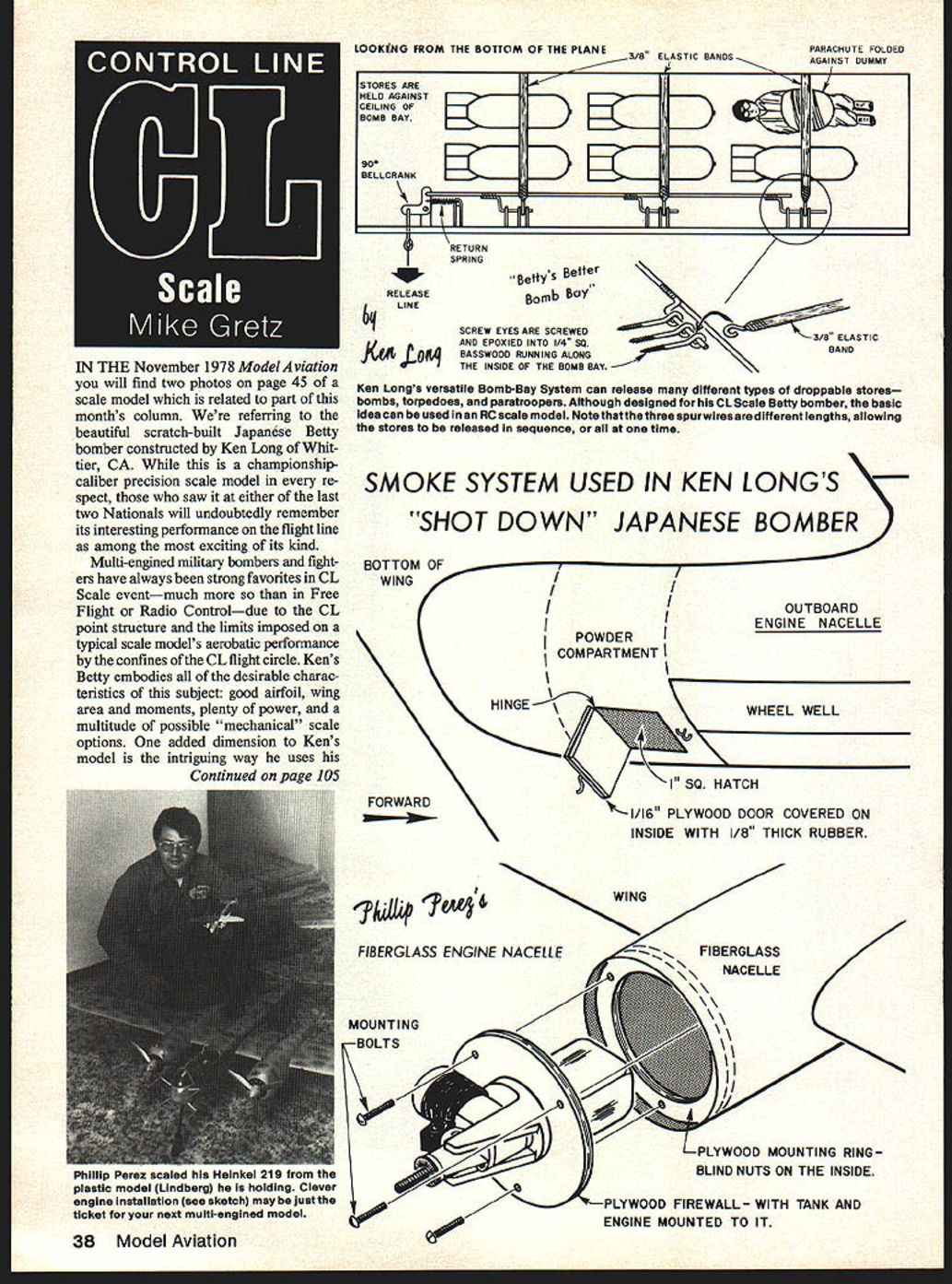
In flight, Ken's Betty recreates the scene starting with the launching of a gliding Ohka bomb. Then the appearance of smoke and several parachuting crew members signal the Betty's demise at the hands of the Allies. (Come on, you didn't really expect him to crash it, did you?) The heart of Ken's replica is the clever internal bomb bay release mechanism that he devised. Five different kinds of droppable stores can be released from the bomb bay, duplicating the capabilities of the versatile full-scale Bettys. The basic ideas behind this system give it great potential for use in many other scale subjects, and it could easily be adapted to an RC scale model. Ken's letter describes the working details.
Ken's letter: "The main wire runs parallel with the fuselage on the inboard side of the bomb bay. Elastic bands are glued with epoxy to the opposite side of the bomb bay. Small eyelets are wrapped with thread and epoxied to the other end of the elastic bands. The bands are then stretched across the bomb bay and the spur wires are put through the eyelets one at a time beginning with the longest wire. The droppable stores are put in under the elastic bands. A slow pull on the fourth line will release the stores, one at a time in sequence. The beauty of using the elastic bands in the bomb bay is that they will facilitate all different sizes and shapes of droppable stores and they will hold fast. Even parachutes folded against the dummy figures will hold until released. A torpedo can be carried using the first and last bands only, released with a fast pull on the release line. It has functioned flawlessly!"
Smoke System
The smoke is baby powder released from a compartment aft of the wheel well in the outboard engine nacelle. A one-inch square hatch is at the bottom. The cloth-hinged hatch door is 1-1/4" square with 1/8" thick soft rubber epoxied to the inside surface to make a seal to prevent the powder from escaping until the release pin is activated. The air moving past the open hatch and the engine vibration shaking the powder down will expel every last bit of the powder. I've found that four ounces of baby powder coming through the one-inch square opening, with 60-foot lines, traveling at a reasonable close-scale speed, will last for about two rounds. Of course, more powder—more rounds.
Transcribed from original scans by AI. Minor OCR errors may remain.

