

Control Line: Scale
Mike Gretz
My January and February 1979 columns dealing with CL scale basics have drawn the best response of any I've done so far. It's obvious that we need to continue in this direction and shed some light on more of those areas that tend to be taken for granted. We'll start this month by looking at one recent letter and I'll put in my comments and suggestions as we go.
Letter from Chris Genna
Chris Genna, of Astoria, Oregon, wrote:
"I am what you might call a novice modeler and haven't competed in any event yet, but I'm leaning toward scale as a main interest. So I was delighted to see your article in the January MA about converting RC scale kits to CL. As I get ready to take what I consider to be a first step toward scale, I have some questions about my particular situation.
"I've got a House of Balsa 1/4 A FW-190. I don't think this plane is suitable for throttle, at least not with a TD .049 or .051, and I plan to skip a lot of detailing and so on. But I want the thing to fly as well as possible in our Sunday sport flying and yet look like a prototype aircraft. I'm not contemplating entering this plane in even a 'stand-way-off' scale event.
"My questions are these: Does what you said about power—that the engine size stated on the box is okay—apply to kits this small? Some of my flying buddies think I'll need more oomph, like perhaps an .09. I don't know what they base this on, just gut reaction I guess."
Reply to Chris
Since I've never built a House of Balsa FW-190, I can't predict exactly how it will perform on control lines. But I can give you my own "gut reactions" about how I would go about it if I were in your shoes. It's an interesting project with some exciting possibilities.
Kept extremely light, with no throttle or extra detailing, you may end up with a CL version of Peanut Scale. I would lean toward a strong but light engine like a Cox TD .051 or .09. In fact, the TD .09 is about the lightest engine of its size that I know of; it might be the best choice.
Don't be too concerned about needing extra power to overcome the drag of a full-bodied fuselage. Guys often make the mistake of assuming that a full-bodied scale model will have a lot more drag than a slim profile type. But there are a lot of cases where a "dirty" profile model—with pushrods, engine, tank, etc., hanging out all over the place—would have as much or more drag than a scale model.
Just remember that the increased scale cross-section (frontal area) won't affect your model's performance to any great extent unless it is accompanied by an increase in weight. Look at the full-scale Gee Bee racers; they relied on smooth contours to overcome their huge frontal area. The Wing Loading (weight-to-wing-area ratio) and the Power Loading (weight-to-thrust ratio) are the keys to good flight performance. Wing loading in particular is the real difference between a CL stunt model and a CL scale model—much more so than drag or frontal area. Al Rabe's well-known stunt models are a good recent example.
So keep your Focke-Wulf as light and aerodynamically clean as possible, and be sure to use braided steel control lines, as opposed to 1/4A Dacron lines, for minimum drag.
Chris' questions about dihedral and ailerons
Chris also asked: "Would it be desirable from a stunting point of view to eliminate some or all of the three inches of dihedral the plans call for? I know it would remove a lot of the scale appearance, but might a flatter wing improve control line flying by a beginner? Could or should the RC ailerons be completed as CL flaps?"
I would choose some photos and a three-view drawing and use the scale amount of dihedral; House of Balsa may have increased the dihedral for RC flight. Again, you can look at some of Al Rabe's stunt models as recent proof that dihedral in itself doesn't hinder stunt ability.
Is the wing removable on this model, Chris? If so, I wouldn't make mine that way. Building the wing into the model could save a little weight, and access to the inside of the fuse isn't as important as it is for the RC version. Likewise, if there are any removable hatches other than the engine cowl, I would build them in too. Remember, light weight is most important if you hope to stunt your scale model!
The only problem with using the RC ailerons as CL stunt-type flaps is that most of their area is near the wing tips, which could cause a rocking motion if their range of movement is too extreme. Nevertheless, I would definitely try using the ailerons as stunt flaps on a model of this type and purpose, but I would limit their travel to about 1/8 to 1/4 of the elevator travel for starters. In other words, at maximum elevator (45°) have about 15° of flaps. This slight flap movement shouldn't cause any trouble and may be the extra edge you need to enable your model to do some basic aerobatics.
Center of Gravity (C.G.)
Chris' question about dihedral brings up something I didn't have room to talk about in that January column. Most everybody can grasp that an aircraft has a fore-and-aft "balance point," and this is often mistakenly referred to as the center of gravity or C.G. Actually, center of gravity refers to more than that.
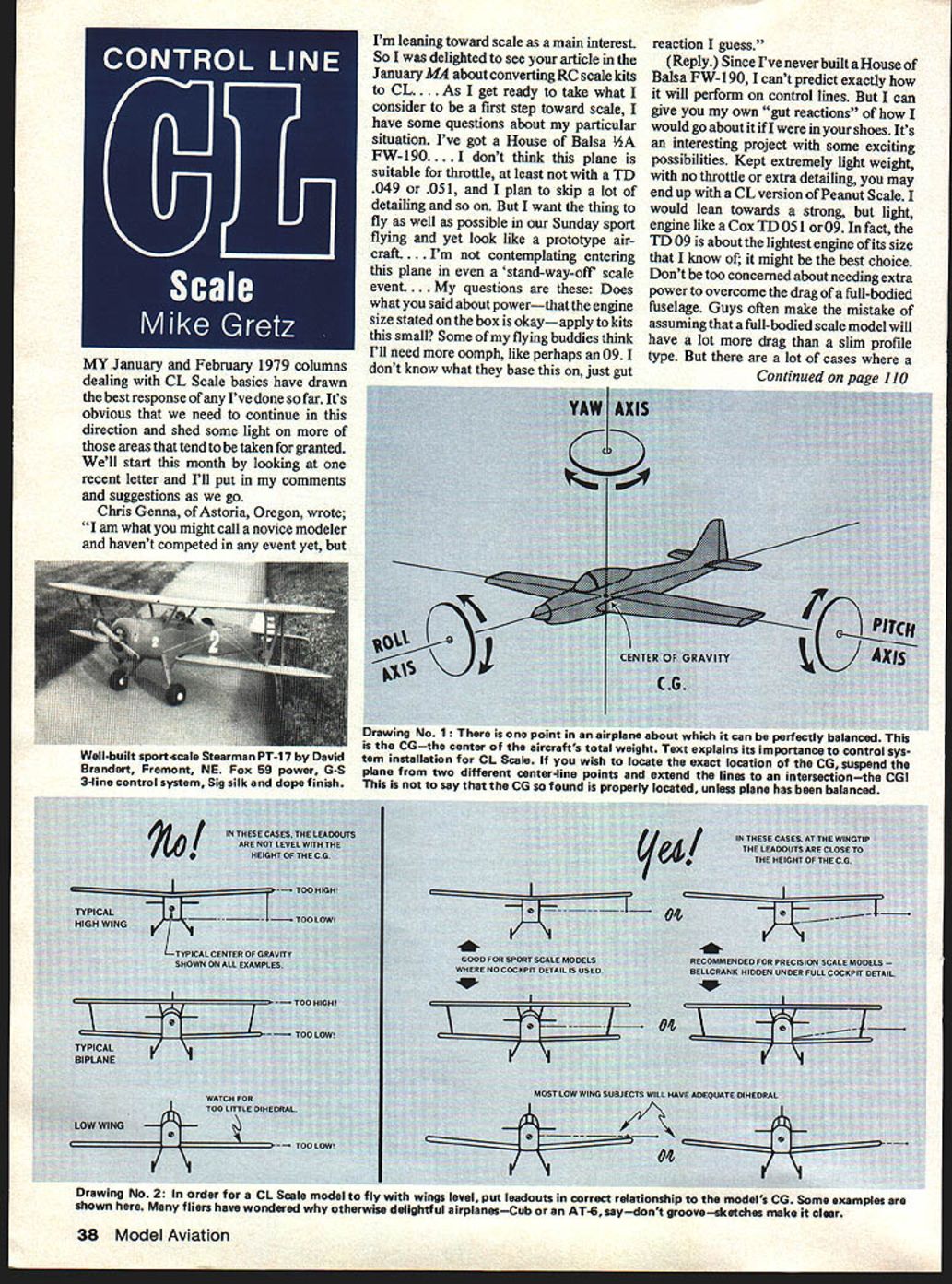
There is one point in an airplane, regardless of the airplane's attitude, about which it can be perfectly balanced, and this is the center of the aircraft's total weight. The center of gravity includes the fore-and-aft balance point as well as the balance points along the aircraft's other axes. All movements of the airplane in flight (pitch, roll, and yaw) revolve around the center of gravity.
In simplest terms, when flying a CL model you are tethering a full-fledged aircraft to circle around you. Naturally, you would ideally want to hook up right at the aircraft's C.G. We try to do that, but in actual practice we normally sweep the leadouts back at the wingtip just slightly from the C.G. to compensate for the extra drag of the control lines.
We discussed in the January column how to locate on the top view of the wing plan the leadouts' fore-and-aft location at the tip in relation to the model's C.G. (by way of the "average chord"). But we didn't get to the question of the leadouts' vertical location at the end of the wing and its relationship to the C.G.
To start, you can imagine what would happen if you hooked the control lines up to the model's nose or tail. It wouldn't fly very well, to say the least. Well, the same would be true (although not as extreme) if you hook up too high or too low vertically—like, say, at the top of the canopy or the bottom of the landing gear. The leadouts, as they near the end of the wing, should be approximately in line height-wise with the center of gravity.
Drawing No. 2 (described below) shows some basic examples for different configurations of aircraft. I don't know of any precise way to find, before the model is built, exactly where the C.G. is going to be vertically. But if you get your model's leadouts in the ballpark, it should cruise naturally in level flight at about shoulder height with the wings perfectly level to the ground without any need for aileron deflection.
However, it's a good idea to make the ailerons on your model movable just in case Murphy's Law #1 ("If it can happen, it will.") should come into play. They will look much more scale-like if they are hinged, and they can then be adjusted if necessary after test flying to compensate for any tendency for one wing to fly higher or lower than the other in level flight.
Drawing No. 1
There is one point in an airplane about which it can be perfectly balanced. This is the C.G.—the center of the aircraft's total weight. Text explains its importance to control system installation for CL scale. If you wish to locate the exact location of the C.G., suspend the plane from two different center-line points and extend the lines to an intersection—the C.G. This is not to say that the C.G. so found is properly located, unless the plane has been balanced.
Drawing No. 2
In order for a CL scale model to fly with wings level, put leadouts in correct relationship to the model's C.G. Some examples are shown here. Many fliers have wondered why otherwise delightful airplanes—Cub or an AT-6, say—don't groove; the sketches make it clear.
Mike Gretz Box 162 Montezuma, IA 50171
Transcribed from original scans by AI. Minor OCR errors may remain.

