
Control Line: Scale
Mike Gretz
Last-minute details are the topic of conversation this month. With me, all of those areas that we work on after a scale model is basically painted qualify as "last-minute details." I'm not talking about rivets, panel lines, and other microscopic details that are only important to the few who build Precision Scale models, but rather some often large and very commonplace components of full-scale aircraft which are very important to the appearance and realism of any class of CL Scale model. Things like a scale prop, wing walks, prominent external details, dummy exhaust pipes, landing gear struts, antennas, pitot tubes, etc. Details such as these play a big role in capturing the character of the aircraft you are trying to duplicate. They are normally not hard to reproduce but too often tend to be rushed at the last minute because of a fast-approaching contest deadline or sunny summer flying weather.
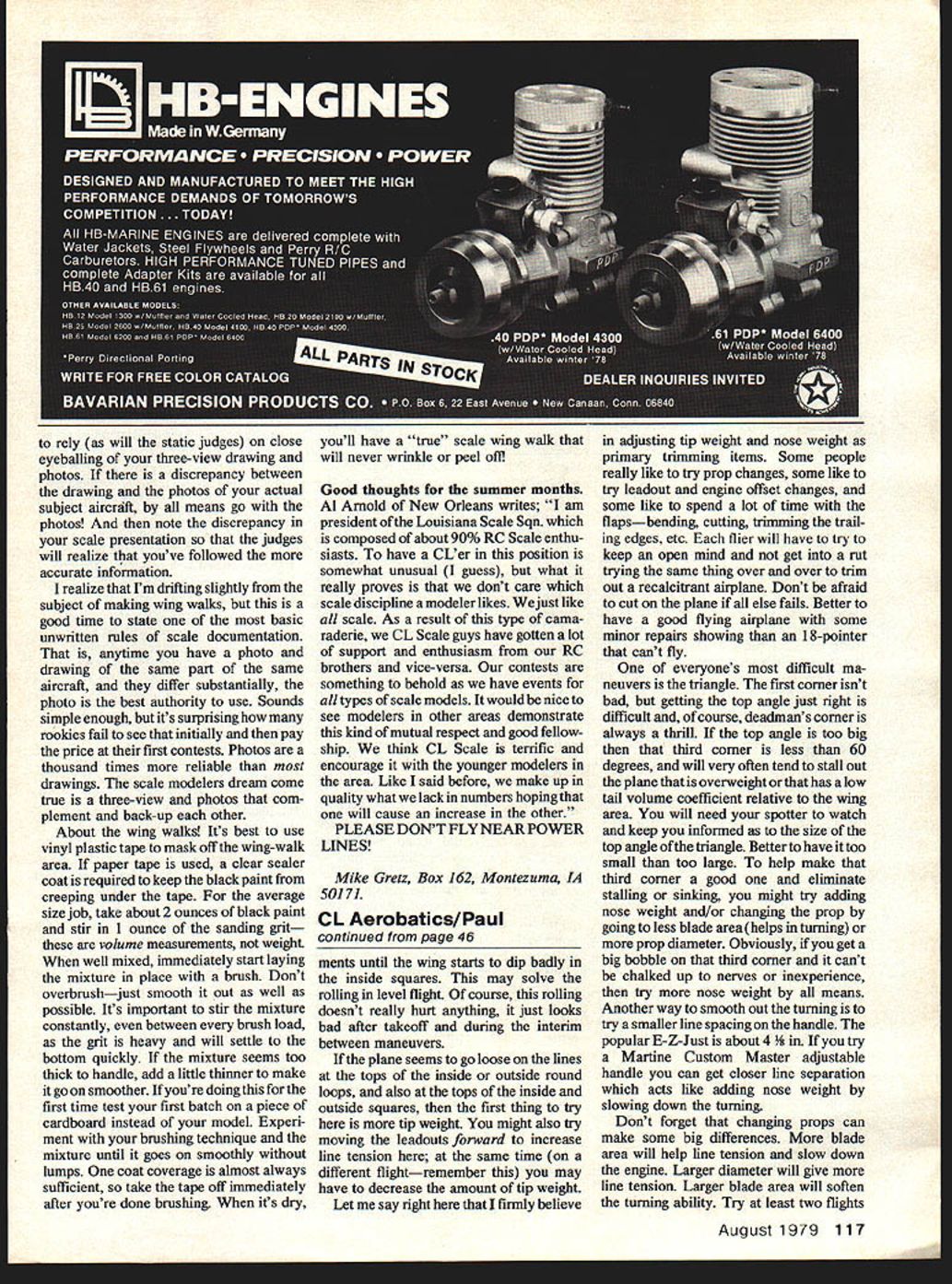
That's ironic because these are in effect the crowning touches to a scale model. Their importance shouldn't be underestimated as they can honestly make or break the scale illusion you are trying to create. For instance, a Stearman PT-17, or a Spirit of St. Louis, without dummy radial engine cylinders will plainly never look right. Nor would a P-51 or P-40 sporting a 2-bladed yellow nylon prop. And even the most liberal scale judge will turn off at the sight of naked wire landing gear legs. I personally believe that the nose, cockpit, and landing gear areas are the main focal points of attention when any scale model is first viewed. Out of habit or whatever, this is where a judge, fellow competitor, or spectator will unconsciously look first in forming his initial impression of whether or not this model is complete and among the "cream of the crop."
In scale competition, think of these as your "high return" areas. In other words, since they are so visible, they can yield more points for the actual hours of work involved than some other areas of the basic structure. If a few of these important details are either absent, or just poorly done, it can detract from the basic airplane's overall impression to the extent that an otherwise good scale model can be made to look bad. I wouldn't go so far as to say that exceptional workmanship in these areas can make an out-of-scale or poorly constructed model score good static points, but doing a good job on these can make a nice scale model look exceptional. It's part of the artistry of creating a believable "Scale Illusion!" Like diamonds on a ring or chrome on a car, a few prominent details that are well done can make a Sport Scale model sparkle.
True Grit:
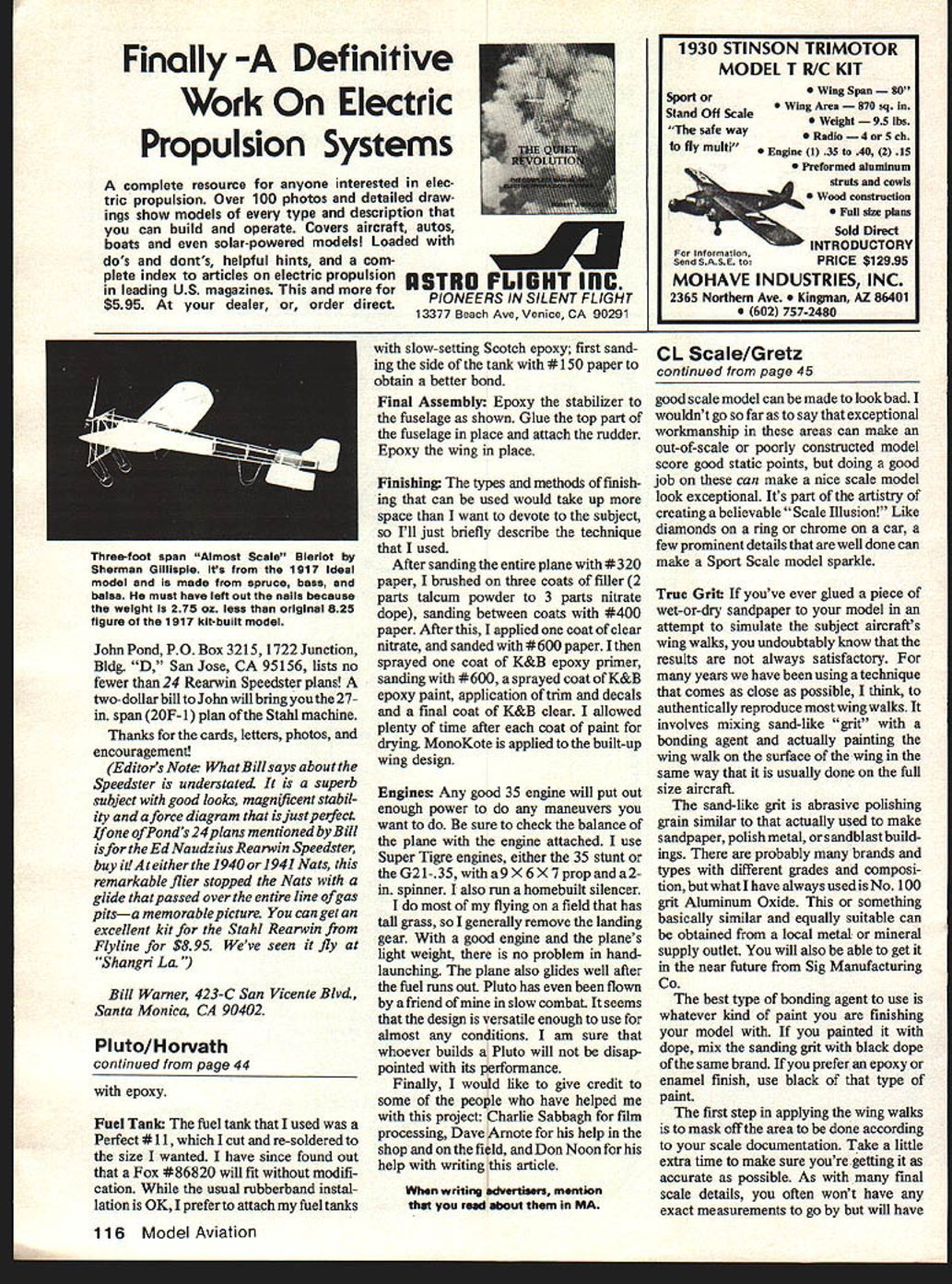
If you've ever glued a piece of wet-or-dry sandpaper to your model in an attempt to simulate the subject aircraft's wing walks, you undoubtedly know that the results are not always satisfactory. For many years we have been using a technique that comes as close as possible, I think, to authentically reproducing most wing walks. It involves mixing sand-like "grit" with a bonding agent and actually painting the wing walk on the surface of the wing in the same way that it is usually done on the full-size aircraft.
The sand-like grit is abrasive polishing grain similar to that actually used to make sandpaper, polish metal, or sandblast buildings. There are probably many brands and types with different grades and compositions, but what I have always used is No. 100 grit aluminum oxide. This or something basically similar and equally suitable can be obtained from a local metal or mineral supply outlet. You will also be able to get it in the near future from Sig Manufacturing Co.
The best type of bonding agent to use is whatever kind of paint you are finishing your model with. If you painted it with dope, mix the sanding grit with black dope of the same brand. If you prefer an epoxy or enamel finish, use black of that type of paint.
The first step in applying the wing walks is to mask off the area to be done according to your scale documentation. Take a little extra time to make sure you're getting it as accurate as possible. As with many other scale details, you often won't have any exact measurements to go by but will have to rely (as will the static judges) on close eyeballing of your three-view drawing and photos. If there is a discrepancy between the drawing and the photos of your actual subject aircraft, by all means go with the photos! And then note the discrepancy in your scale presentation so that the judges will realize that you've followed the more accurate information.
I realize that I'm drifting slightly from the subject of making wing walks, but this is a good time to state one of the most basic unwritten rules of scale documentation. That is, anytime you have a photo and drawing of the same part of the same aircraft, and they differ substantially, the photo is the best authority to use. Sounds simple enough, but it's surprising how many rookies fail to see that initially and then pay the price at their first contests. Photos are a thousand times more reliable than most drawings. The scale modelers' dream come true is a three-view and photos that complement and back up each other.
About the wing walks! It's best to use a vinyl plastic tape to mask off the wing-walk area. If paper tape is used, a clear sealer coat is required to keep the black paint from creeping under the tape. For the average size job, take about 2 ounces of black paint and stir in 1 ounce of the sanding grit — these are volume measurements, not weight. When well mixed, immediately start laying on the mixture in place with a brush. Don't overbrush — just smooth it out as well as possible. It's important to stir the mixture constantly, even between every brush load, as the grit is heavy and will settle to the bottom quickly. If the mixture seems too thick to handle, add a little thinner to make it go on smoother. If you're doing this for the first time, test your first batch on a piece of cardboard instead of your model. Experiment with your brushing technique and the mixture until it goes on smoothly without lumps. One coat coverage is almost always sufficient, so take the tape off immediately after you're done brushing. When it's dry, you'll have a "true" scale wing walk that will never wrinkle or peel off!
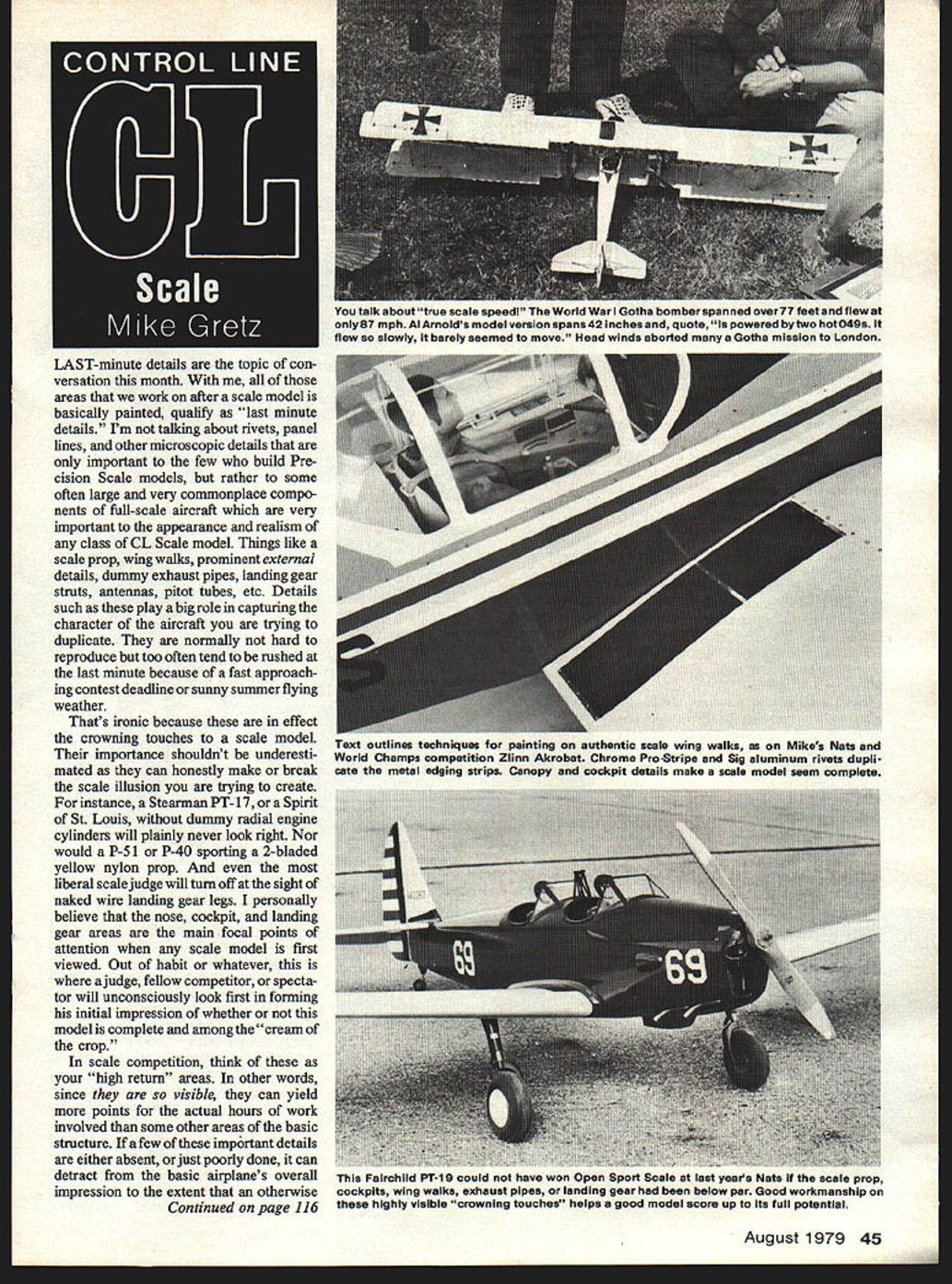
Good thoughts for the summer months. Al Arnold of New Orleans writes: "I am president of the Louisiana Scale Sqn. which is composed of about 90% RC Scale enthusiasts. To have a CL'er in this position is somewhat unusual (I guess), but what it really proves is that we don't care which scale discipline a modeler likes. We just like all scale. As a result of this type of camaraderie, we CL Scale guys have gotten a lot of support and enthusiasm from our RC brothers and vice-versa. Our contests are something to behold as we have events for all types of scale models. It would be nice to see modelers in other areas demonstrate this kind of mutual respect and good fellowship. We think CL Scale is terrific and encourage it with the younger modelers in the area. Like I said before, we make up in quality what we lack in numbers hoping that one will cause an increase in the other."
PLEASE DON'T FLY NEAR POWER LINES!
Mike Gretz, Box 162, Montezuma, IA 50171.
Transcribed from original scans by AI. Minor OCR errors may remain.

