
Control Line: Scale
Mike Gretz
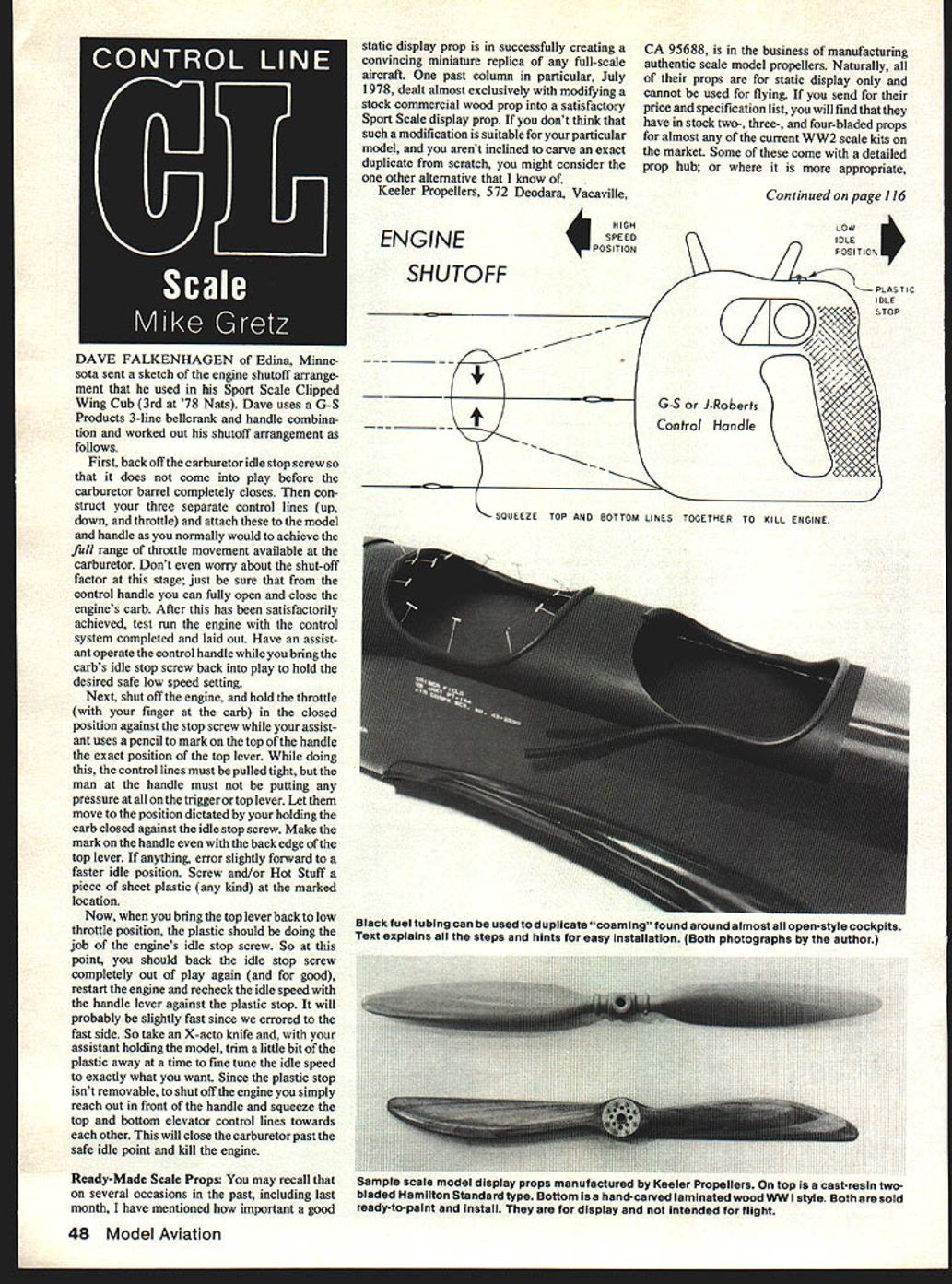
Engine shutoff arrangement (Dave Falkenhagen, Edina, MN)
Dave Falkenhagen used the following engine shutoff arrangement on his Sport Scale Clipped Wing Cub (3rd place, '78 Nats) with a G-S Products 3-line bellcrank and handle.
- Back the carburetor idle stop screw out so it does not interfere with the carburetor barrel closing.
- Construct three separate control lines (up, down, throttle) and attach them to the model and handle so you have the full range of throttle movement—able to fully open and fully close the carb. Don’t worry about shutoff at this stage.
- Test-run the engine with the completed control system laid out. Have an assistant operate the handle while you bring the carb's idle stop screw back into play and set the desired safe low idle speed.
- Shut off the engine. With your finger holding the throttle closed against the idle stop screw, have the assistant pull the control lever tight (no pressure on the trigger/top lever) and mark the exact position of the top lever on the handle—align the mark with the back edge of the top lever. If uncertain, err slightly forward (a slightly faster idle).
- Screw or Hot Stuff (epoxy) a small piece of sheet plastic to the handle at the marked location to serve as a permanent stop.
- Move the top lever back to the low-throttle position so the plastic stop now serves as the idle stop. Back the idle stop screw completely out of play again.
- Restart the engine and check idle with the handle lever against the plastic stop. If it's slightly fast, use an X-Acto knife (with the model held by an assistant) to trim small amounts of plastic until the idle is exactly correct.
- To shut off the engine on the ground, squeeze the top and bottom elevator control lines toward each other. This closes the carb past the safe idle point and kills the engine.
Ready-Made Scale Props
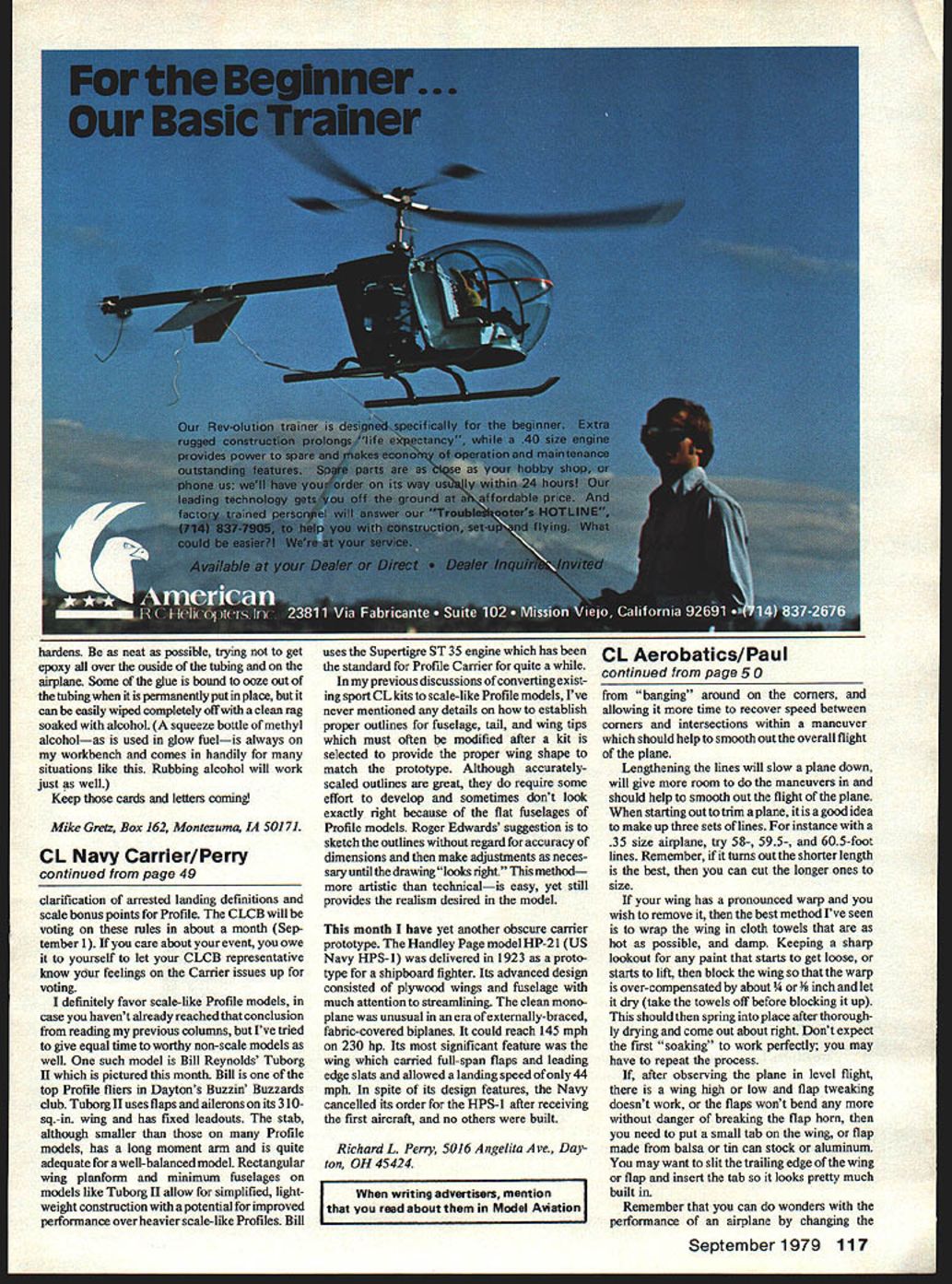
A convincing static display prop is important for a realistic scale replica. If modifying a stock wood prop or carving one isn't suitable, consider Keeler Propellers:
- Keeler Propellers, 572 Deodara, Vacaville, CA 95688.
- They manufacture authentic static display model propellers (not for flying).
- Stock items include two-, three-, and four-bladed props for most WWII scale kits; some include detailed prop hubs or contoured spinners.
- Parts are cast in gray epoxy resin, ready-to-paint with minimal finishing required.
- They also offer hand-carved laminated wood scale props suitable for many WWI kits, ready-to-finish with metal hub plates.
- Custom props (cast resin or wood) can be made if you supply adequate scale documentation: full-size prop diameter, photos, drawings. All provided materials will be returned.
"Ring Around the ... Cockpit" (cockpit coaming)
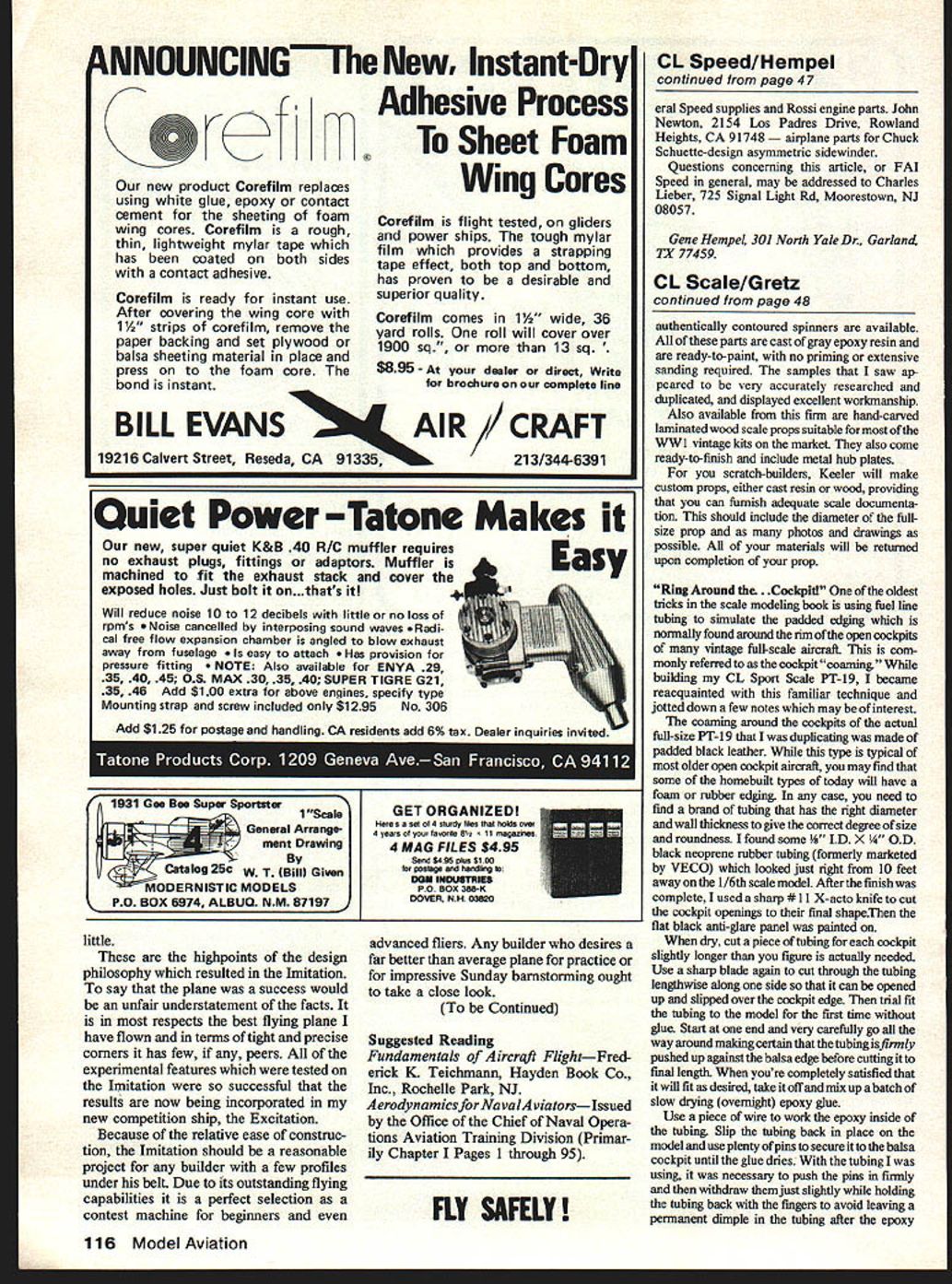
To simulate the padded edging (coaming) around open cockpits, fuel line tubing works well.
- Choose tubing with the correct diameter and wall thickness for scale appearance. For a 1/6 scale PT-19, 3/16" I.D. x 1/4" O.D. black neoprene rubber tubing (formerly marketed by VECO) looked right from about 10 feet.
- Finish the model first. Cut the cockpit opening to final shape with a sharp #11 X-Acto knife and paint the anti-glare panel flat black.
- Cut a piece of tubing slightly longer than needed. Split the tubing lengthwise so it can be slipped over the cockpit rim. Trial-fit without glue, pushing the tubing firmly against the balsa edge. When satisfied, remove it.
- Mix slow-drying (overnight) epoxy. Use a piece of wire to push epoxy inside the tubing, slip the tubing back into place, and pin it to the balsa until the epoxy cures.
- Push pins in firmly and withdraw slightly while holding the tubing to avoid permanent dimples.
- Be neat—try not to get epoxy on the outside of the tubing or airplane. Wipe any oozed epoxy off with a clean rag soaked in methyl alcohol (used in glow fuel) or rubbing alcohol.
Keep those cards and letters coming!
Mike Gretz Box 162, Montezuma, IA 50171
Transcribed from original scans by AI. Minor OCR errors may remain.

