
CONTROL LINE: Scale
Mike Gretz
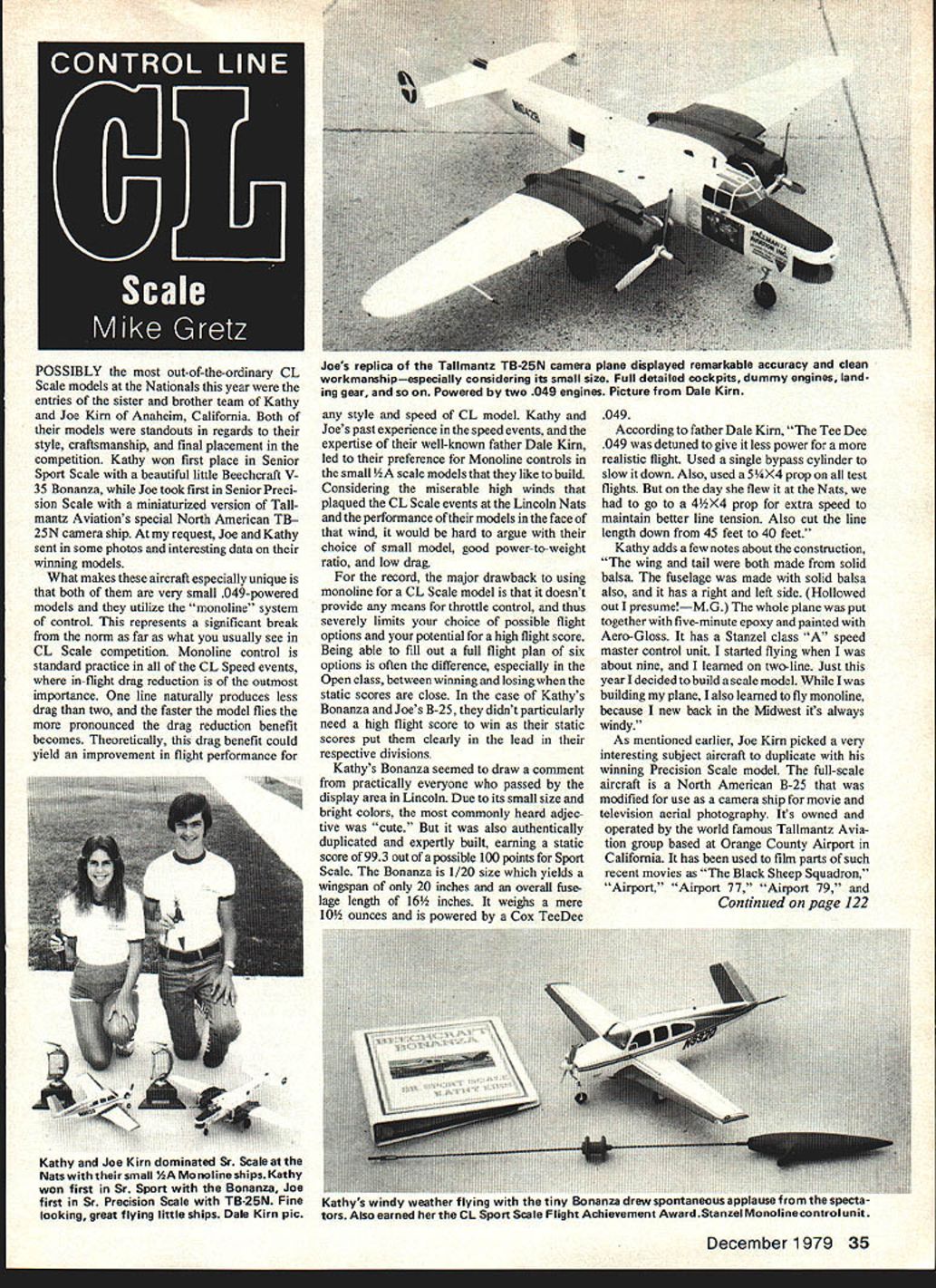
Possibly the most out-of-the-ordinary CL Scale models at the Nationals this year were the entries of the sister-and-brother team of Kathy and Joe Kirn of Anaheim, California. Both of their models were standouts in style, craftsmanship, and final placement in the competition. Kathy won first place in Senior Sport Scale with a beautiful little Beechcraft V-35 Bonanza, while Joe took first in Senior Precision Scale with a miniaturized version of Tallmantz Aviation's special North American TB-25N camera ship. At my request, Joe and Kathy sent in some photos and interesting data on their winning models.
Monoline control
What makes these aircraft especially unique is that both of them are very small .049-powered models and they utilize the "monoline" system of control. This represents a significant break from the norm as far as what you usually see in CL Scale competition. Monoline control is standard practice in all of the CL Speed events, where in-flight drag reduction is of the utmost importance. One line naturally produces less drag than two, and the faster the model flies the more pronounced the drag-reduction benefit becomes. Theoretically, this drag benefit could yield an improvement in flight performance for any style and speed of CL model.
Kathy and Joe's past experience in the speed events, and the expertise of their well-known father Dale Kirn, led to their preference for monoline controls in the small 1/2A scale models that they like to build. Considering the miserable high winds that plagued the CL Scale events at the Lincoln Nats and the performance of their models in the face of that wind, it would be hard to argue with their choice of small model, good power-to-weight ratio, and low drag.
For the record, the major drawback to using monoline for a CL Scale model is that it doesn't provide any means for throttle control, and thus severely limits your choice of possible flight options and your potential for a high flight score. Being able to fill out a full flight plan of six options is often the difference—especially in the Open class—between winning and losing when the static scores are close. In the case of Kathy's Bonanza and Joe's B-25, they didn't particularly need a high flight score to win, as their static scores put them clearly in the lead in their respective divisions.
Kathy's Bonanza
Kathy's Bonanza seemed to draw a comment from practically everyone who passed by the display area in Lincoln. Due to its small size and bright colors, the most commonly heard adjective was "cute." But it was also authentically duplicated and expertly built, earning a static score of 99.3 out of a possible 100 points for Sport Scale.
Specifications and construction notes:
- Scale: 1/20
- Wingspan: 20 inches
- Fuselage length: 16½ inches
- Weight: 10½ ounces
- Power: Cox Tee Dee .049
According to father Dale Kirn: "The Tee Dee .049 was detuned to give it less power for a more realistic flight. I used a single bypass cylinder to slow it down. Also used a 5¼×4 prop on all test flights. But on the day she flew it at the Nats, we had to go to a 4¼×4 prop for extra speed to maintain better line tension. Also cut the line length down from 45 feet to 40 feet."
Kathy adds a few notes about the construction: "The wing and tail were both made from solid balsa. The fuselage was made with solid balsa also, and it has a right and left side. (Hollowed out I presume—M.G.) The whole plane was put together with five-minute epoxy and painted with Aero-Gloss. It has a Stanzel class 'A' speed master control unit. I started flying when I was about nine and I learned on two-line. Just this year I decided to build a scale model. While I was building my plane, I also learned to fly monoline, because I now live back in the Midwest; it's always windy."
Joe's B-25 camera ship
As mentioned earlier, Joe Kirn picked a very interesting subject aircraft to duplicate with his winning Precision Scale model. The full-scale aircraft is a North American B-25 that was modified for use as a camera ship for movie and television aerial photography. It's owned and operated by the world-famous Tallmantz Aviation group based at Orange County Airport in California. It has been used to film parts of such recent productions as The Black Sheep Squadron, Airport, Airport '77, and Airport '79.
Scale Model Research Photos (photo packs)
The photo list I received describes packs for 57 different aircraft, including:
- Wittman Tailwind
- "Flying Flea"
- Lockheed Orion
- P-26 Peashooter
- PT-22
- Grumman Duck
- P-38s
- P-51s
- P-40E
- and many more
The packs vary from $5.50 to $17.50 per set and contain from 9 to 33 top-quality color photos. The prints are a full 3½ × 5¼" size (not 3½ × 5), which means you get full prints of everything on the standard 35-mm negatives—no spinners chopped off or missing wing tips, ordinarily. For a free copy of the latest list, send a stamped, self-addressed long envelope to:
Dale Willoughby Scale Model Research Photos P.O. Box 675 Orange, CA 92666
Final notes
Now that the flying season is winding down, I hope you'll have time to send me some photos, drawings, ideas, or comments for use in this column. We need your contributions to keep this space interesting and informative. Model Aviation will pay you $5 for each item that is printed.
Mike Gretz Box 162 Montezuma, IA 50171
Transcribed from original scans by AI. Minor OCR errors may remain.

