
Control Line: Scale
Mike Gretz
Let's assume that this winter's big project is going to be that fast-selling new "exact scale" kit from Super Duper Model Company. Or maybe you're going to scratch-build that next masterpiece from plans, either your own or someone else's. Regardless of which track you take, sooner or later we all end up at the hobby shop looking through the dealer's balsa assortment. We know what size we need, but other than that how many of us really know what we're looking at? Do all those equal-size sheets look pretty much the same to you, or can you see the subtle qualities that give each piece a character all its own?
There are two things to be considered when selecting a piece of sheet wood — its weight and grain direction. These are unrelated considerations, and the wide range of possible blends of each is what makes balsa wood such a unique and versatile building material. For instance, it's possible to find different pieces of the same size sheet that are either:
- soft, light and flexible;
- soft, light and rigid;
- hard, heavy and rigid; or
- hard, heavy and flexible — and umpteen degrees of each in between.
By learning to identify the basic types, you can better select the correct piece for a certain part of your model. The resulting model can then be built lighter, stronger, look better, and fly better.
Weight
Weight is an important consideration whether the balsa you need is in the form of a sheet, a stick, or a block. The strength of balsa is directly related to its weight (or density). The heavier the wood, the stronger and harder it is. Contrary to some popular opinion, balsa is only the fourth or fifth lightest wood in the world. Its real suitability for model aircraft building comes from its outstanding strength-to-weight ratio.
The balsa tree is very fast-growing, reaching a height of 60 to 90 feet in only six to ten years. After that time, the tree begins to rot. Consequently, the density and quality of the lumber obtained can vary enormously. Densities can vary from 4 to 20 pounds per cubic foot. Eight- to 12-pound balsa is considered medium, or average, weight. Six pounds or less is considered "contest" grade.
Logically, one should select the lightest, softest grades for the lightly stressed parts of the structure (block wing tips, sheet tail surfaces, etc.) and the heavier, hard grades for wing spars and fuselage longerons.
Grain direction
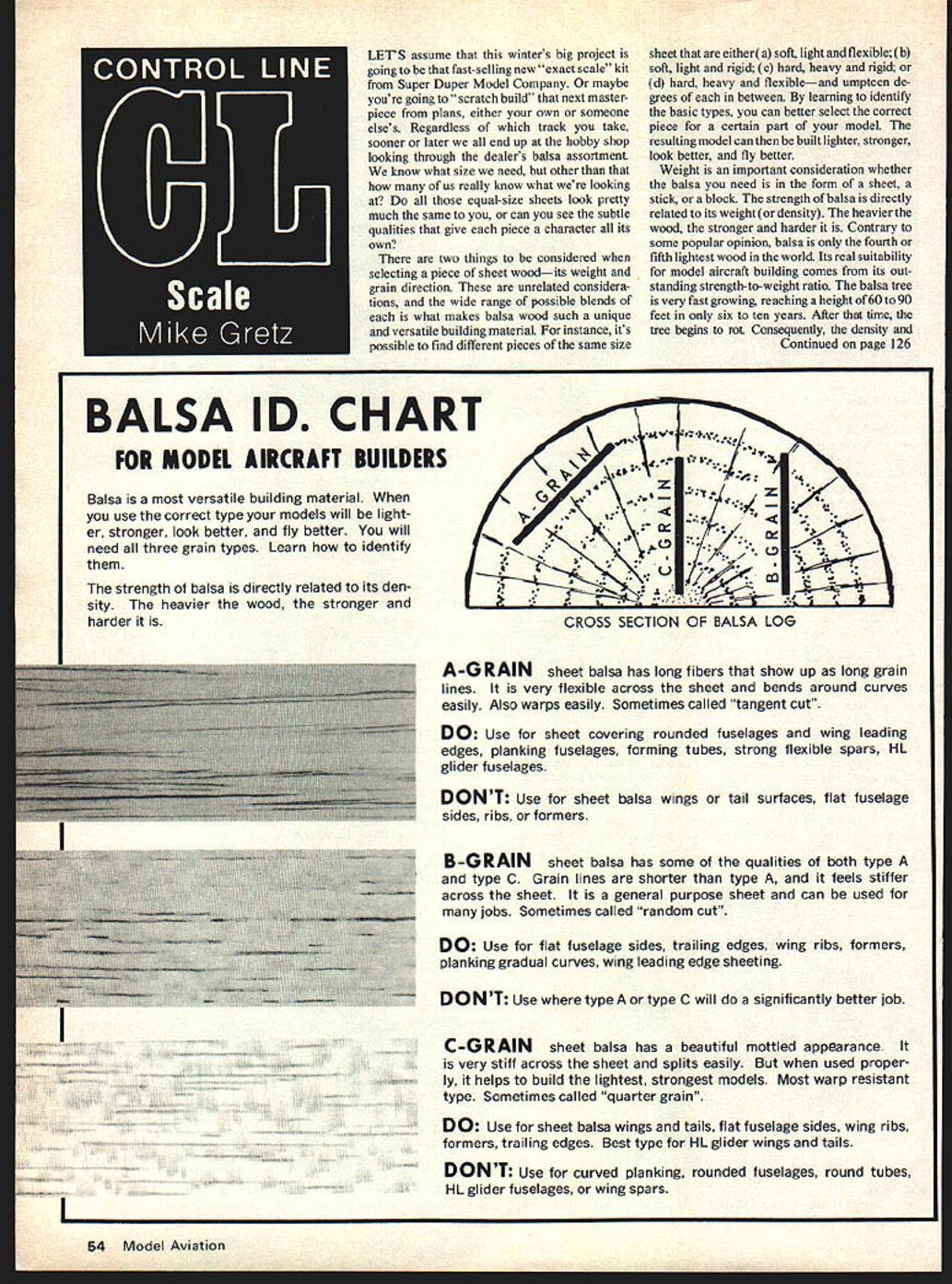
Grain direction is an important consideration, primarily in the selection of sheet balsa. The way the grain runs through the sheet largely controls its rigidity or flexibility.
- A-grain (tangent cut): If the sheet is cut so that the tree's annular rings run across the thickness of the sheet, the sheet will be fairly flexible edge to edge. In fact, after soaking in water some tangent-cut sheets can be completely rolled into a tube shape without splitting.
- C-grain (quarter grain): If the sheet is cut with the annular rings running through the thickness of the sheet, the sheet will be very rigid edge to edge and cannot be bent without splitting.
- B-grain (random cut): When the grain direction is less clearly defined, the sheet will have intermediate properties between A and C grain.
The accompanying chart (not included here) illustrates the three basic grain types for sheet balsa and lists the most appropriate uses for each.
Remember, when selecting sheet balsa, grain direction and weight should be considered separately. You can find light or heavy A-grain, light or heavy B-grain, and light or heavy C-grain. Grain direction controls the stiffness, not the weight.
Mike Gretz, Box 162, Montezuma, IA 50171.
Transcribed from original scans by AI. Minor OCR errors may remain.

