
Control Line: Scale
Mike Gretz
I've mentioned before the large growth over the last few years in the number of quality scale model kits on the market. Granted, almost all of them are labeled (or mislabeled?) as "RC" kits, but they are equally suitable for control line flying. In fact, a large percentage of the CL sport scale models you see at contests these days are adaptations of an RC scale kit. The majority of these modern kits are in the .45 to .60 engine size range. In my opinion that is the best size for top-notch control line scale flight performance.
I know of several modelers who are converting RC kits to CL this winter and who are, for the first time, looking into using retracts in their new models. There is no question that retractable landing gear adds tremendously to the excitement and realism of any scale model whose full-scale counterpart used them. And, as with scale kits in general, the improvements in commercial retracts over the past few years have been inspiring. Not too many years ago operational retracts were extremely rare even in CL or RC competition scale models. (I emphasize operational because it was quite common for a competitor to claim retractable gear but to unashamedly decline to use it when it came time to fly.) Nowadays, the quality and dependability of the retract units on the market make adding this feature to a scale model almost as easy as putting in the engine.
Choosing retract systems
When shopping for a suitable retract system for any scale model, realize one thing: even with a minimum of detailing, most scale landing gears are going to be too heavy to be hoisted by a mechanical, servo-driven landing gear system. The servo-driven units on the market (for example Kraft, Goldberg, Pro-Line, Southern RC) are designed primarily for RC pattern and sport models whose landing gear consists of a small wheel on a short plain piece of music wire. In most of our cases, when you have a scale-size wheel and scale-length landing-gear legs, the weight will be too much for a servo to handle.
For this reason, I would never recommend considering anything but a pneumatic retract system for a scale model in the .45 to .60 engine size range. Examples of pneumatic systems are Rhom Air, Sonic Systems, and B&D.
I've also found that pneumatic retracts are very simple to actuate in the throttle-equipped model without having to add any extra weight or a separate servo.
Throttle-actuated pneumatic systems (Rhom Air example)
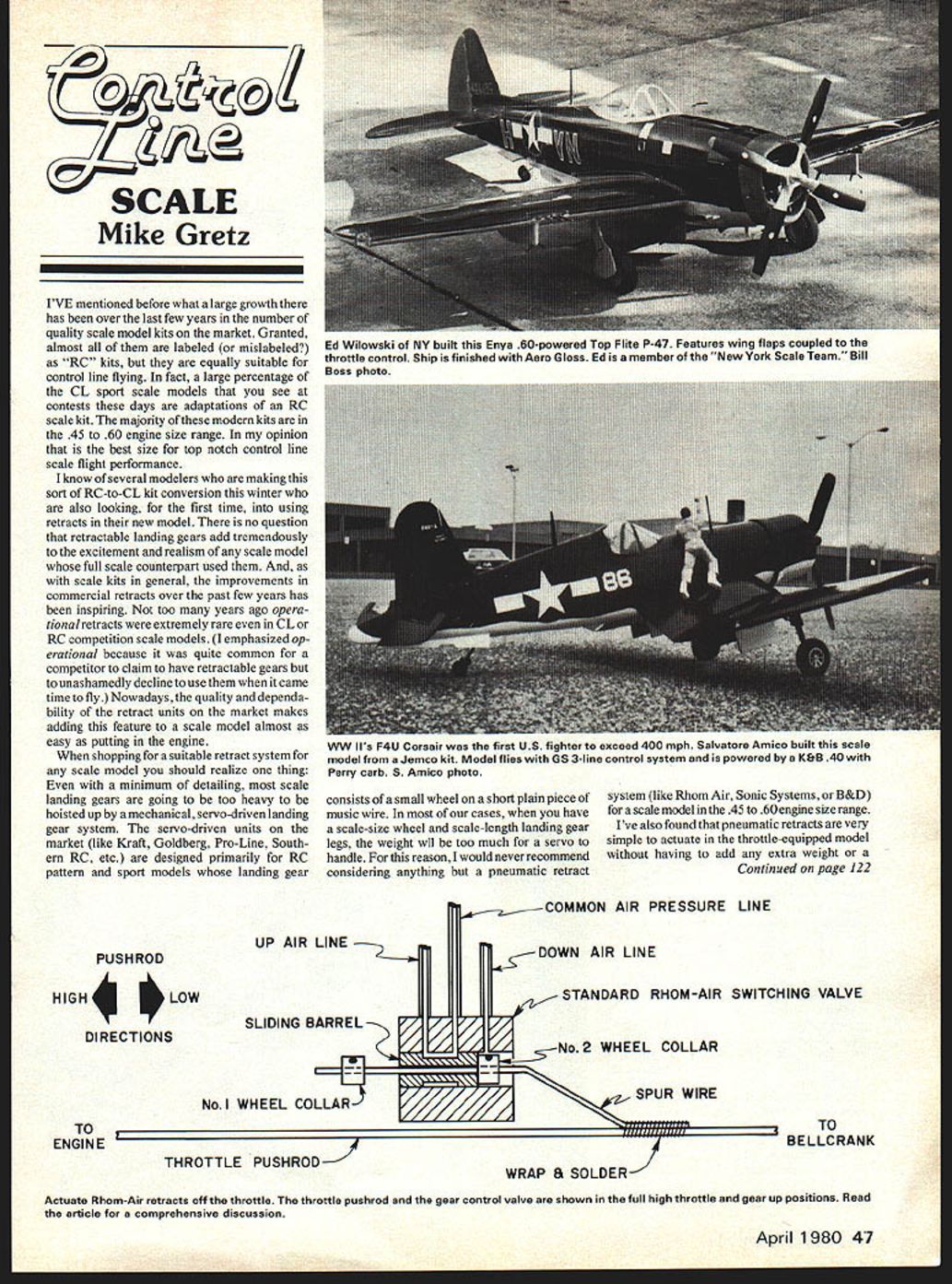
The Rhom Air retract system, which I am most familiar with (having used it since 1973), has a four-way switching valve to actuate the up and down movements of the landing gear. (I presume the other pneumatic systems have a similar valve.) This valve is basically a junction box for the three hoses: up, down, and pressure (air) hose. The valve has a grooved sliding barrel inside which routes the pressurized air to the appropriate up or down hose at each end of the barrel's travel. In RC applications a standard servo drives the inner barrel to open the valve. In my Zlin, I use the throttle pushrod to do the same job.
As you can see in the accompanying drawing, a "spur" wire was wrapped and soldered to the throttle pushrod. On the spur wire are two wheel collars that are small enough to slide into the valve and push the barrel. The valve body itself is securely fastened to the fuselage structure. When the throttle pushrod moves forward to open the carburetor, the number 2 collar pushes the barrel to the front of the valve, thus connecting the up air hose with the pressure hose and bringing the landing gear up. Conversely, as the throttle pushrod closes the carb, the number 1 collar pushes the barrel to the rear of the valve, which connects the down circuit and lowers the landing gear.
The use of wheel collars on the spur wire makes the exact timing of the retraction and extension of the gear adjustable within the engine's power range. I had my number 2 collar adjusted so the gears came up at absolute full high throttle. Obviously, this makes it necessary to take off with just slightly less than full power to avoid prematurely retracting the gear on the ground. That doesn't present any problem if your model is adequately powered. My number 1 collar was adjusted so the gear came down when I had throttled back to about the one-third to one-half power setting.
Practical notes and extensions
- This actuating arrangement should work equally well in any model in the size and wing-loading range of my Zlin.
- In all the years I flew that particular model (including two Nationals), I never had any reason to wish I could operate the retracts independently of the throttle.
- You might consider using an extra pneumatic air cylinder to operate flaps (or a tailhook, etc.) in conjunction with your retracts and throttle. You can simply plug the extra cylinder into the retract system the same way that is done for a retractable tailwheel or nose gear.
Mike Gretz Box 162, Montezuma, IA 50171.
Transcribed from original scans by AI. Minor OCR errors may remain.

