
Control Line: Scale
Mike Gretz
Last month's column showed a method for operating pneumatic retractable landing gears off a standard 3-line throttle system. I forgot to mention that the greatest benefit from actuating the retract cycle, or any other extra option, off the throttle mechanism is eliminating the need for extra flying lines in addition to the normal three.
On some of the most complex CL Scale subjects, which have several mechanical scale options (like bombers and fighters), it's not uncommon to see one, two, or even three extra flying lines being used. It's quite obvious that the additional weight and drag of these extra lines will put a greater burden on that model in flight. The increased drag will be especially noticeable on a windy day. Bear in mind that we were talking about models in the .40 to .60 engine size range. It's true that more power can minimize the effects of the extra drag, but wouldn't "an ounce of prevention be worth a pound of cure"? Whether you're considering a model with just one extra scale operation or five, I strongly recommend you always aim to keep the number of flying lines to an absolute minimum. The retract system shown last month achieves that aim.
Flaps and Throttle
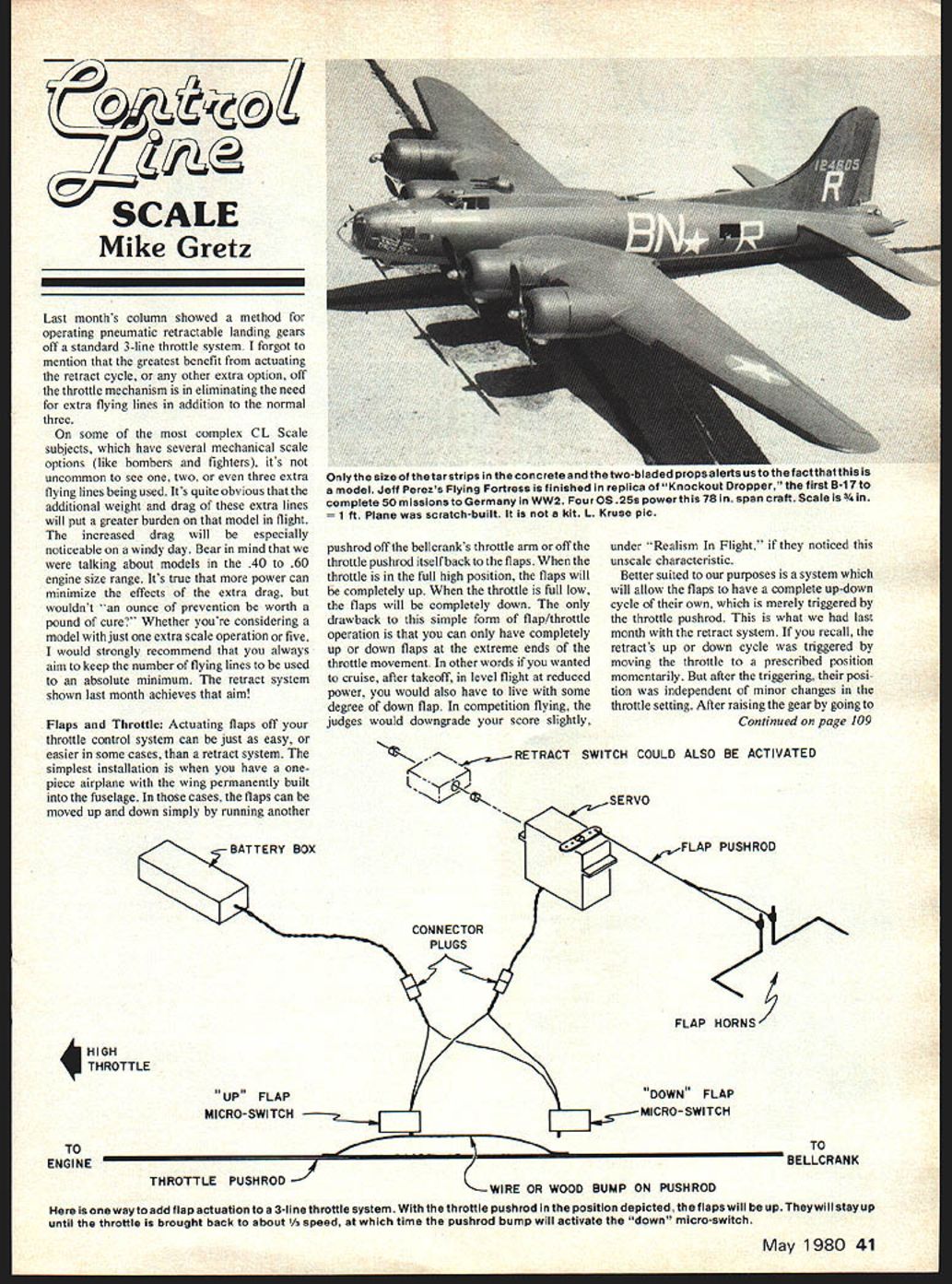
Actuating flaps off your throttle control system can be just as easy, or easier in some cases, than a retract system. The simplest installation is when you have a one-piece airplane with the wing permanently built into the fuselage. In those cases, the flaps can be moved up and down simply by running another pushrod off the bellcrank's throttle arm or off the throttle pushrod itself back to the flaps. When the throttle is in the full-high position, the flaps will be completely up. When the throttle is full low, the flaps will be completely down.
The only drawback to this simple form of flap/throttle operation is that you can only have completely up or down flaps at the extreme ends of the throttle movement. In other words, if you wanted to cruise, after takeoff, in level flight at reduced power, you would also have to live with some degree of down flap. In competition flying, the judges would downgrade your score slightly, under "Realism in Flight," if they noticed this unscale characteristic.
Better suited to our purposes is a system that allows the flaps to have a complete up-down cycle of their own, merely triggered by the throttle pushrod. This is what we had last month with the retract system. If you recall, the retract's up or down cycle was triggered by moving the throttle to a prescribed position momentarily. But after the triggering, their position was independent of minor changes in the throttle setting. After raising the gear by going to absolute full-high throttle, the gear would stay up until the throttle was moved back down to about 1/3 speed. Any degree of power between full high and 1/3 could be used in cruising flight without bringing the gear down. On the other hand, once the gear were brought down they would stay down regardless of whether the engine was running at anywhere from full idle to just short of absolute high. Only when the throttle was held firmly at absolute full-high throttle would the gear be triggered to cycle up. The same benefits of an independent cycle with throttle-triggering can be achieved for flaps using the system shown in this month's drawing. This arrangement is what I have in my sport-scale PT-19. I know of several other noted competition fliers who have done it basically the same way.
Servo operation and micro-switch triggering
The flaps are actually moved by an RC-type electric servo, which gets its power from an onboard battery pack. The servo is triggered to move first completely in one direction and then completely in the other by two small micro-switches located next to the throttle pushrod. A hump is securely built onto the pushrod so that when it moves in either direction far enough, the hump will depress the appropriate switch and actuate the servo. Micro-switches are available at any Radio Shack or similar store. I used "Archer Subminiature Roller Lever Switches," 5 amp, $1.19 each, in my PT-19.
The exact location of the two switches should be adjustable to allow fine timing of the flap movements within the servo's range. I've got mine set up about like I recommended last month for retracts — the full-high throttle position brings them up, and the 1/3 to 1/2 power position brings them down. However, when setting up the timing of the down flap on your model during test flights, be aware of a tendency for the model to "balloon" or "bump" in flight if the flaps are brought down suddenly while the plane is still traveling at a high rate of speed. Make sure the flaps don't start down until the model has slowed enough to make the transition smoothly.
Wing mounting and wiring
In my PT-19, which has a removable wing, the 3-line bellcrank was mounted in the fuselage so that the elevator and throttle pushrods could be permanently hooked up to it. Between the micro-switches, which are mounted along the throttle pushrod, and the flap servo and battery pack, which are mounted in the wing, I have two connector plugs in the wiring. Thus, when I want to take off the wing for transport, the only parts of the control system that will be affected are those two simple electrical connectors. There's no need to undo any pushrods or mechanical linkages.
Power and equipment
The size of the battery pack you'll need depends on the servo you choose. I've got an old Bonner Duramite servo that I found in the dark corners of Sig's workshop. It dates back about 20 years and requires four AA pen cell batteries. Actually, you can do a lot better than this heavy old servo with the equipment on the market today.
I'd recommend Carl Goldberg's "Retract Power Systems" (cat. no. RPS-1). Although intended for the company's mechanical retract units, this power pack is an ideal control for electric servo projects. Most RC servos on the market today would cost you between $40 to $80 for the servo alone. The Goldberg unit sells for $34.95 and gives you:
- the servo
- a two AA-cell battery pack
- the micro-switches
- the connector plugs
It is completely assembled and ready to install. I'd consider it one of the most overlooked bargains on the RC market today for the serious CL Scale enthusiast.
Combining retracts and flaps
By the way, if your particular scale subject calls for both retracts and flaps, it would be quite simple once you have your flap servo installed to also actuate your pneumatic retract valve off the other side of the servo arm. You would then be working two additional scale operations very effectively off a standard throttle system without needing any extra flying lines.
Mike Gretz, Box 162, Montezuma, IA 50171.
Transcribed from original scans by AI. Minor OCR errors may remain.

