
Control Line SCALE
Mike Gretz
World Championships Cancelled
In case you haven't heard, the 1980 CL Scale World Championships have been cancelled. The deadline the contest organizers set for a final entry commitment from the interested countries recently passed without a sufficient number signed up for CL Scale. As I mentioned in my March '80 column, five countries are needed to stage a World Championships. At the time I wrote that column (Dec. '79) only four countries had been firmly committed. I felt fairly confident that one more nation would sign up in time, but it didn't work out that way.
Perhaps the intense political situations that have developed around the world since then, including talk of an Olympic boycott, may have had something to do with the reluctance of any new countries to sign up. It's hard to say.
This is the second time in a row that the WC CL Scale event was cancelled due to political problems and an apparent lack of interest by enough of the FAI participating countries. The first time was in 1978. One has to wonder what kind of mammoth effort it might take in future years to get CL Scale back on the WC schedule. Just look at the uphill battle the FF Scale enthusiasts of this country are having in trying to get their event to World Championship status. My sincerest hope is that this second cancellation will not lead to a similar struggle for the many CL Scale competitors here in the United States who have expressed to me their hope of someday participating in a Scale World Championships.
Al Arnold and His Models
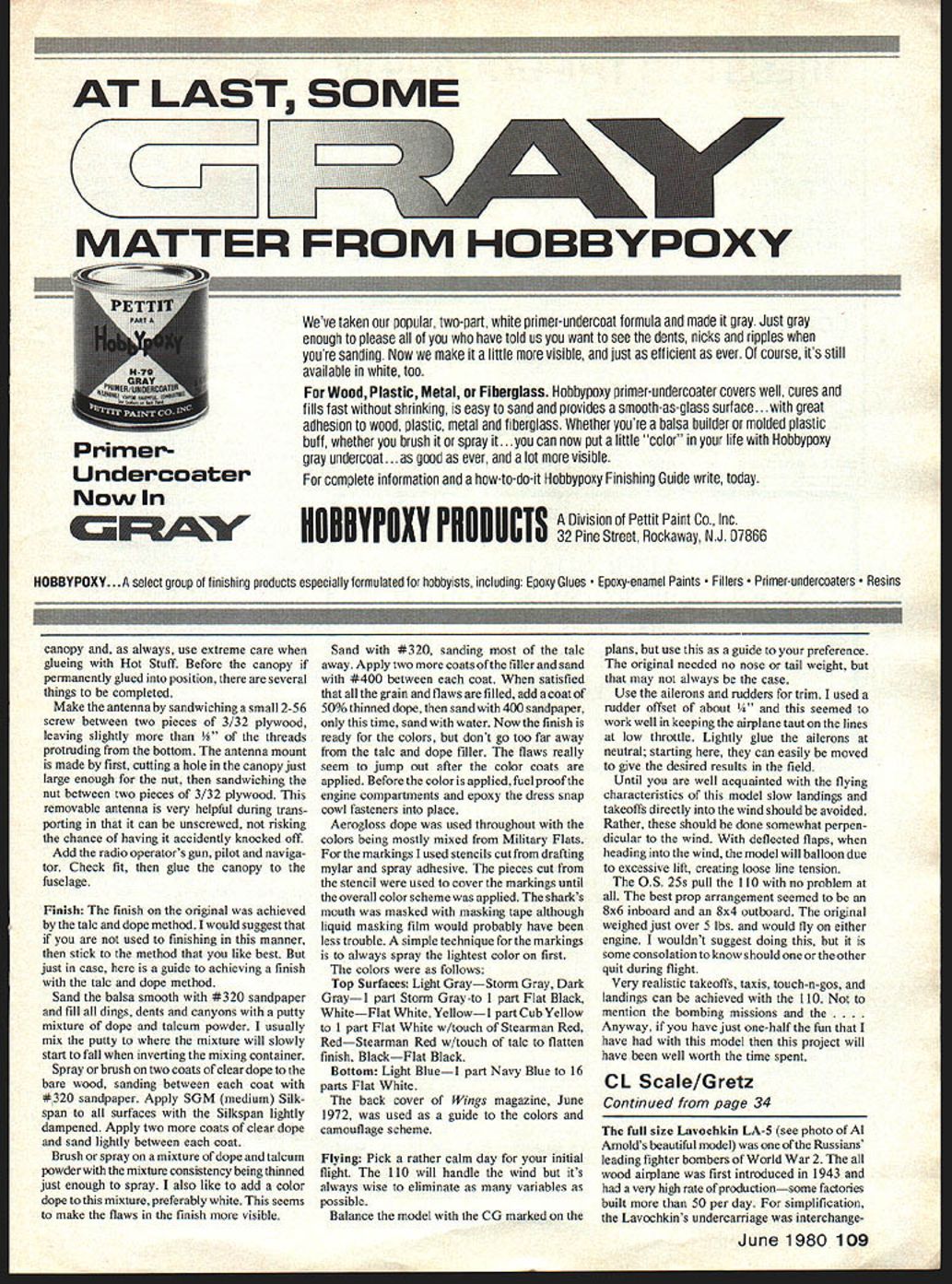
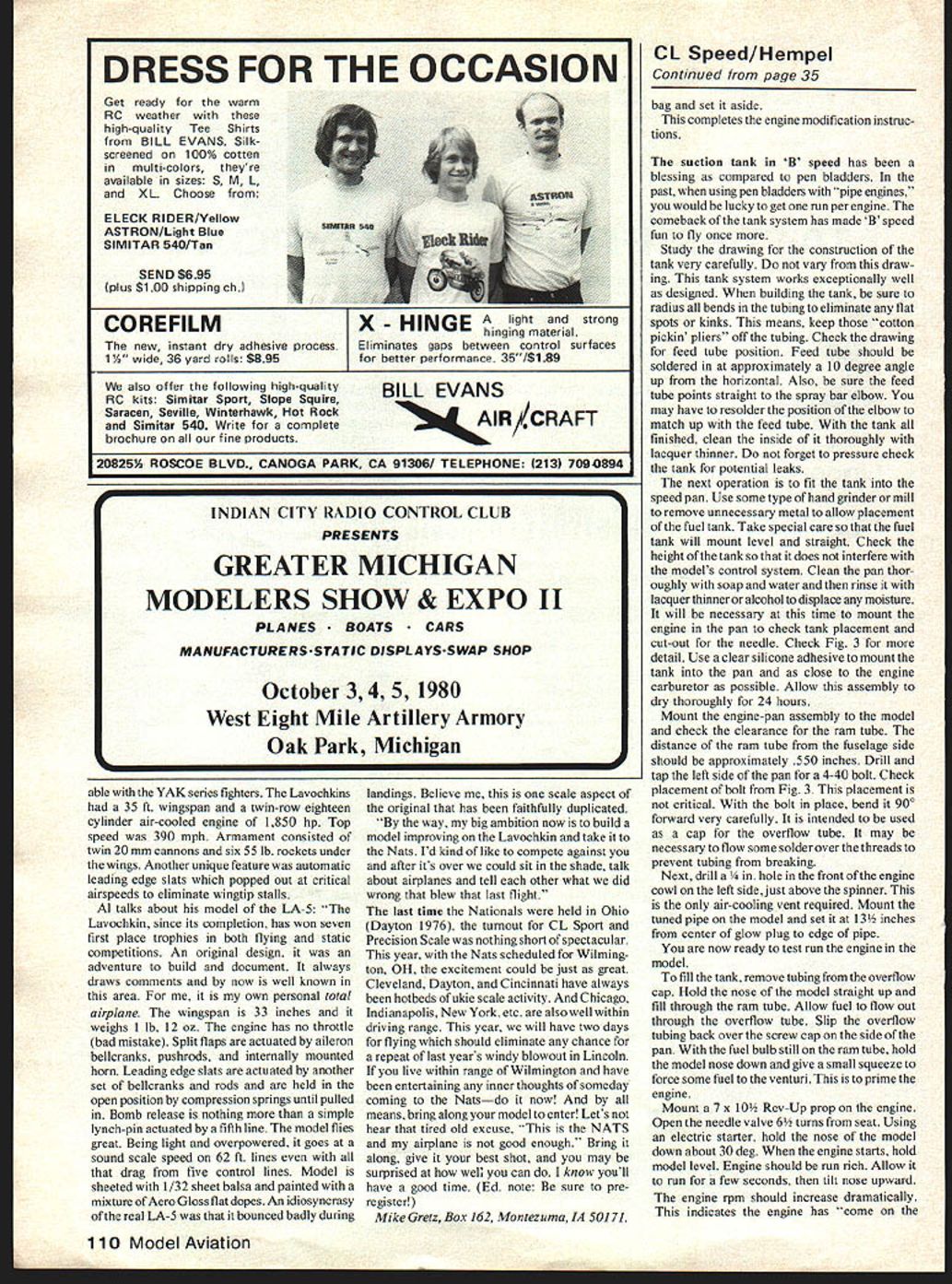
Al Arnold is a modeler in New Orleans who flies a unique style of CL Scale model. You might recall that I have pictured most of his models before in this column. A photo of Al's Gotha bomber was in the August '79 Model Aviation, and his Albatros D-IIIa was shown in our January '80 issue. All of his models reflect a strong FF Scale influence in both their size and construction style. Most of them are small, from 28 to 42 in. wingspan. He recently sent in more photos of his other interesting CL Scale aircraft.
Al is president of the "Louisiana Scale Squadron," a club that includes FF, CL, and RC scale modelers all lumped into one group that has scale as their common denominator.
Al Arnold — Background and Philosophy
Here is part of Al Arnold's letter:
"I cut my teeth as a kid on rubber FF scale and for several years that's all I built. When I first got into CL, the only construction techniques I knew were to keep it light and simple. Now I find that my CL models are really beefed-up FF jobs with a glow engine and control lines. Because a light, overpowered model seems to fly better than a heavy, underpowered one, I have shown up at contests and been competitive with models other guys can't understand.
"The Albatros is a good example — a 28 in. wingspan biplane with all that drag — flies well on an .049. The Gotha G.IV is an excellent example of this philosophy applied to a large model. I'm telling you this because many people seem to think a ukie scale ship has to be heavy to be good and I don't."
I've mentioned on many occasions that I like to build my CL Scale models in a larger 40 to 70 in. wingspan range. Now I wouldn't want anyone to assume, therefore, that I disagree with Al Arnold's style of building. If you came to that conclusion, you've probably missed the main point of Al's and my own reasoning. In fact we are in total agreement: what makes a CL Scale model fly really well is to build it light and overpowered. Al keeps his wing loading down with ultra-light construction whereas I prefer to do it with a larger model.
Someday I'm going to build a small ultra-light ukie scale like Al's and give my arm a rest. It looks like fun.
Canopy
As always, use extreme care when gluing with Hot Stuff. Before the canopy is permanently glued into position, there are several things to be completed.
Antenna
Make the antenna by sandwiching a small 2-56 screw between two pieces of 3/32 in. plywood, leaving slightly more than 1/8 in. of the threads protruding from the bottom. The antenna mount is made by first cutting a hole in the canopy just large enough for the nut, then trimming the nut between two pieces of 3/32 in. plywood. This removable antenna is very helpful during transporting because it can be unscrewed, avoiding the chance of having it accidentally knocked off.
Add the radio operator's gun, pilot, and navigator. Check the fit, then glue the canopy to the fuselage.
Finish
The finish on the original was achieved by the talc-and-dope method. If you are not used to finishing this way, stick to the method you like best. But just in case, here is a guide to achieving a finish with the talc-and-dope method.
- Sand the balsa smooth with #320 sandpaper and fill all dings, dents, and canyons with a putty mixture of dope and talcum powder. I usually mix the putty to where the mixture will slowly start to fall when inverting the mixing container.
- Spray or brush on two coats of clear dope to the bare wood, sanding between each coat with #320 sandpaper.
- Apply SGM (medium) Silkspan to all surfaces with the Silkspan slightly dampened.
- Apply two more coats of clear dope and sand lightly between each coat.
- Brush or spray on a mixture of dope and talcum powder with the mixture thinned just enough to spray. I also like to add a color dope to this mixture, preferably white. This seems to make the flaws in the finish more visible.
- Sand with #320, sanding most of the talc away.
- Apply two more coats of the filler and sand with #400 between each coat.
- When satisfied that all the grain and flaws are filled, add a coat of 50% thinned dope, then sand with #400 sandpaper — this time sand with water.
- Now the finish is ready for the colors. Don't stray too far from the talc-and-dope filler; the flaws really seem to jump out after the color coats are applied.
- Before the color is applied, fuel-proof the engine compartments and epoxy the dress snap or cowling fasteners into place.
Aerogloss dope was used throughout, with colors mostly mixed from Military Flats. For the markings I used masks cut from drafting mylar and spray adhesive. The pieces cut from the stencil were used to cover the markings until the overall color scheme was applied. The shark's mouth was masked with masking tape, although liquid masking film would probably have been less trouble.
A simple technique for the markings is to always spray the lightest color on first. The colors used were as follows:
- Top Surfaces:
- Light Gray — Storm Gray.
- Dark Gray — 1 part Storm Gray to 1 part Flat Black.
- White — Flat White.
- Yellow — 1 part Cub Yellow to 1 part Flat White with a touch of Stearman Red.
- Red — Stearman Red with a touch of flat to flatten the finish.
- Black — Flat Black.
- Bottoms:
- Light Blue — 1 part Navy Blue to 16 parts Flat White.
The back cover of Wings magazine, June 1972, was used as a guide to the colors and camouflage scheme.
Flying
Pick a rather calm day for your initial flight. The 110 will handle wind, but it's always wise to eliminate as many variables as possible.
Balance the model with the CG marked on the plans, but use this as a guide to your preference. The original needed no nose or tail weight, but that may not always be the case.
Use the ailerons and rudder for trim. I used a rudder offset of about 1/4 in., and this seemed to work well in keeping the airplane taut on the lines at low throttle. Lightly glue the ailerons at neutral; starting here, they can easily be moved to give the desired results in the field.
Until you are well acquainted with the flying characteristics of this model, slow landings and takeoffs directly into the wind should be avoided. Rather, these should be done somewhat perpendicular to the wind. With deflected flaps when heading into the wind, the model will balloon due to excessive lift, creating loose line tension.
The O.S. 25s pull the 110 with no problem at all. The best prop arrangement seemed to be an 8x6 inboard and an 8x4 outboard. The original weighed just over 5 lbs. and would fly on either engine. I wouldn't suggest doing this, but it is some consolation to know should one or the other quit during flight.
Very realistic takeoffs, taxis, touch-and-goes, and landings can be achieved with the 110 — not to mention the bombing missions and the ... Anyway, if you have just one-half the fun that I have had with this model then this project will have been well worth the time spent.
Lavochkin (LA-5)
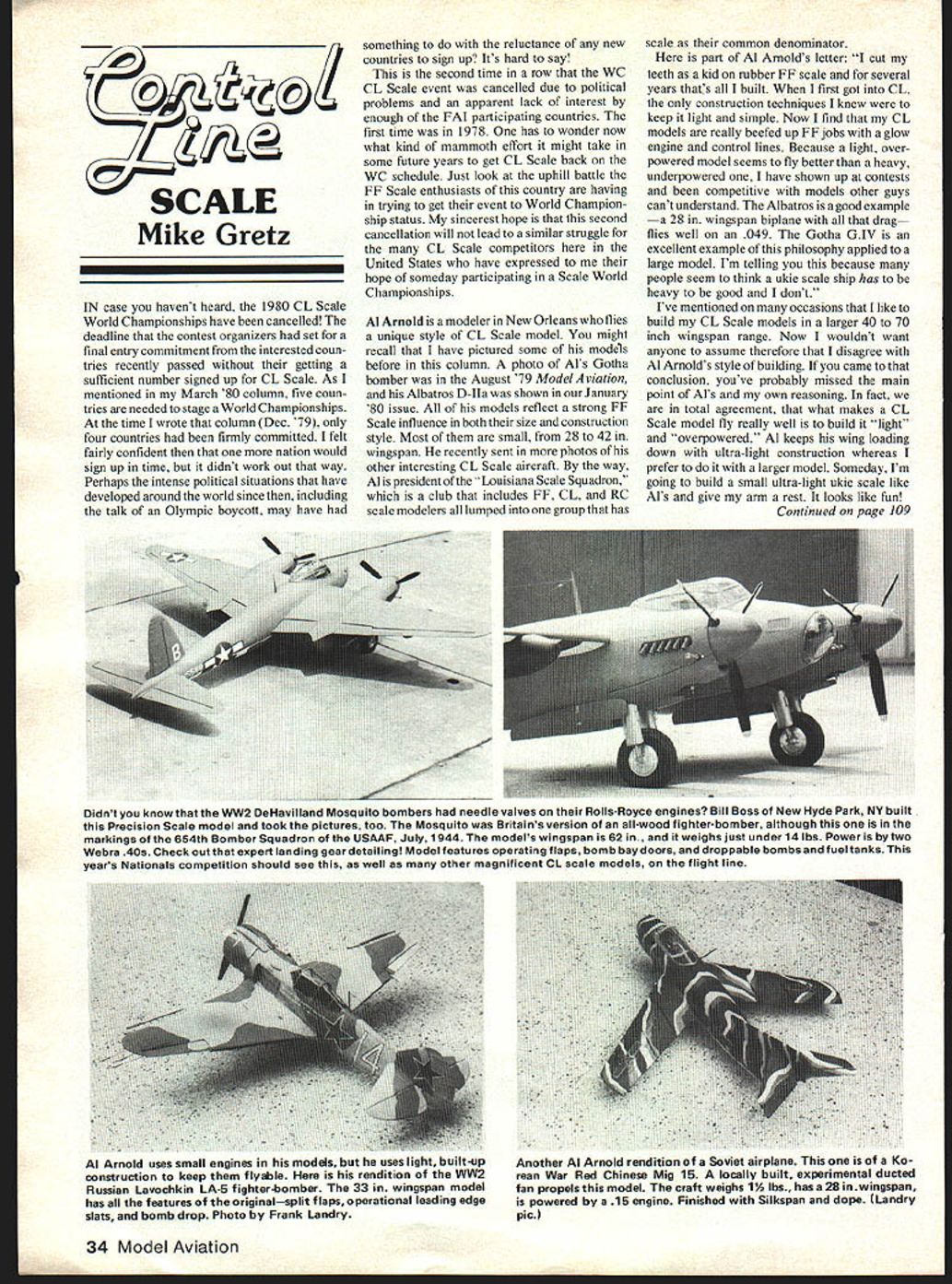
Comparable with the YAK series fighters, the Lavochkins had a 35 ft. wingspan and a twin-row, eighteen-cylinder, air-cooled engine of 1,850 hp. Top speed was 390 mph. Armament consisted of twin 20 mm cannons and six 55 lb. rockets under the wings. Another unique feature was automatic leading-edge slats which popped out at critical airspeeds to eliminate wingtip stalls.
Al talks about his model of the LA-5:
"The Lavochkin, since its completion, has won seven first-place trophies in both flying and static competitions. An original design, it was an adventure to build and document. It always draws comments and by now is well known in this area. For me, it is my own personal total airplane.
"The wingspan is 33 in. and it weighs 1 lb 12 oz. The engine has no throttle (bad mistake). Split flaps are actuated by aileron bellcranks, pushrods, and an internally mounted horn. Leading-edge slats are actuated by another set of bellcranks and rods and are held in the open position by compression springs until pulled in. Bomb release is nothing more than a simple lynch-pin actuated by a 6 lb. line. The model flies great. Being light and overpowered, it goes at a sound scale speed on 62 ft lines even with all that drag from five control lines. The model is sheeted with 1/32 in. sheet balsa and painted with a mixture of Aerogloss flat dope.
"An idiosyncrasy of the real LA-5 was that it bounced badly during landings. Believe me, this is one scale aspect of the original that has been faithfully duplicated."
"By the way, my big ambition now is to build a model improving on the Lavochkin and take it to the Nats. I'd kind of like to compete against you and after it's over we could sit in the shade, talk about airplanes, and tell each other what we did wrong that blew that last flight."
Nationals
The last time the Nationals were held in Ohio (Dayton 1976), the turnout for CL Sport and Precision Scale was nothing short of spectacular. This year, with the Nats scheduled for Wilmington, OH, the excitement could be just as great. Cleveland, Dayton, and Cincinnati have always been hotbeds of scale activity. Chicago, Indianapolis, New York, etc., are also well within driving range.
This year we will have two days for flying which should eliminate any chance for a repeat of last year's windy blowout in Lincoln. If you live within range of Wilmington and have been entertaining any inner thoughts of someday going to the Nats — do it now! And by all means, bring along your model to enter! Let's not hear the usual tired old excuse, "This is the NATS and my airplane is not good enough." Bring it along, give it your best shot, and you may be surprised at how well you can do. I know you'll have a good time.
(Ed. note: Be sure to preregister!)
Mike Gretz Box 162 Montezuma, IA 50171
Transcribed from original scans by AI. Minor OCR errors may remain.

