
Control Line: Scale
Mike Gretz
REALISM is the name of this game. What we are trying to do is to make a model aircraft look like a full-size aircraft. Sounds simple enough, but all too often you'll see a nicely built Scale model which will never shed its model image because of one or two glaring model-type features.
Glaring is the key word. Nothing will break up a working scale illusion more quickly in a judge's eyes than a shiny, glossy glow engine head, muffler, or needle valve. Another disturbing fault is too-glossy paint or unfinished balsa showing inside the cockpit, cowling, flap bays, or wheel wells. These glimpses of a Scale ship's model parts can distract a judge and make the difference between achieving or losing complete realism.
Granted, some Scale subjects just don't lend themselves as well as others to completely hiding a glow engine and muffler. In addition, most models being built today are of the Sport Scale type, so there is no need for a complete cockpit, cowling, and wheel-well detail like in Precision Scale. And even with some Precision Scale projects, incomplete documentation (as with many foreign aircraft) makes complete detailing impossible. When a Scale aircraft's model-type features stick out like a sore thumb, make them less noticeable with a little realistic painting. Simply camouflage those glaring, shiny model parts with paint. It doesn't take long and can have a great effect.
If it's a needle valve sticking out of an otherwise clean cowl, make it as short as possible and paint it the same color as the surrounding surface. From a judge's viewpoint 15 feet away, it will practically disappear.
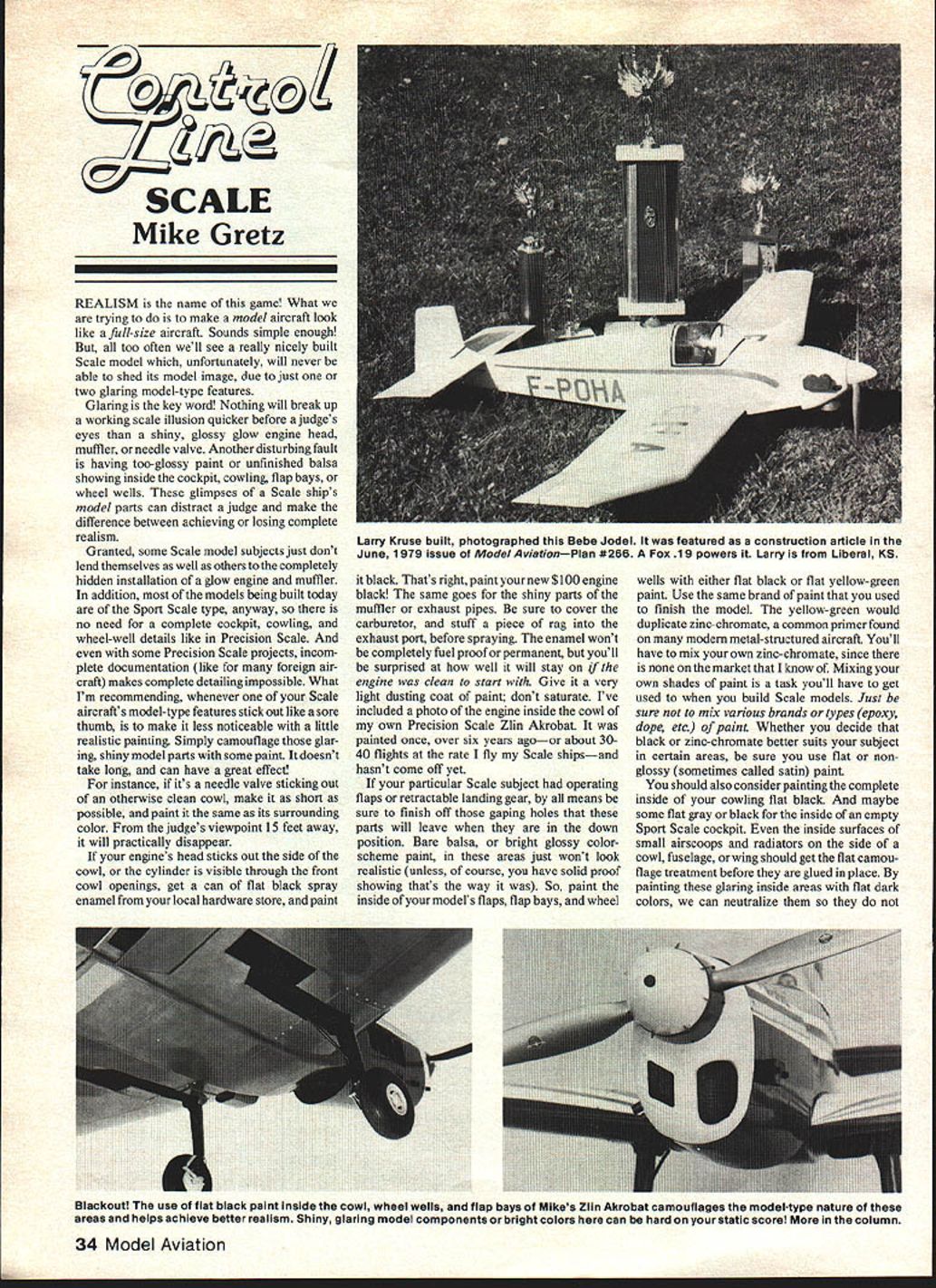
If your engine's head sticks out the side of the cowl, or the cylinder is visible through the front cowl openings, get a can of flat black spray enamel from a hardware store and paint it black. That's right—paint your new $100 engine black! The same goes for shiny parts of the muffler or exhaust pipes. Be sure to cover the carburetor and stuff a rag into the exhaust port before spraying. The enamel won't be completely fuel-proof or permanent, but you'll be surprised how well it will stay on if the engine was clean to start with. Give it a very light dusting coat of paint; don't saturate. I painted the engine in the cowl of my Precision Scale Zlin Akrobat once, over six years ago (about 30–40 flights at the rate I fly my Scale ships), and it hasn't come off yet.
If your subject had operating flaps or retractable landing gear, be sure to finish off the gaping holes left when those parts are in the down position. Bare balsa or bright glossy paint in these areas just won't look realistic (unless you have solid proof that this was the actual finish). Paint the inside of your model's flaps, flap bays, and wheel wells with either flat black or flat yellow-green paint. Use the same brand of paint you used to finish the model. The yellow-green duplicates zinc-chromate, a common primer found on many modern metal-structured aircraft. You'll probably have to mix your own zinc-chromate shade, since I know of none on the market. Mixing paint shades is a task you'll get used to when building Scale models. Just be sure not to mix various brands or types (epoxy, dope, etc.) of paint. Whether you decide that black or zinc-chromate better suits your subject, be sure you use flat or non-glossy (sometimes called satin) paint.
You should also consider painting the complete inside of your cowling flat black. Likewise, use some flat gray or black for the inside of an empty Sport Scale cockpit. Even the inside surfaces of small airscoops and radiators on the side of a cowl, fuselage, or wing should get the flat treatment before they are glued in place. By painting these glaring inside areas with flat, dark colors, you neutralize them so they do not distract from the important outer features of the model.
So stand back and take a good long look at your own Scale aircraft. Are there areas of model glare? If in doubt, paint flat.
Quick fixes
- Shorten and paint exposed needle valves to match the surrounding color.
- Spray-visible engine heads, mufflers, and exhaust pipes flat black (cover carburetor and block exhaust first).
- Paint inside flap bays, wheel wells, cowling, airscoops, and empty cockpits flat black or zinc-chrome (yellow-green).
- Use the same brand/type of paint as the exterior finish; avoid mixing incompatible paints.
Season wrap-up / Call for submissions
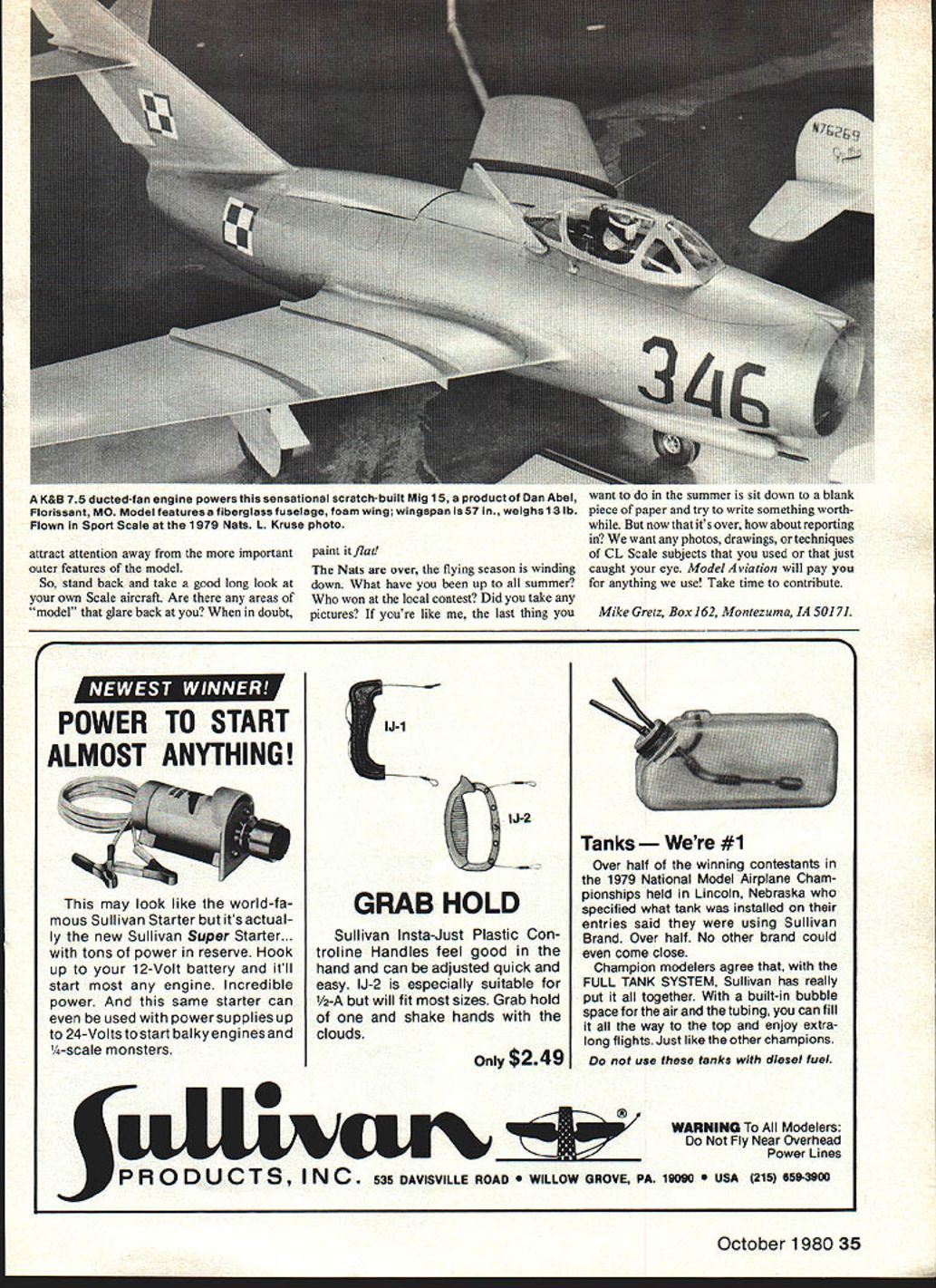
The Nats are over and the flying season is winding down. What have you been up to all summer? Who won at the local contest? Did you take any pictures? If you're like me, the last thing you wanted to do in the summer was sit down to a blank piece of paper and write something worthwhile. Now that it's over, how about reporting in?
We want any photos, drawings, or techniques of CL Scale subjects that you used or that caught your eye. Model Aviation will pay you for anything we use. Take time to contribute.
Mike Gretz Box 162 Montezuma, IA 50171
Transcribed from original scans by AI. Minor OCR errors may remain.

