
Control Line: Scale
By Mike Gretz
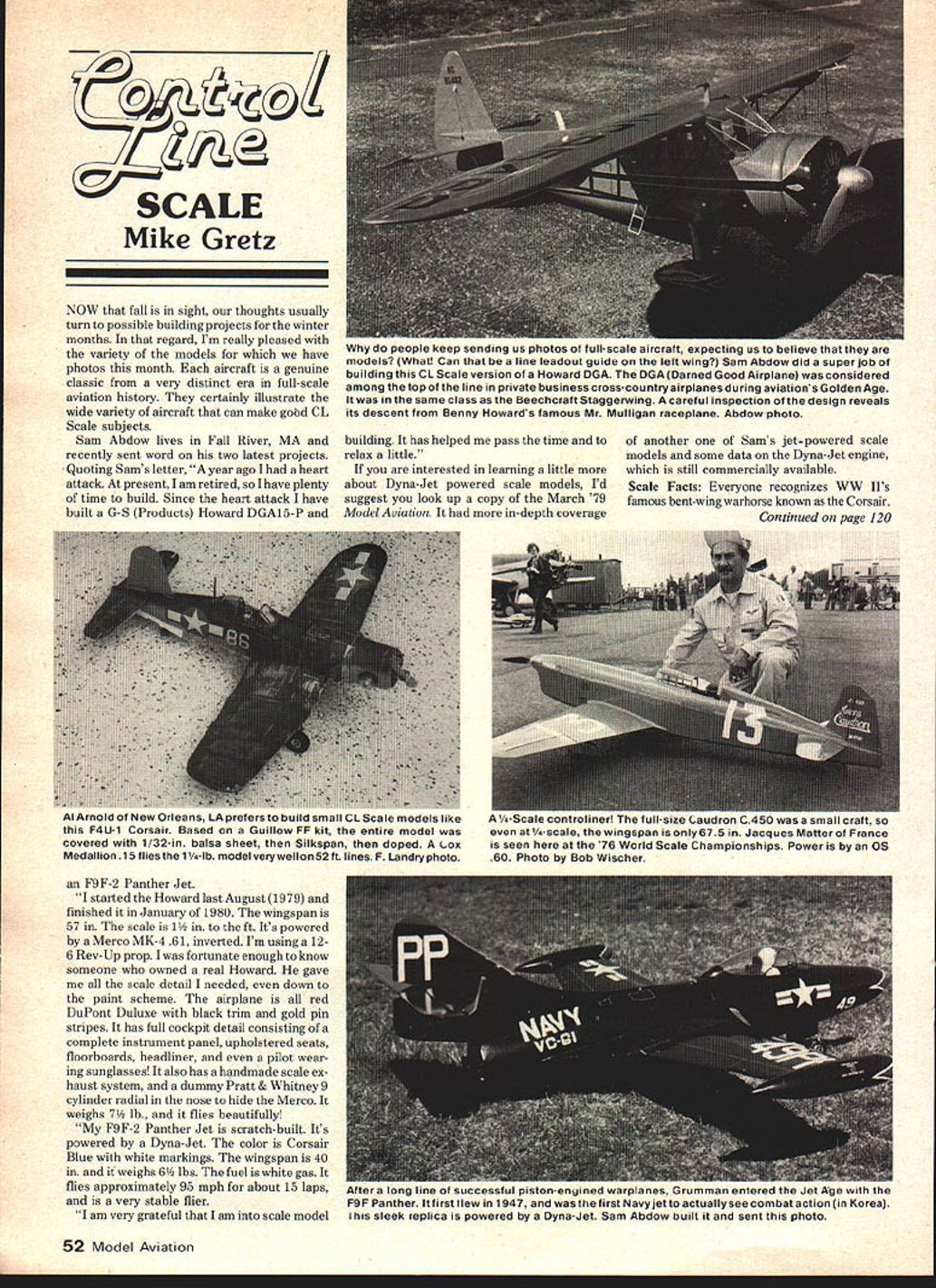
Now that fall is in sight, our thoughts usually turn to possible building projects for the winter months. I'm really pleased with the variety of the models we have photos of this month. Each aircraft is a genuine classic from a distinct era in full-scale aviation history, and they illustrate the wide variety of aircraft that can make good CL scale subjects.
Sam Abdow (Fall River, MA)
Sam Abdow recently sent word about his two latest projects. In his letter he wrote that a year ago he had a heart attack. He is now retired and has plenty of time to build. Since the heart attack he has built a G-S (Products) Howard DGA-15-P and an F9F-2 Panther jet. Building has helped him pass the time and relax a little.
If you're interested in Dyna-Jet powered scale models, he suggests looking up the March 1979 Model Aviation, which had in-depth coverage of another of Sam's jet-powered scale models and some data on the Dyna-Jet engine, which is still commercially available.
Scale facts — Howard DGA-15-P and F9F-2 Panther (Sam Abdow)
Sam's Howard:
- Started: August 1979; Finished: January 1980
- Wingspan: 57 in.
- Scale: 1½ in. to the ft.
- Power: Merco MK-4 .61, inverted
- Prop: 12x6 Rev-Up
- Finish: all red DuPont DuLuxe with black trim and gold pinstripes
- Details: full cockpit detail (complete instrument panel, upholstered seats, floorboards, headliner, pilot figure wearing sunglasses), handmade scale exhaust system, and a dummy Pratt & Whitney 9-cylinder radial in the nose to hide the Merco
- Weight: 7 1/4 lb.
- Performance: flies beautifully
Sam's F9F-2 Panther:
- Scratch-built
- Power: Dyna-Jet
- Finish: Corsair Blue with white markings
- Wingspan: 40 in.
- Weight: 6 1/2 lb.
- Fuel: white gas
- Performance: about 95 mph for approximately 15 laps; a very stable flier
Sam says he is very grateful for scale model building — it has helped him pass the time and relax.
CL Scale / Gretz
I'll confess I was puzzled a few years back when I heard the Corsair referred to as a Goodyear FG Corsair. I had thought the correct nomenclature was Chance Vought F4U Corsair. Salvatore Amico's photo of his model Corsair prompted me to research the true scale facts again.
The Chance Vought company did indeed design, develop, and build the Corsair. The F4U-1D was the most widely used version during the war. It had 2,250 hp and a top speed of 425 mph. To meet battlefield demand, further production of the F4U was licensed to Brewster Aircraft and Goodyear. The aircraft they turned out were identical to the F4U-1D, although Brewster and Goodyear each used different designations.
Production totals:
- Chance Vought F4U-1: 7,830
- Brewster F3A-1D: 735
- Goodyear FG-1D: 4,017
- Total production: 12,582
Regardless of factory, the Corsair's combat effectiveness was legendary. Corsairs destroyed 2,140 Japanese aircraft while losing only 189 of their own — a kill-loss ratio of 11.3 to 1. Before the war was over, the Japanese were referring to the Corsair as "Whistling Death."
Mike Gretz Box 162, Montezuma, IA 50171.
Transcribed from original scans by AI. Minor OCR errors may remain.

