
Control Line: Scale
Mike Gretz
It's been said a million times: one of the things that makes the hobby of model building and flying so enjoyable is the character of the people you meet while involved in it. If you're like me, it was the creating, tinkering, working with your hands, and the lore of flight that first attracted you to the hobby. But wasn't it enjoyable the first time you happened across someone at the hobby shop or airport who "talked the same language"? Most of the time, an almost instant rapport is apparent that makes conversation with a previous stranger easy and relaxing.
I have become even more aware of that common bond since I started writing this column. There has been a continuous influx of photos and ideas from modelers all over the country. The openness of those modelers has been a genuine source of pleasure for me. Here's a good example.
Alan Callaghan — British Nationals
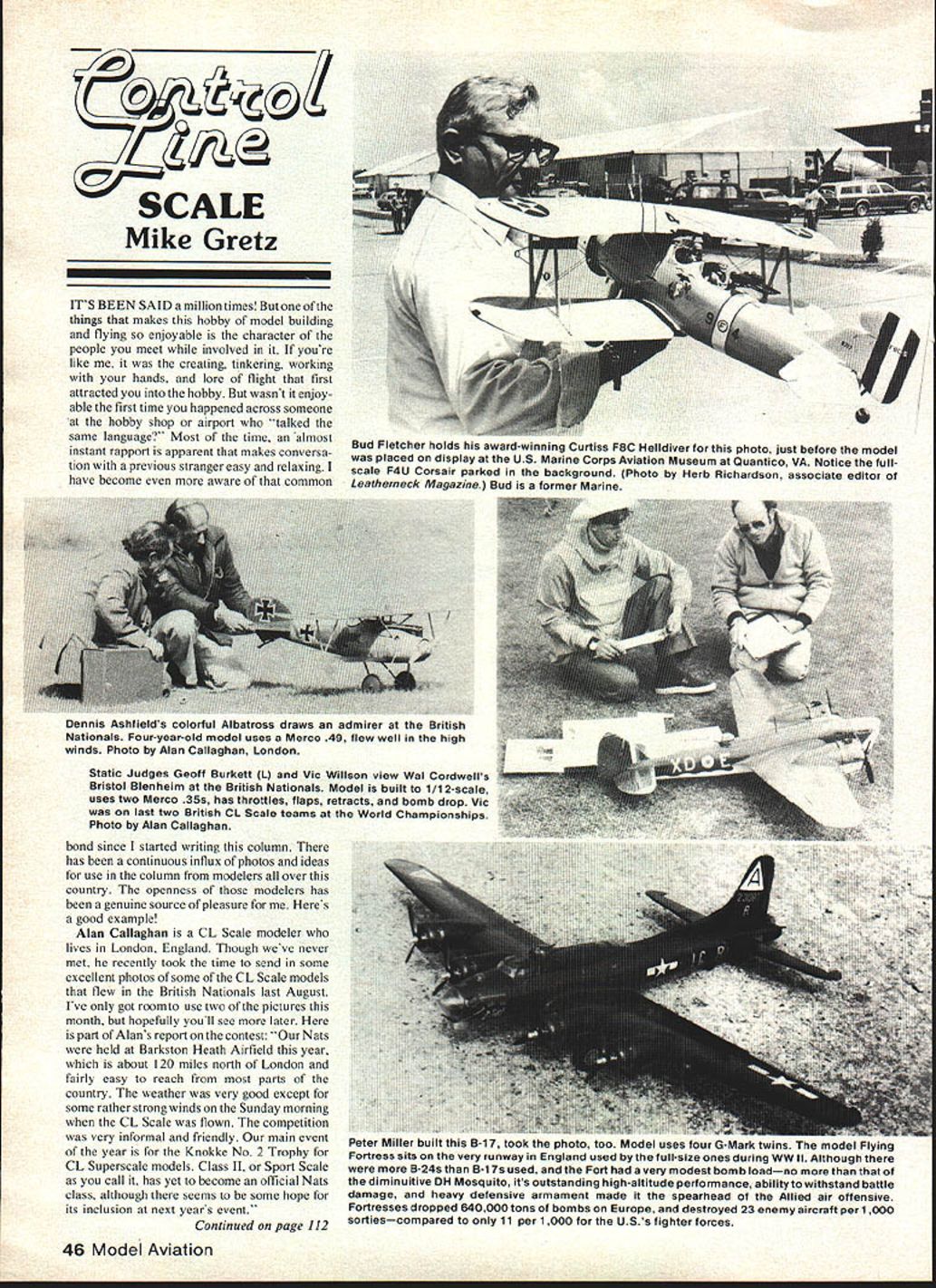
Alan Callaghan is a CL Scale modeler who lives in London, England. Though we've never met, he recently took the time to send in some excellent photos of some of the CL Scale models that flew in the British Nationals last August. I've only got room to use two of the pictures this month, but hopefully you'll see more later.
Here is part of Alan's report on the contest: "Our Nats were held at Barkston Heath Airfield this year, which is about 120 miles north of London and fairly easy to reach from most parts of the country. The weather was very good except for some rather strong winds on the Sunday morning when the CL Scale was flown. The competition was very informal and friendly. Our main event of the year is for the Knokke No. 2 Trophy for CL Superscale models. Class II, or Sport Scale as you call it, has yet to become an official Nats class, although there seems to be some hope for its inclusion at next year's event."
Peter Miller — B-17 "Chow-Hound"
Another letter from overseas came from Peter Miller of Suffolk, England. He has built a 1/19-scale model of a B-17 Flying Fortress, nicknamed "Chow-Hound." Peter related in his letter that the photo he was sending was taken on a wartime airfield which was home to the 381st Bomb Group of the 8th Air Force. Full-size B-17s rolled over the same spot that his "Chow-Hound" occupies in the photo.
The model is scratch-built with a detachable wing. Power is supplied by four G-Mark twin engines. These are, according to Peter, grossly over-propped on Tornado 7x6 three-bladers, which makes the 7-1/4-lb. model very realistic in flight. The throttles are operated via a torque-rod system (see the October 1979 MA CL Scale column for a similar system). Peter proudly stated that his "Chow-Hound" came in second last June at the Old Warden All-Scale Rally, which is the largest Scale event in England each year.
USMC Scale Aircraft Rally — Bud Fletcher
For the past two years, the U.S. Marine Corps Aviation Museum has sponsored a USMC Scale Aircraft Rally at its home base near Quantico, Va. While this is basically an R/C contest, they include a static display event to determine the most authentic Scale model of a Marine Corps aircraft at the contest.
This past summer, the static event was open to all types of Scale models, and the eventual winner was Bud Fletcher with a beautiful CL Curtiss Helldiver. Bud was himself a Marine aviation ordnanceman during the Korean War and now lives in the Bronx, N.Y. Here is part of what he had to say about his standout model: "My Curtiss F8C-5 Helldiver is scratch-built from my own plans. The scale is 1 in. = 1 ft. It includes hand-made pilot, gunner, cylinder heads, and Lewis machine guns. The finish is Aero-Gloss—no decals; everything is painted with stencils. The power plant is a McCoy .36 Sportsman." This black-and-white photo of his Helldiver was taken by Herb Richardson, associate editor of Leatherneck magazine.
Zinc-Chromate Primer — Richard Aley
In the October 1980 column, I talked about painting certain areas of your model—like wheel wells and the insides of wings—with either flat black or greenish-yellow paint for better realism. The greenish-yellow was to simulate zinc-chromate, which is a full-scale aviation primer and corrosion inhibitor. Richard Aley of Honolulu, HI, doesn't like to just simulate zinc-chromate—he prefers to use the real thing. His reasons make good sense.
He says, "Martin-Senour markets a genuine zinc-chromate primer (Martin-Senour No. 8829) that I have used with very good results. In addition to providing proper color for internal parts, it can be very useful when painting external parts of models. You can use it on music wire and then top-coat it with dope, and it sticks nicely. As is known, dope on bare music wire has almost no adhesion, normally. Automotive supply stores that handle Martin-Senour products can usually supply the No. 8829 primer in quart cans."
Farewell and Column Change
This will be my last column on CL Scale for Model Aviation. In recent months, jobs and personal considerations have made it virtually impossible for me to find the time that I feel is really necessary to do this column justice. I want to thank all the modelers who contributed their ideas and photos for publication in the past three years.
Next month, Dick Byron, twice Nats Sport Scale champion, will take over the duties here. I'm sure he'll do a great job. If you support him as you did me, this column will continue to be an open forum for CL Scale modelers all over the world. Remember, no idea is too basic for publication. The columns that I did which received the most favorable comment from readers were those dealing with the most fundamental problems of building your first CL Scale ship. A technique might seem elementary to some of us, but you can bet that it is a mystery to someone else! There are a lot of would-be Scale builders out there who might just need the spark of one of your ideas to get them going. I plan on sending Dick material regularly. I hope you will too!
Good luck with your hobby!
Mike Gretz Box 162 Montezuma, IA 50171
Transcribed from original scans by AI. Minor OCR errors may remain.

