
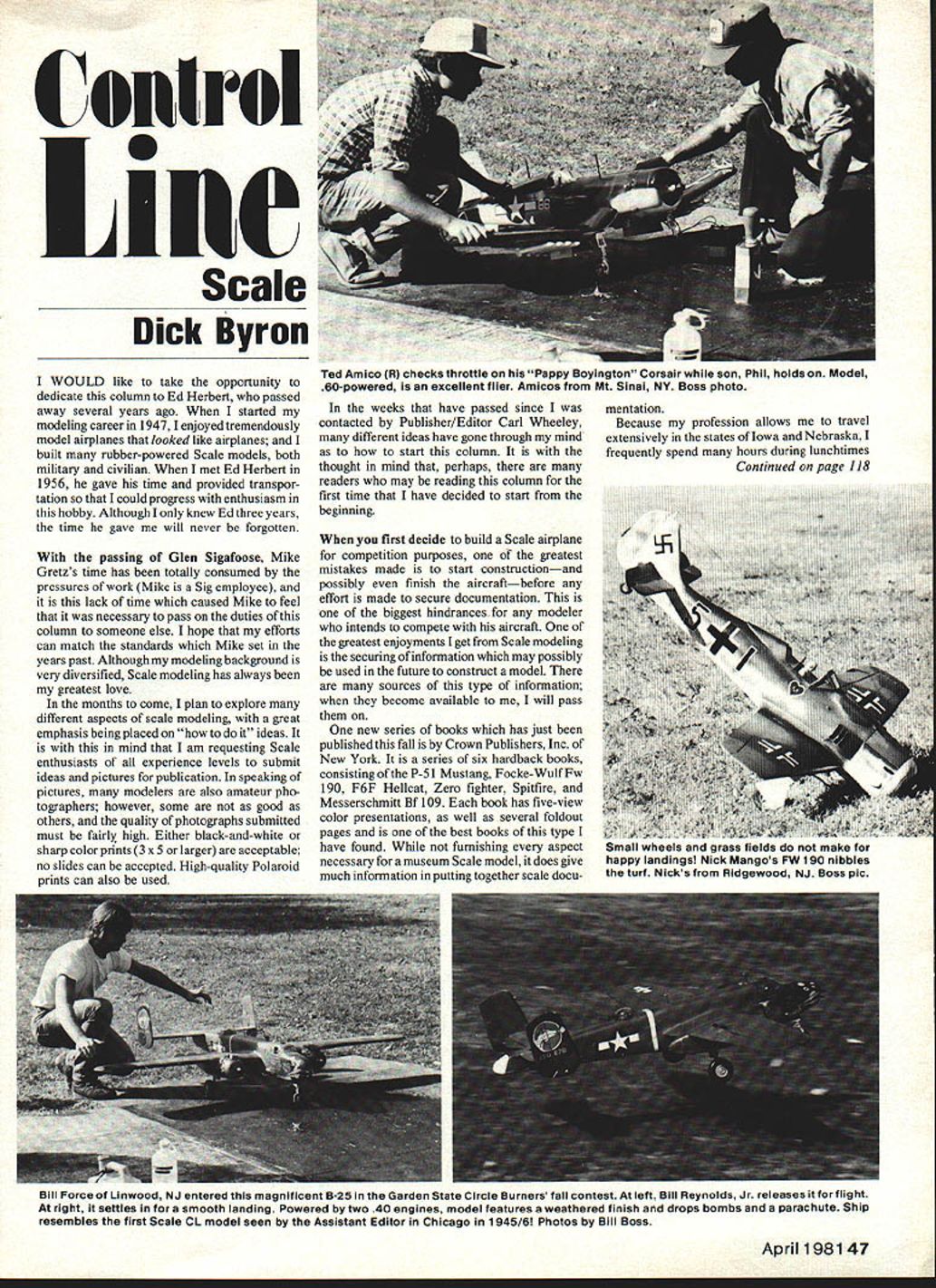
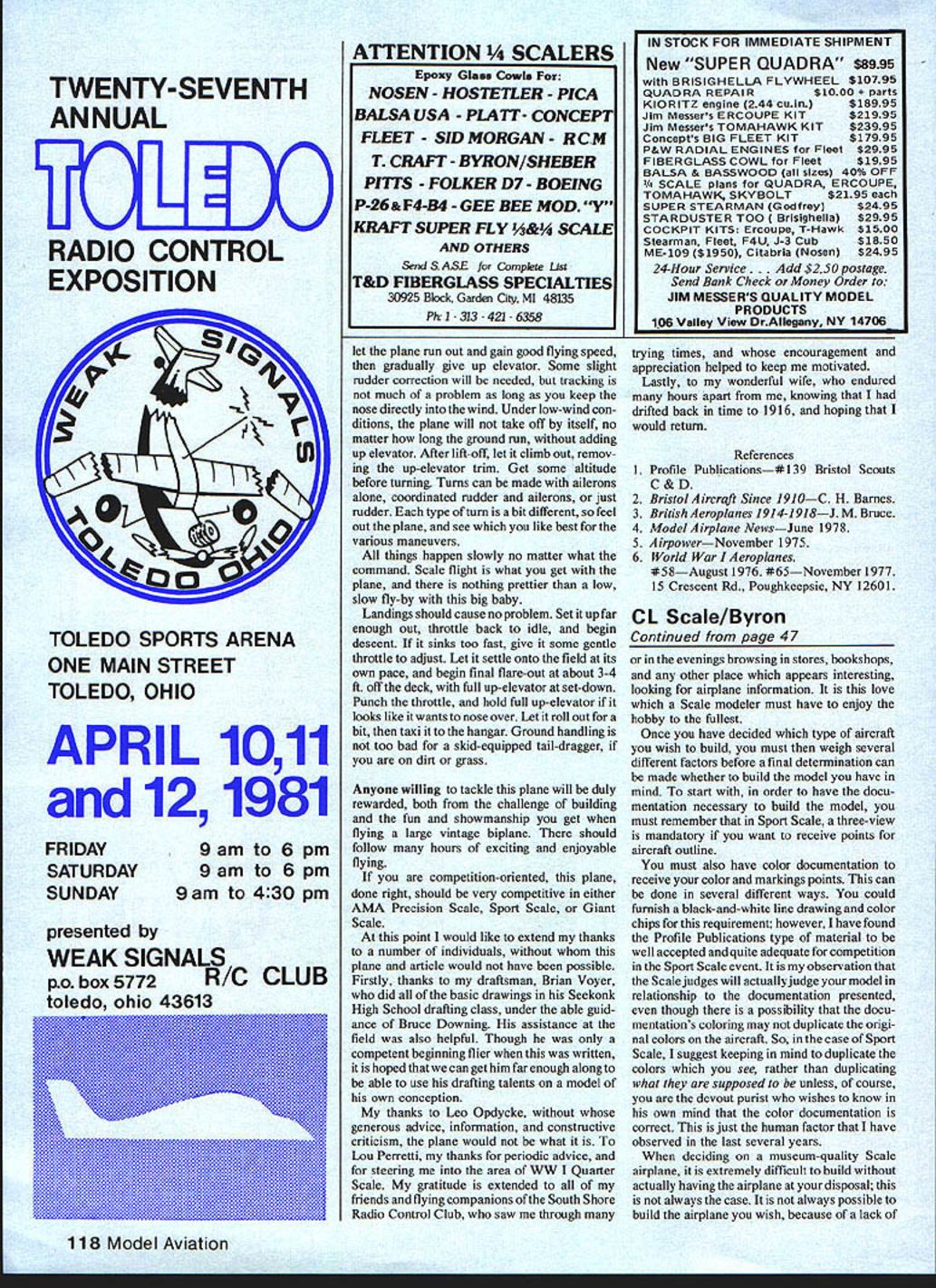
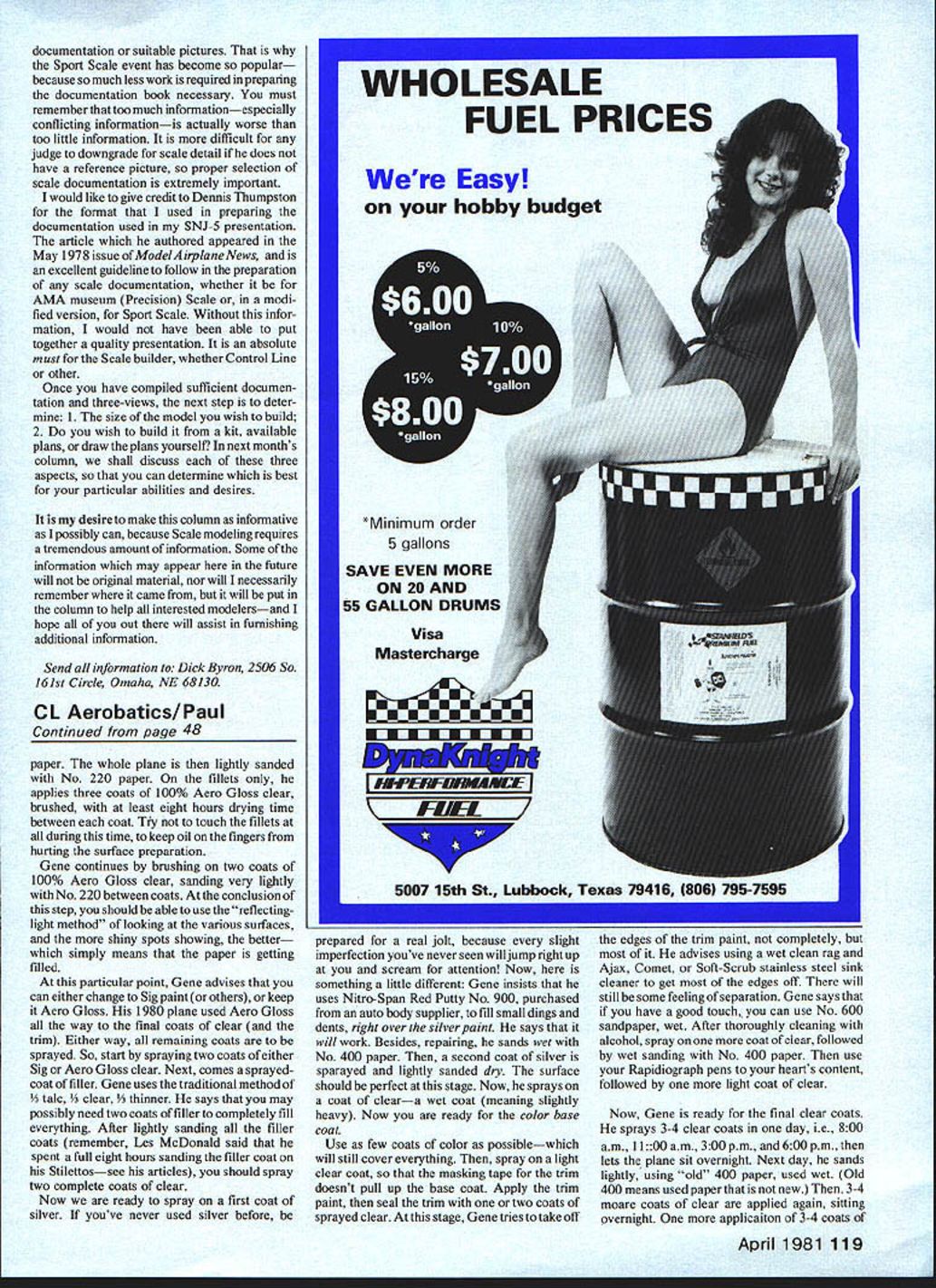
Control Line: Scale
Dick Byron
Dedication and Introduction
I would like to dedicate this column to Ed Herbert, who passed away several years ago. When I started my modeling career in 1947, I enjoyed tremendously model airplanes that looked like airplanes; I built many rubber-powered scale models, both military and civilian. When I met Ed Herbert in 1956, he gave his time and provided transportation so that I could progress with enthusiasm in this hobby. Although I only knew Ed three years, the time he gave me will never be forgotten.
With the passing of Glen Sigafoose, Mike Gretz's time has been totally consumed by the pressures of work (Mike is a Sig employee), and it is this lack of time that caused Mike to pass on the duties of this column to someone else. I hope that my efforts can match the standards Mike set in years past. Although my modeling background is diversified, scale modeling has always been my greatest love.
In the months to come I plan to explore many different aspects of scale modeling, with a strong emphasis on "how to do it" ideas. With this in mind, I request scale enthusiasts of all experience levels to submit ideas and pictures for publication.
Photography and Submissions
- Submit high-quality black-and-white or sharp color prints, 3 x 5 inches or larger.
- No slides can be accepted.
- High-quality Polaroid prints are acceptable.
- Many modelers are also amateur photographers; however, submitted photographs must be of good quality.
Send all information to: Dick Byron 2506 So. 161st Circle Omaha, NE 68130
Getting Started: Documentation First
When you first decide to build a scale airplane for competition, one of the greatest mistakes is to start construction — and possibly even finish the aircraft — before making any effort to secure documentation. This is one of the biggest hindrances for any modeler who intends to compete. One of my greatest enjoyments in scale modeling is securing information that may be used later to construct a model. There are many sources of information; when they become available to me, I will pass them on.
Because my profession allows me to travel extensively in Iowa and Nebraska, I frequently spend many hours during lunchtimes or in the evenings browsing stores, bookshops, and any other place that appears interesting, looking for airplane information. It is the love of research that a scale modeler must have to enjoy the hobby to the fullest.
Recommended Reference Material
One new series of books published this fall by Crown Publishers, Inc. (New York) is worth noting. The series consists of six hardback books: P-51 Mustang, Focke-Wulf Fw 190, F6F Hellcat, Zero fighter, Spitfire, and Messerschmitt Bf 109. Each book has five-view color presentations and several foldout pages. While they do not furnish every aspect necessary for a museum-quality scale model, they provide much useful information for putting together scale documentation.
Choosing the Type of Scale Model
Once you have decided which type of aircraft you wish to build, weigh several factors before making a final decision:
- Documentation requirements: In Sport Scale, a three-view is mandatory if you want points for aircraft outline.
- Color documentation: You must have color documentation to receive color and markings points. This can be provided as a black-and-white line drawing plus color chips, but publications like Profile Publications are often well accepted for Sport Scale competition.
- Judges and documentation: Scale judges will judge your model in relation to the documentation presented. It is therefore important to present documentation that matches what you build. For Sport Scale, I suggest duplicating the colors you see, rather than what they are supposed to be, unless you are the owner/pilot and know the aircraft's exact colors.
- Conflicting information: Too much information — especially conflicting information — can be worse than too little. Proper selection of scale documentation is extremely important.
When deciding on a museum-quality scale airplane, it is extremely difficult to build without actually having access to the real airplane. Lack of documentation or suitable pictures can make a project impossible. That is why the Sport Scale event has become popular — it requires less work preparing the documentation book.
Documentation Format and Credit
I would like to credit Dennis Thumpston for the format I used in preparing the documentation for my SNJ-5 presentation. His article in the May 1978 issue of Model Airplane News is an excellent guideline for preparing scale documentation, whether for AMA Precision (museum) Scale or, in modified form, Sport Scale. Without that information I would not have been able to put together a quality presentation. It is an essential reference for the scale builder, whether control line or other.
Once you have compiled sufficient documentation and three-views, the next step is to determine:
- The size of the model you wish to build.
- Whether you wish to build from a kit, available plans, or draw the plans yourself.
In next month's column we will discuss each of these three aspects so you can determine which is best for your abilities and desires.
CL Flight and Handling (Scale Flight Tips)
Let the plane run out and gain good flying speed, then gradually give up elevator. Some slight rudder correction will be needed, but tracking is not much of a problem as long as you keep the nose directly into the wind. Under low-wind conditions, the plane will not take off by itself, no matter how long the ground run, without adding up elevator.
After lift-off, let it climb out, removing the up-elevator trim. Get some altitude before turning. Turns can be made with ailerons alone, coordinated rudder and ailerons, or just rudder. Each type of turn feels different, so experiment and see which you prefer for various maneuvers.
Scale flight happens slowly and gracefully. There is nothing prettier than a low, slow fly-by by a large vintage biplane.
Landings should present no problem. Set up far enough out, throttle back to idle, and begin descent. If it sinks too fast, give gentle throttle to adjust. Let it settle onto the field at its own pace, and begin final flare-out at about 3–4 ft off the deck, with full up-elevator at set-down. If it looks like it wants to nose over, punch the throttle and hold full up-elevator. Let it roll out, then taxi to the hangar. Ground handling is not too bad for a skid-equipped tail-dragger if you are on dirt or grass.
Anyone willing to tackle this plane will be duly rewarded by the challenge of building and the fun and showmanship of flying a large vintage biplane. There should follow many hours of exciting and enjoyable flying.
If you are competition-oriented, this plane, done right, should be very competitive in AMA Precision Scale, Sport Scale, or Giant Scale.
Acknowledgments
I extend my thanks to a number of individuals without whom this plane and article would not have been possible:
- Brian Voyer — my draftsman, who did all the basic drawings in his Seekonk High School drafting class under the guidance of Bruce Downing. His assistance at the field was also helpful.
- Leo Opdycke — for generous advice, information, and constructive criticism.
- Lou Perretti — for periodic advice and for steering me into the area of WW I Quarter Scale.
- My friends and flying companions of the South Shore Radio Control Club — for encouragement and appreciation that kept me motivated.
- Lastly, to my wonderful wife, who endured many hours apart from me while I drifted back in time to 1916.
References
- Profile Publications — #139 Bristol Scouts C & D.
- Bristol Aircraft Since 1910 — C. H. Barnes.
- British Aeroplanes 1914–1918 — J. M. Bruce.
- Model Airplane News — June 1978.
- Airpower — November 1975.
- World War I Aeroplanes — #58 — August 1976, #65 — November 1977. 15 Crescent Rd., Poughkeepsie, NY 12601.
Transcribed from original scans by AI. Minor OCR errors may remain.

