
Control Line: Scale
By Dick Byron
Jim Lee's model (Topeka, KS)
I have a friend, James Lee, who lives in Topeka, KS. While visiting Jim a few years ago, I discovered a very large and complex model in his basement. Built of metal, it was very heavy and very detailed. When I began writing this column, I immediately thought of this model and contacted Jim for information and pictures, because it is a very interesting and unique aircraft.
He sent pictures, in which you will notice a very complex framework and intricate wire bracing and detailing. Although the aircraft is now in considerable disrepair, its uniqueness was overwhelming to me. The wingspan is 88 in. On the right wing is a decal that says, "The Penn State College Extension Service Civilian Pilot Training." On the left wing, a decal indicates, "Built by War Model Production Project Pennsylvania WPA Piper YO-59." The decals are actually more like paper than the decals we know today.
Jim states: "It was originally constructed with operational rudder, elevator, aileron, stab trim, complete with cable pulleys and all necessities to duplicate the real aircraft. It had a steel rod fuselage (very heavy), wood spars, a sheet metal leading edge, turnbuckles, and a multi-leaf spring tail skid. In other words, it was a complete duplication of the full-size aircraft. The model was completely soldered together and painted with a black lacquer. The wings appear to be galvanized tin. The aircraft was acquired by Ottawa University in Kansas in approximately 1968. Dr. David Bemmels was cleaning his storeroom and had this airplane in a corner. He said it had originally been used in a CAP program to show control functions and aircraft construction. Dr. Bemmels is a former Free Flight modeler, a full-scale pilot, and a darn good professor."
If anybody has any additional information on this aircraft, it would fill a great void in my knowledge, as well as that of many other readers. Jim is anxious to learn more about the aircraft; if you can furnish information, please forward it to me and I will forward it to Jim.
Scale documentation
I received a very interesting letter a few weeks ago from a man many of us will remember (newcomers to the hobby may not have heard of him), Mr. Bill Effinger. Bill founded Berkeley Models in 1933 in a garage on Berkeley Place in Brooklyn, NY. The service Bill is involved in now, while not directly related to Control Line Scale flying, could very possibly develop into another source of scale information.
Bill has formed W.E. Technical Services, Inc. The address is 526 Lorell Terrace, Atlanta, GA 30238, phone (404) 255-2888. Many of you will remember that over the years Bill had literally over a hundred CL Scale designs with Berkeley Models. I personally have built many of the kits and feel Bill has given us all a great amount of enjoyment through his efforts.
In his letter Bill states, "As for Scale documentation, the thing that is important is scale dimensions, not three-views — which are often drawn by graphics department personnel rather than by engineering. Also, photos are often distorted by special lenses. I use paint shop drawings, usually close enough in giving marking details as well." I am sure Bill would be glad to answer any interested modelers about his available services. As a modeler, I feel it is my duty to pass along information of interest to the hobby — whether it be Control Line, RC, or anything that may interest fellow modelers in scale enjoyment; and that is what it is all about — enjoyment!
Volunteers for '81 Nats
A note from John Preston, NASA secretary-treasurer, states that the time is drawing close to firm up help to run Scale at the Nats. As a competitor, it is always enjoyable to compete at the Nats; however, without event directors, judges (both flight and static), there would be no Nats. If you have a desire to compete someday, the experience and information gained from judging can be extremely important in developing competitive aircraft in the future.
This year we will be selecting the Scale team in both Control Line and RC for the 1982 Scale World Championships, tentatively to be held in Russia. It is important we get qualified help for static and flight judging. Anybody interested, please contact John Preston by mail at 7012 Elvira Court, Falls Church, VA 22042, or call (703) 532-2417 (office phone (301) 492-6604). If you can help even just a little, it will be much appreciated.
Duplicating machine guns
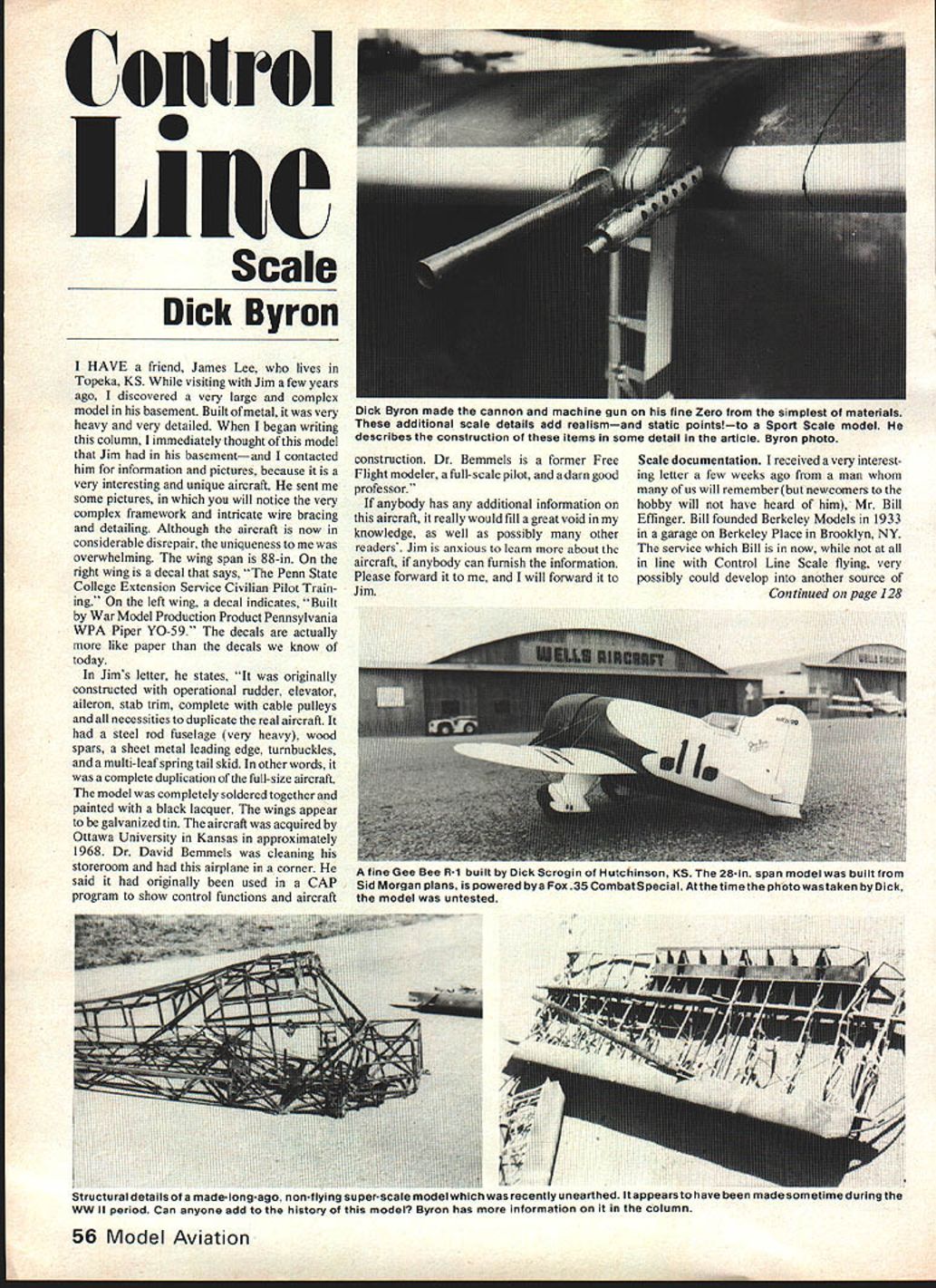
One of the pictures this month is of the machine gun and cannon used on my Zero. The cannon on the left was formed using aluminum tubing that was placed against a block of wood and an awl driven into the end to expand the cannon flash suppressor muzzle, giving the bell-mouth effect. This method is simple and very quick, with only two attempts being necessary to duplicate the initial cannon.
The air-cooled machine gun barrel pictured was formed using several sizes of brass tubing. The outer brass tubing, 1/4 in., had multiple holes drilled through it to give the air-cooled barrel effect. One was slotted and hammered down into the inside cone of a Cox T.D. half-A propeller spinner to compress the tube into the smallest diameter. The barrel itself is 5/16 in. diameter brass tubing, supported in the center of the 1/4 in. tubing by small rings of telescoped brass tubing of appropriate diameters to go from 5/16 in. to 1/4 in. Again, this is very simple and quite easy to duplicate. They were painted with Testor's enamel (steel metal gray). Although not fuelproof, no problems have been encountered.
Richard Byron 2506 S. 161st Circle Omaha, NE 68130 (402) 333-0796
Transcribed from original scans by AI. Minor OCR errors may remain.

