
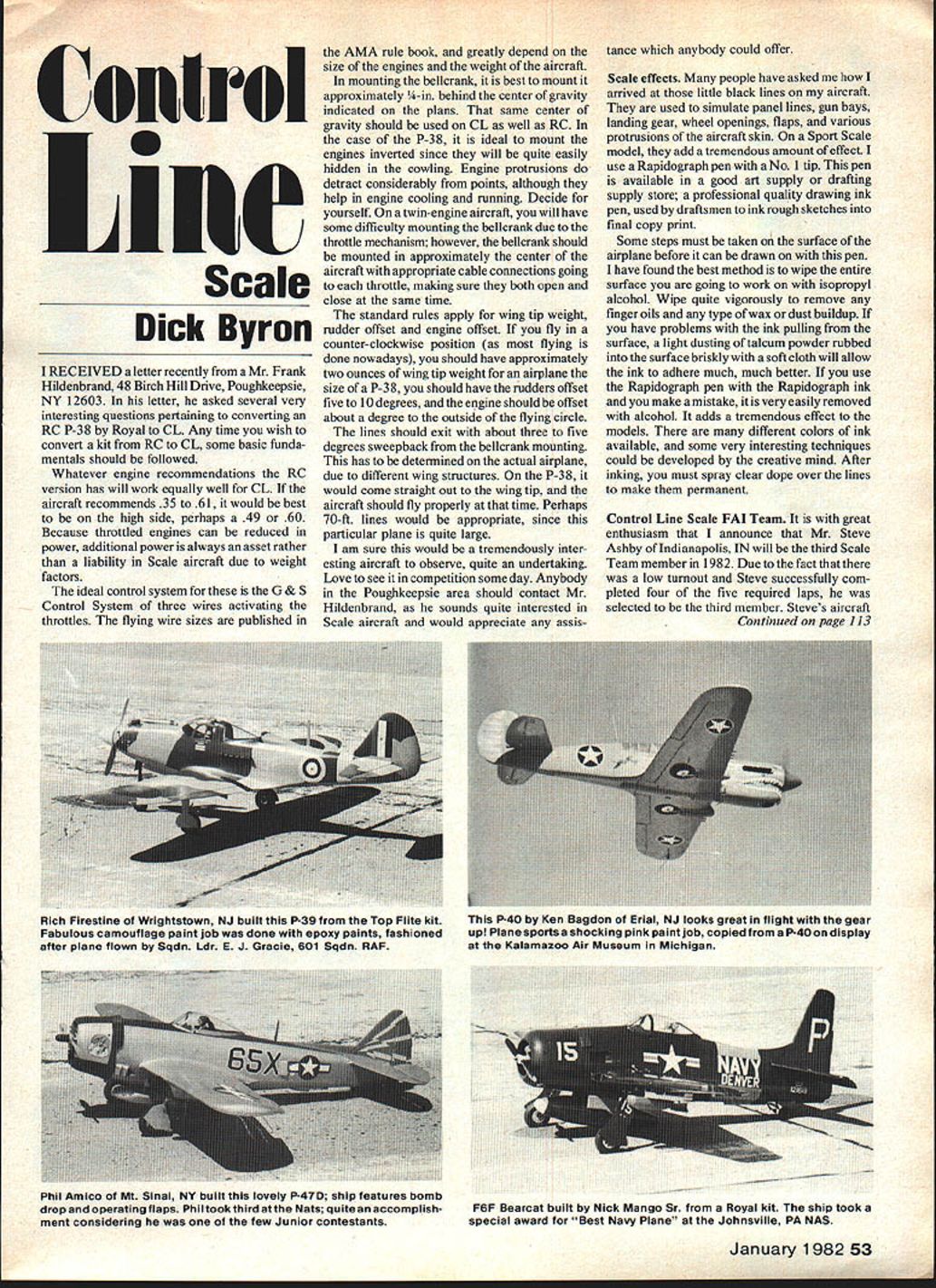
Control Line: Scale
Dick Byron
I received a letter recently from Mr. Frank Hildenbrand, 48 Birch Hill Drive, Poughkeepsie, NY 12603. In his letter he asked several very interesting questions pertaining to converting an RC P-38 by Royal to CL. Any time you convert a kit from RC to CL, some basic fundamentals should be followed.
Engine and power recommendations
Whatever engine recommendations the RC version has will work equally well for CL. If the aircraft recommends .35 to .61, it is best to be on the high side — perhaps a .49 or .60. Because throttled engines can be reduced in power, additional power is an asset rather than a liability in scale aircraft due to weight factors.
- Use a throttled engine so power can be reduced in flight when necessary.
- Prefer the higher end of the recommended range for heavier scale models.
Control system
The ideal control system is the G & S control system of three wires activating the throttles. The flying wire sizes are published in the AMA rule book and depend greatly on the size of the engines and the weight of the aircraft.
Bellcrank and engine mounting
- Mount the bellcrank approximately 1/4 in. behind the center of gravity indicated on the plans. Use the same center of gravity for CL as for RC.
- On the P-38, it is ideal to mount the engines inverted since they can be easily hidden in the cowling. Engine protrusions detract from scale points, although they help with engine cooling and running — decide for yourself.
- On a twin-engine aircraft you may have difficulty mounting the bellcrank because of the throttle mechanism. Mount the bellcrank approximately at the center of the aircraft with appropriate cable connections to each throttle, making sure they both open and close at the same time.
Offsets and balance
The standard rules apply for wingtip weight, rudder offset, and engine offset.
- If you fly counter-clockwise (as most flying is done nowadays), use approximately 2 ounces of wingtip weight for an airplane the size of a P-38.
- Rudders should be offset 5 to 10 degrees.
- Engines should be offset about 1 degree to the outside of the flying circle.
Lines and sweepback
The lines should exit with about 3 to 5 degrees sweepback from the bellcrank mounting. This must be determined on the actual airplane due to different wing structures. On the P-38 the lines could come straight out to the wingtip and the aircraft should still fly properly.
- Consider using approximately 70-ft lines for a large model like this P-38.
This would be a tremendously interesting aircraft to observe and quite an undertaking. Anyone in the Poughkeepsie area should contact Mr. Hildenbrand, as he sounds quite interested in scale aircraft and would appreciate any assistance.
Scale effects (panel lines, gun bays, etc.)
Many people have asked how I arrived at those little black lines on my aircraft. They are used to simulate panel lines, gun bays, landing gear openings, flaps, and various skin protrusions. On a sport-scale model they add a tremendous amount of effect.
- I use a Rapidograph pen with a No. 1 tip (a professional-quality drafting ink pen available at art or drafting supply stores).
- Prepare the surface by wiping vigorously with isopropyl alcohol to remove finger oils, wax, and dust.
- If the ink pulls from the surface, lightly dust with talcum powder and rub briskly with a soft cloth to improve adhesion.
- If you use Rapidograph pen and ink and make a mistake, the ink is easily removed with alcohol.
- After inking, spray clear dope over the lines to make them permanent.
There are many ink colors available; creative techniques can produce interesting effects.
Control Line Scale FAI Team
It is with great enthusiasm that I announce Mr. Steve Ashby of Indianapolis, IN will be the third Scale Team member in 1982. Due to a low turnout and because Steve successfully completed four of the five required laps, he was selected as the third member. Steve's aircraft was exceptionally interesting and should be a stiff competitor with a new wing. He suffered some flying and engine problems which, I am sure, he will have solved by June 1982. Welcome, Steve — I am very happy to have you on the team.
Richard P. Byron 2506 So. 161st Circle Omaha, NE 68130
Transcribed from original scans by AI. Minor OCR errors may remain.

