
Control Line: Scale
Dick Byron
Sources for small hardware and supplies
I recently received a catalog from Caltronic Laboratory, P.O. Box 36356, 461 South Cochran Avenue, Los Angeles, CA 90036. They have an extremely large supply of extremely small nuts and bolts, both brass and stainless steel. For any serious Scale builder, this is a must source for hard-to-find supplies. They also have, in addition to nuts and bolts, other supplies needed to build certain portions of Scale airplanes. Serious modelers should have a copy of this catalog in their files. These items are not readily available from any other source that I know of.
An excellent source for 3-views: I recently received a catalog from Repla-Tech International, Inc., 48500 McKenzie Highway, Vida, OR 97488. They are an excellent source of 3-views for many aircraft—also pictures, plans, etc. A serious Scale builder should definitely have this catalog for reference. I recently purchased some pictures and drawings from them; their service was speedy and excellent.
A new idea for impaired fliers
I recently received a letter from Mr. Joseph Eiben, associate vice-president for AMA District 3, of Solon, OH 44139. He states, "My primary reason for writing you is to comment on the letter you received from Ed Moore in regard to his problem with flying Control Line models. I remember, too, a device marketed a long, long time ago for flying Control Line aircraft outside of the circle. It was a mechanical linkage device; the main drawback was its inability to compensate for loss of line tension, a certain occurrence."
At any rate, I do a little bit of RC sport flying, and the perfect answer is the combination of these two facts. In my initial stage of flying sport Radio Control aircraft, I had my 7-year-old son stand in the middle of a Control Line circle, and I tethered the RC aircraft to him on a 60-foot line. Standing outside of the circle, I was able to keep the aircraft in full view and get the feel of an RC transmitter as opposed to a Control Line handle. This technique would work perfectly in Ed Moore's case. Ed would have the option of having a helper hold the model on a tether and controlling it from outside the circle using a single-channel RC setup, a very economical piece of equipment. The model could also be tethered by use of a pole and a swivel, in which case Ed could fly by himself.
"The big advantage of abandoning a mechanical device and going to a simple RC system is that Ed would have full throttle control of the aircraft even in the event that line tension is not maintained. I would recommend that Ed consider a two-channel system so that he could have throttle and elevator control to make his flying more enjoyable and safer. As a matter of fact, he may be able to utilize some of the very inexpensive RC systems used for race cars, since his model will be no more than 100 feet or so from him at any time. I think if Ed really enjoys Control Line flying as much as he has implied in his correspondence, this would be an approach that would satisfy his requirements."
This scheme described by Joe appears to be an outstanding idea for some other fliers as well. Why I never thought of it before, I don't know, but it surely is feasible; perhaps someone will take the initiative to do more experimentation with it, so that a person incapable of standing and flying a standard Control Line model will have the thrill. Thank you very much, Joseph, for your thoughts and imaginative ideas.
Photos and the PT-17
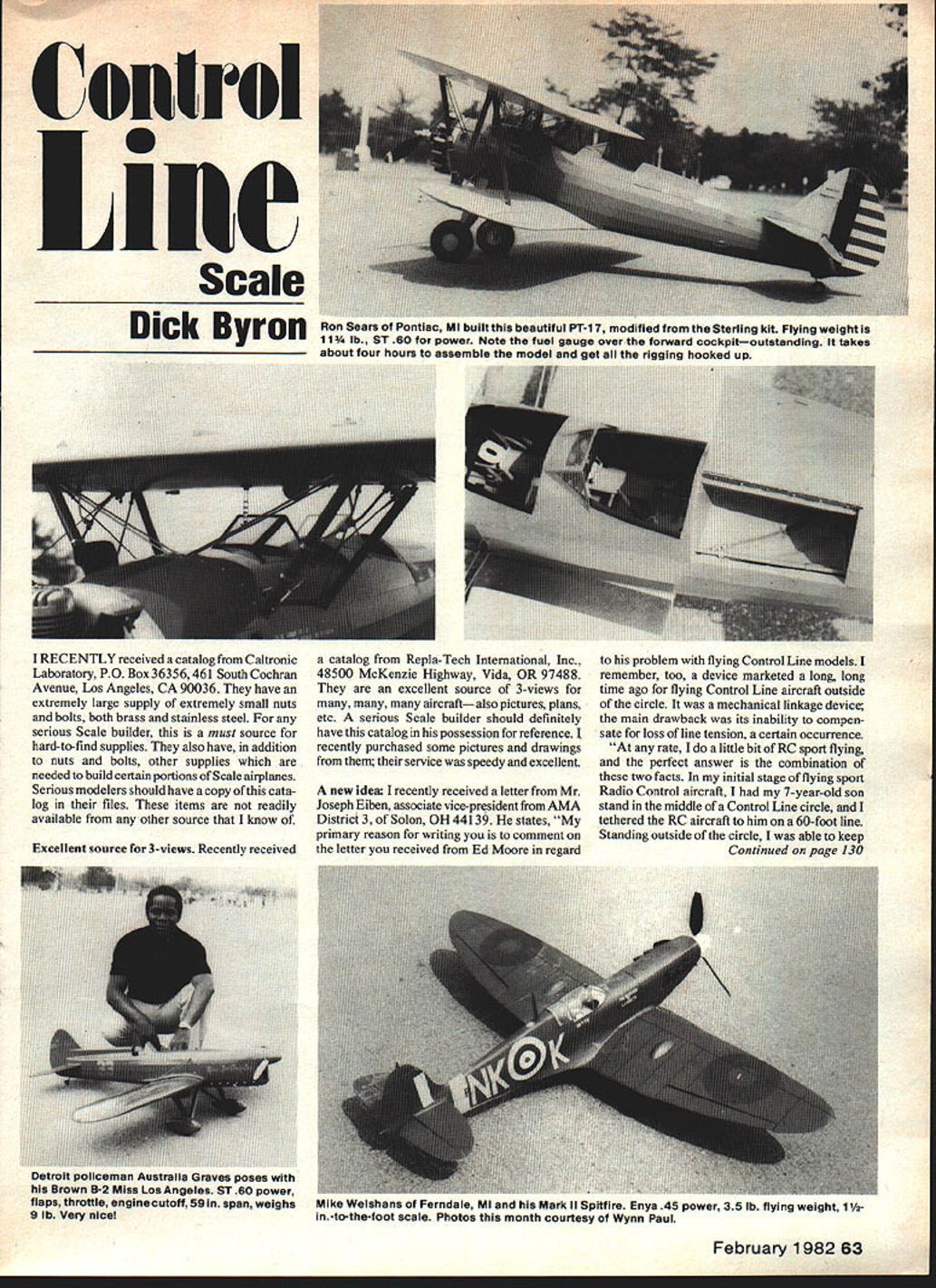
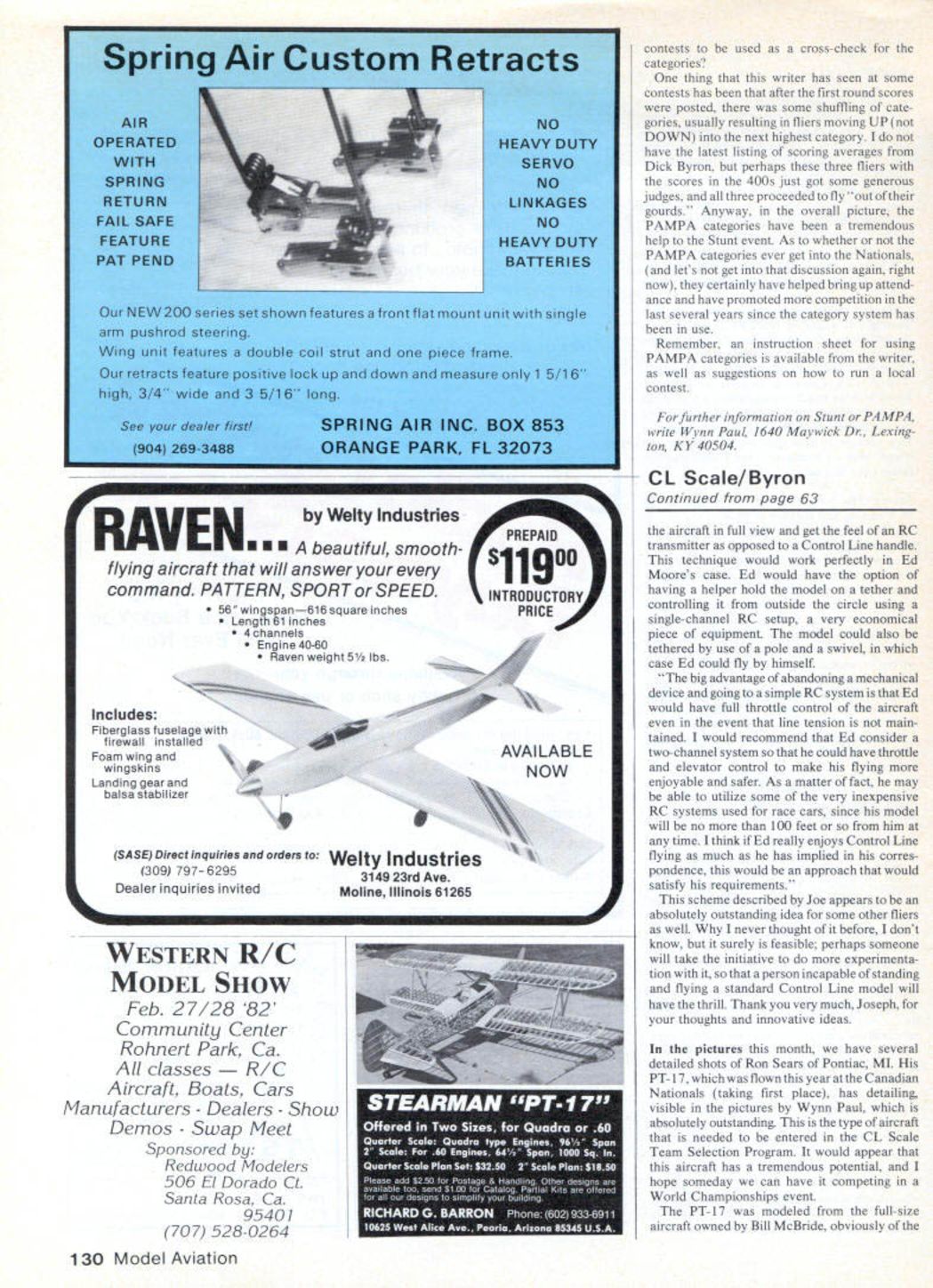
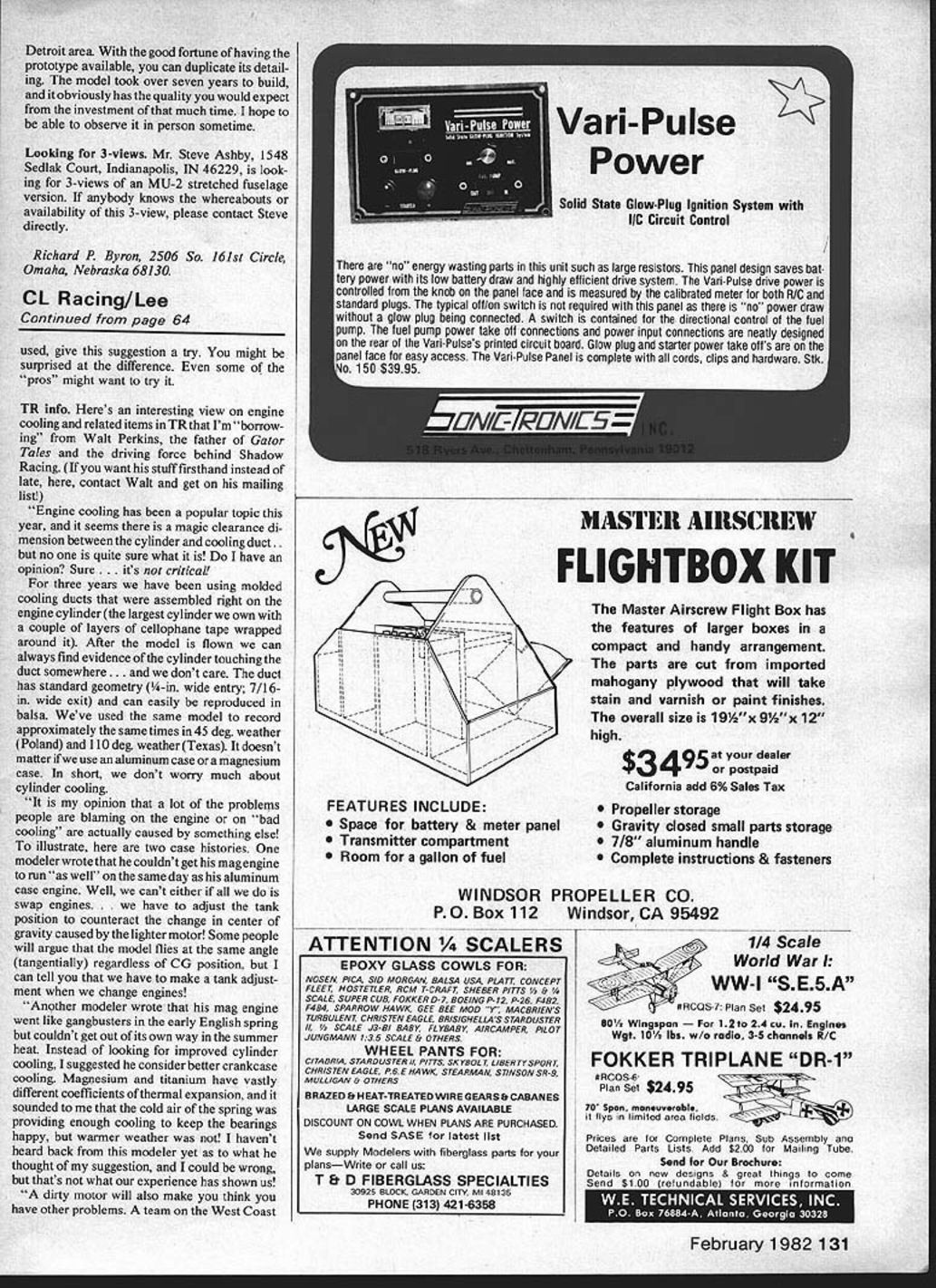
In the pictures this month, we have several detailed shots of Ron Sears of Pontiac, MI. His PT-17, which was flown this year at the Canadian Nationals (taking first place), has detailed work visible in the pictures by Wynn Paul, which is absolutely outstanding. This is the type of aircraft that should be entered in the CL Scale Team Selection Program. It would appear that this aircraft has tremendous potential, and I hope someday we can have it competing in a World Championship event.
The PT-17 was modeled from the full-size aircraft owned by Bill McBride, obviously of the Detroit area. With the good fortune of having the prototype available, you can duplicate its detailing. The model took over seven years to build, and it obviously has the quality you would expect from the investment of that much time. I hope to be able to observe it in person sometime.
Looking for 3-views
Mr. Steve Ashby, 1548 Sedlak Court, Indianapolis, IN 46229, is looking for 3-views of an MU-2 stretched-fuselage version. If anybody knows the whereabouts or availability of this 3-view, please contact Steve directly.
Richard P. Byron 2506 S. 161st Circle Omaha, Nebraska 68130
Transcribed from original scans by AI. Minor OCR errors may remain.

