
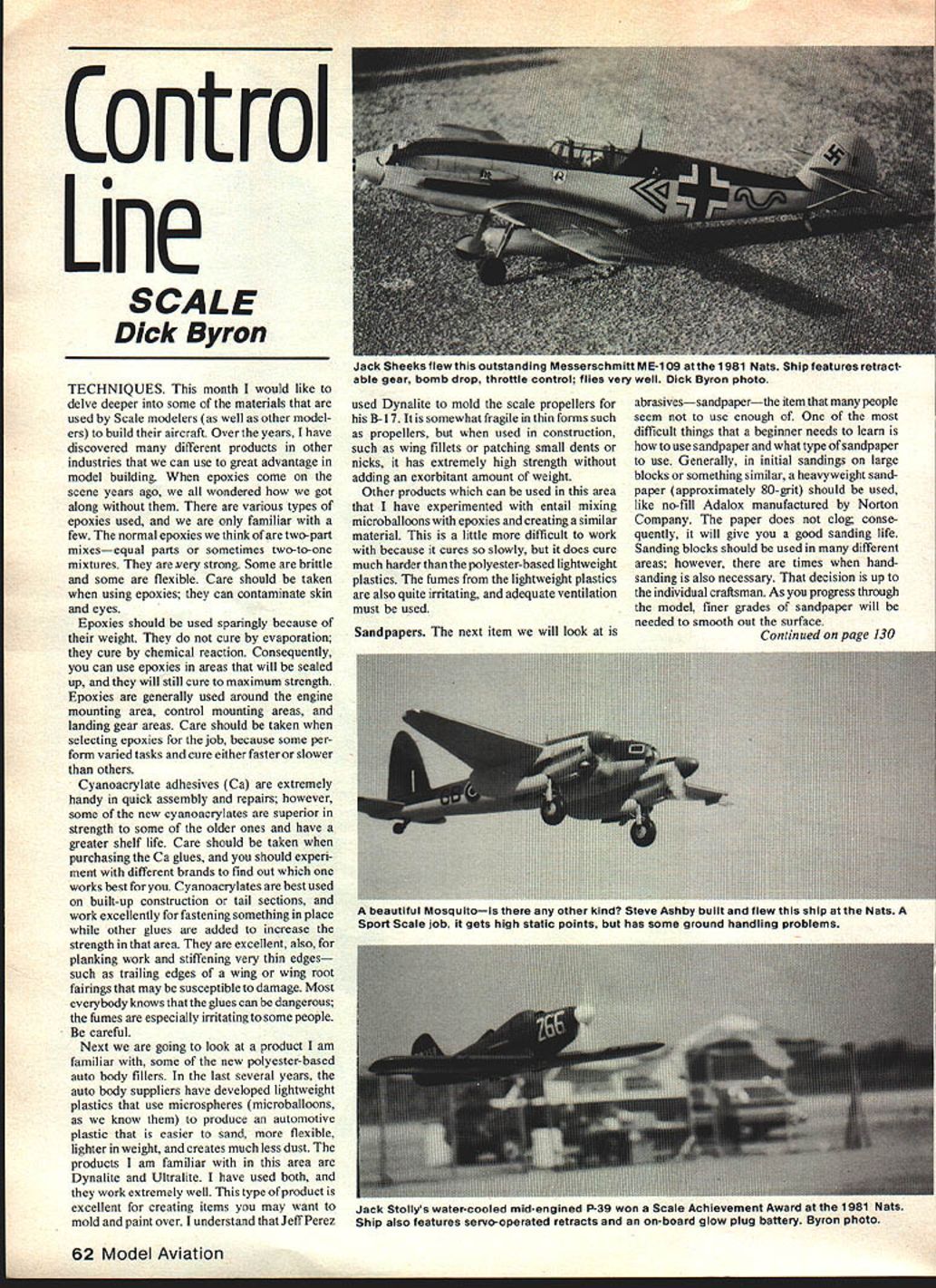
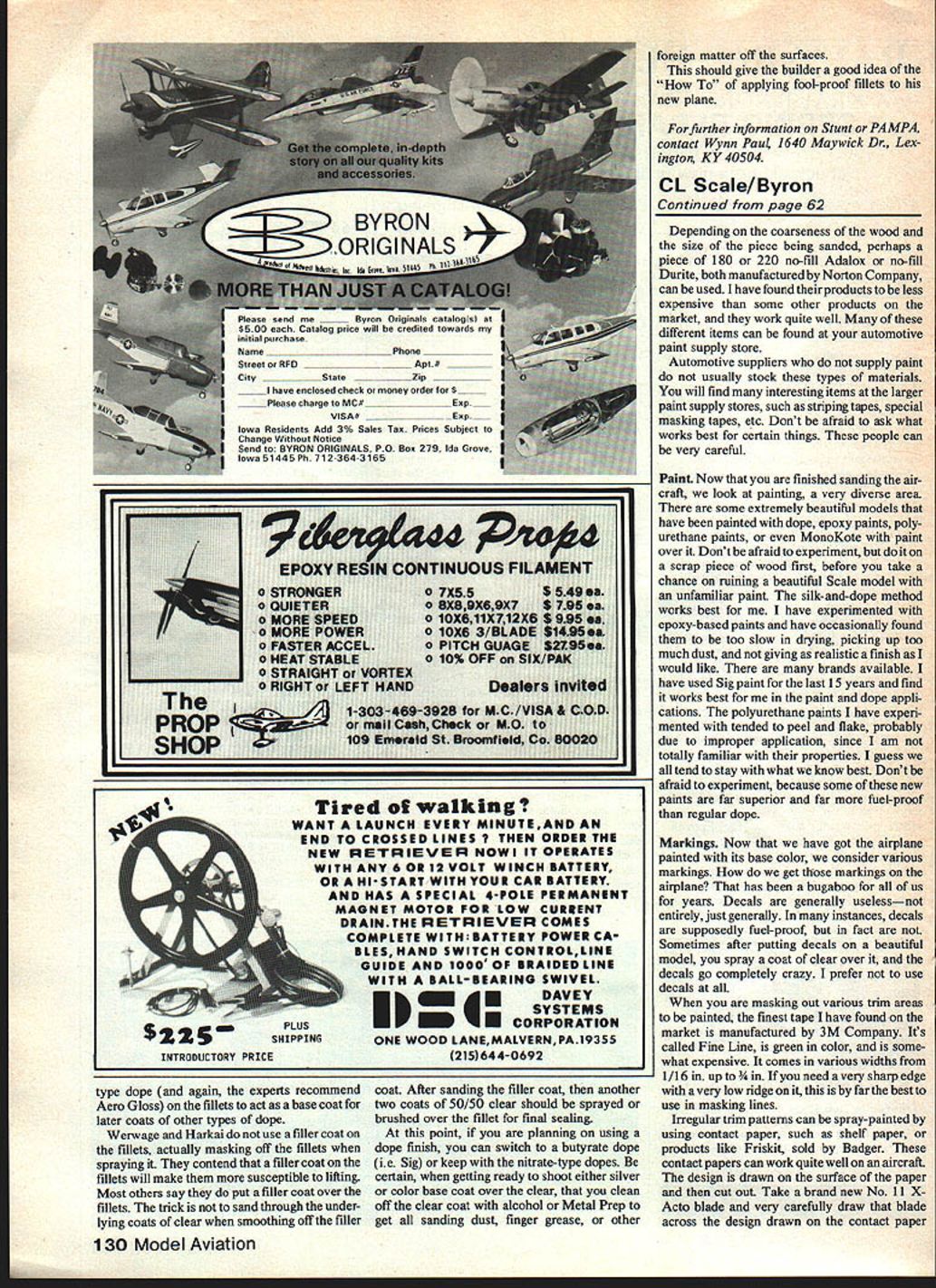
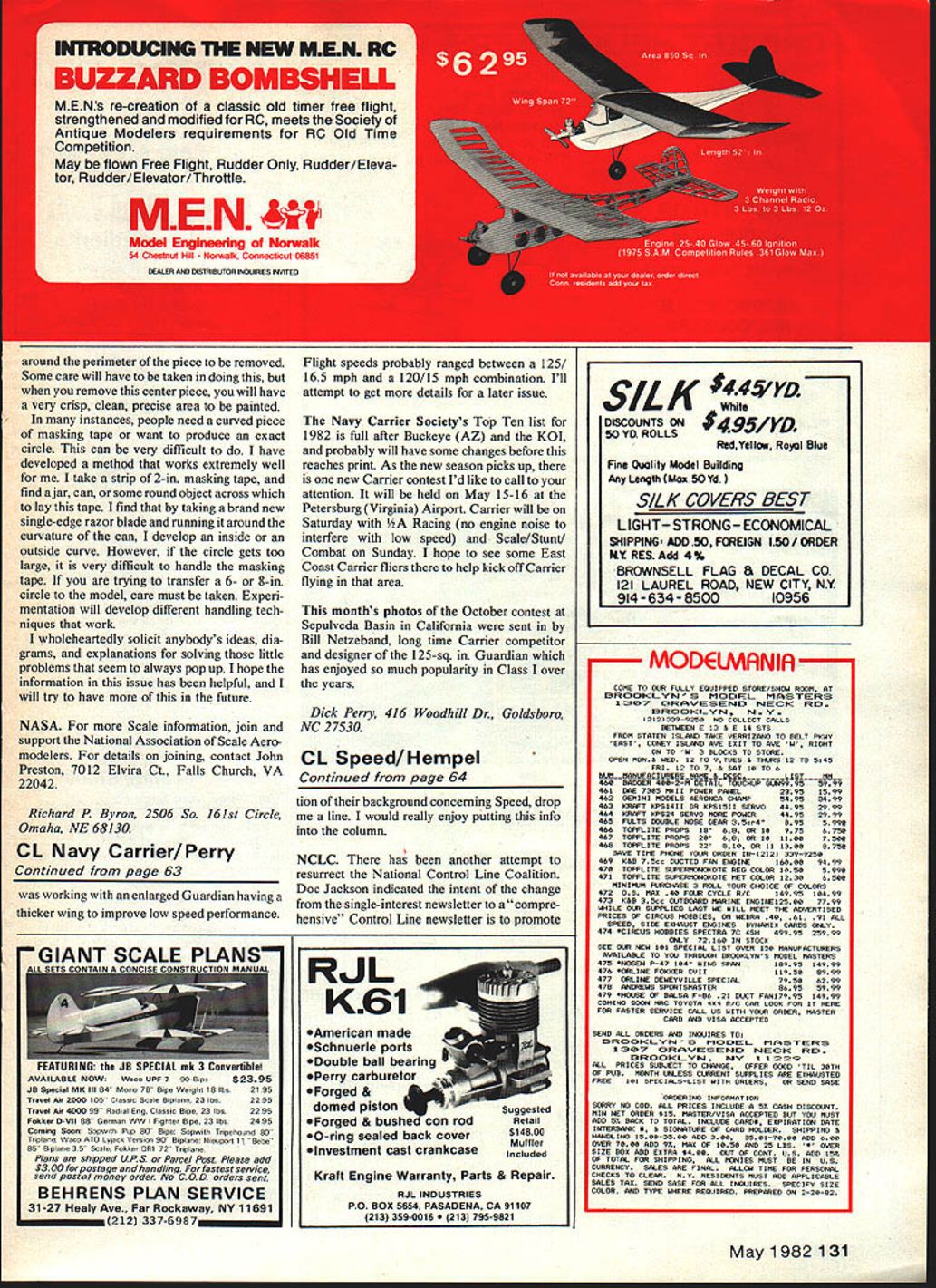
Control Line: Scale
Dick Byron
Techniques
This month I delve deeper into some of the materials used by scale modelers (and other modelers) to build their aircraft. Over the years I have discovered many products from other industries that can be used to great advantage in model building. When epoxies arrived, we all wondered how we got along without them. Below are notes on epoxies, cyanoacrylates, lightweight fillers, abrasives, painting, and markings.
Epoxies
- Epoxies are typically two-part mixes—equal parts or sometimes two-to-one mixtures. They are very strong; some are brittle, some flexible.
- Care should be taken when using epoxies: they can contaminate skin and eyes.
- Epoxies should be used sparingly because of their weight.
- They do not cure by evaporation; they cure by chemical reaction. Consequently, you can use epoxies in areas that will be sealed up and they will still cure to maximum strength.
- Common uses: engine mounting areas, control mounting areas, and landing gear areas.
- Select an epoxy appropriate to the job—some cure faster or slower and have different properties.
Cyanoacrylate adhesives (CA)
- Cyanoacrylates are extremely handy for quick assembly and repairs.
- Newer CAs can be superior in strength and have a greater shelf life than older varieties.
- Experiment with different brands to find what works best for you.
- Best uses: built-up construction, tail sections, temporarily fastening parts while other glues are added, planking work, and stiffening very thin edges (e.g., trailing edges, wing root fairings).
- Be aware that CA fumes can be irritating; take appropriate safety precautions.
Polyester-based auto body fillers and microballoons
- Auto body suppliers have developed lightweight plastics using microspheres (microballoons) to produce fillers that are easier to sand, more flexible, lighter, and create less dust.
- Products such as Dynalite and Ultralite work extremely well for molding and painting items, wing fillets, and patching small dents or nicks.
- These materials can be somewhat fragile in thin forms (e.g., propellers), but they provide high strength without excessive weight when used appropriately.
- Another option is mixing microballoons with epoxies to create a similar work material. This mixture cures more slowly and can cure harder than polyester-based fillers, but it is a little more difficult to work with.
- Fumes from polyester-based lightweight plastics can be irritating—use adequate ventilation.
Sandpapers (Abrasives)
- Sandpaper is an essential tool many people underuse. Beginners must learn how to use sandpaper and which types to use.
- For initial sanding on large blocks, use heavyweight sandpaper (approximately 80-grit). No‑fill papers such as Adalox (manufactured by the Norton Company) do not clog and provide long sanding life.
- Use sanding blocks in many areas, but hand-sanding is necessary at times. The choice depends on the craftsman and the workpiece.
- As you progress, switch to finer grits (e.g., 180 or 220) to smooth surfaces. No‑fill Adalox or no‑fill Durite (both by Norton) are good, economical choices.
- Many of these abrasives and related items can be found at larger automotive paint supply stores. Automotive suppliers who do not sell paint may not stock these materials—ask at paint supply stores for other useful items (striping tapes, special masking tapes, etc.).
Paint
- Painting is a diverse area. Models have been finished with dope, epoxy paints, polyurethane paints, or even MonoKote with paint over it. Experimentation is encouraged—test on scrap wood first.
- The silk-and-dope method works well for me. I have used Sig paint for many years with satisfactory results.
- Epoxy-based paints can be slow to dry, attract dust, and may not produce the desired realistic finish.
- Polyurethane paints I have tried tended to peel and flake, possibly due to improper application. Newer paints can be far superior and more fuel-proof than regular dope—don’t be afraid to try them, but practice first.
- Before shooting silver or color base coats over clear, clean the clear coat with alcohol or Metal Prep to remove sanding dust, finger grease, or other contaminants.
Markings
- Applying markings has long been a challenge. Decals are sometimes disappointing; they may not be truly fuel-proof and can react poorly to clear coats.
- Masking and painting markings often gives better results:
- For very fine, sharp lines, 3M Fine Line tape (green) is excellent. It comes in widths from 1/16" up to 1/2" and produces a low ridge for sharp edges.
- For irregular trim patterns, use contact paper (shelf paper) or products like Friskit (sold by Badger). Draw the design on the mask and cut it out with a new No. 11 X‑Acto blade, remove the backing, apply the mask, spray, and then remove and touch up as needed.
Fillets and dope finishing
- Type dope (experts recommend Aero Gloss) can be used on fillets as a base coat for later coats of other types of dope.
- There are differing practices: some builders (e.g., Wernicke and Harkai) mask off fillets when spraying and do not use a filler coat, arguing that a filler coat can lift. Others recommend a filler coat over fillets.
- If you use a filler coat, take care not to sand through the underlying clear coats when smoothing. After sanding the filler coat, apply another two coats of 50/50 clear (sprayed or brushed) over the fillet for final sealing.
- If using a dope finish, you can switch to a butyrate dope (e.g., Sig) or use nitrate-type dopes—clean surfaces before topcoating.
This overview should give the builder a good idea of materials and methods for building and finishing a fool-proof scale control-line airplane. Use proper safety precautions (ventilation, eye and skin protection) and practice new techniques on scrap before applying them to your model.
Transcribed from original scans by AI. Minor OCR errors may remain.

