
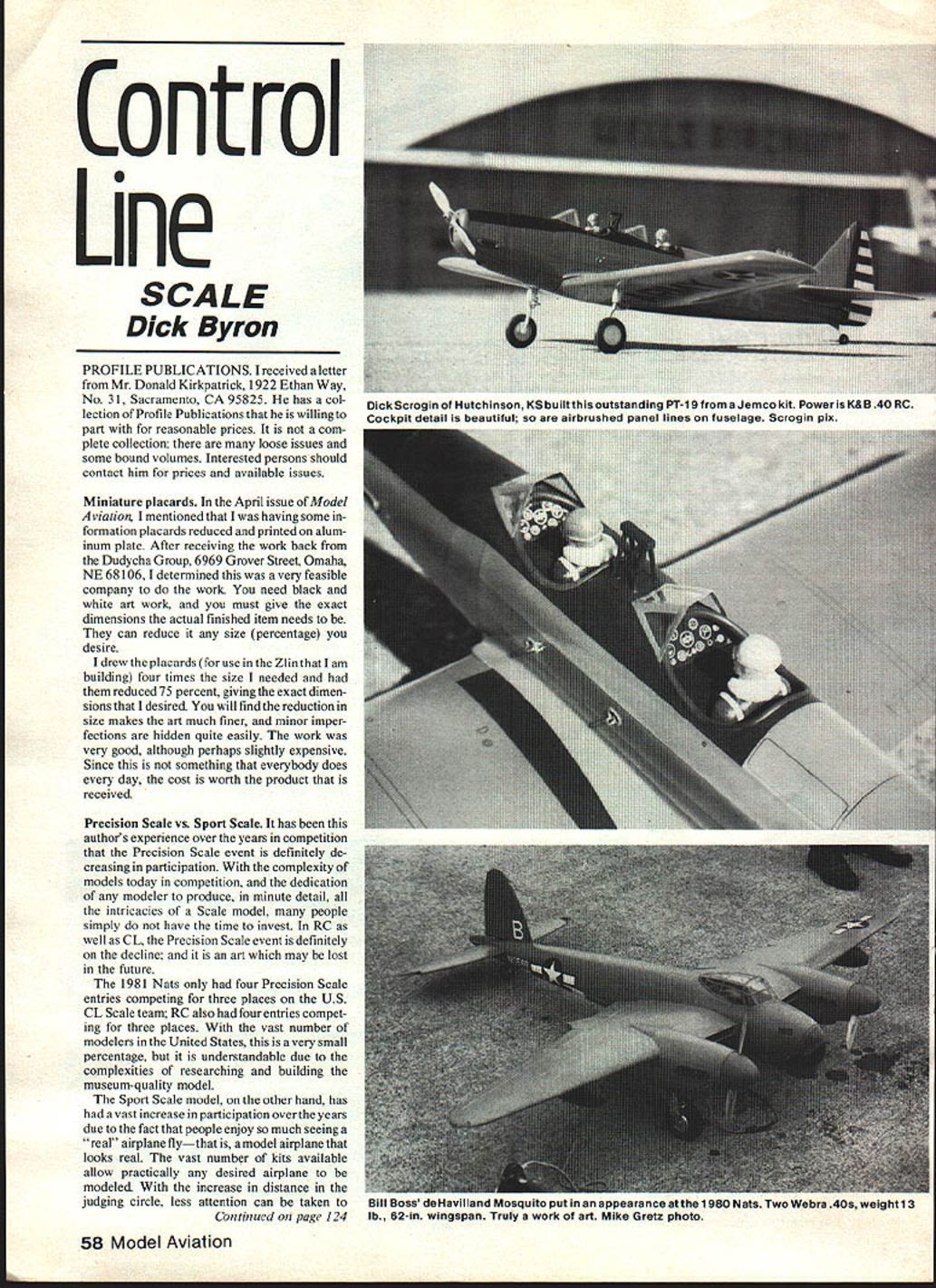
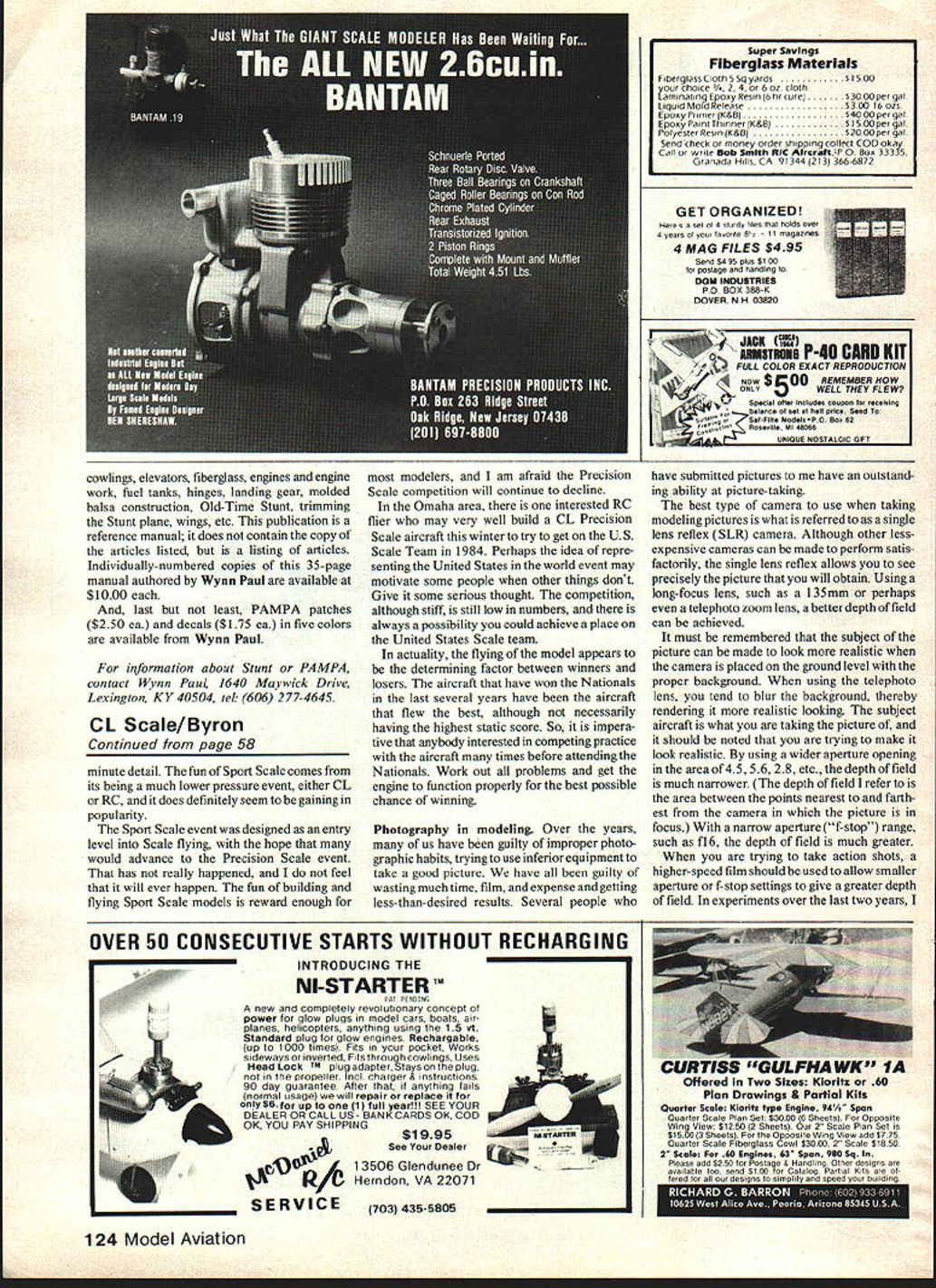
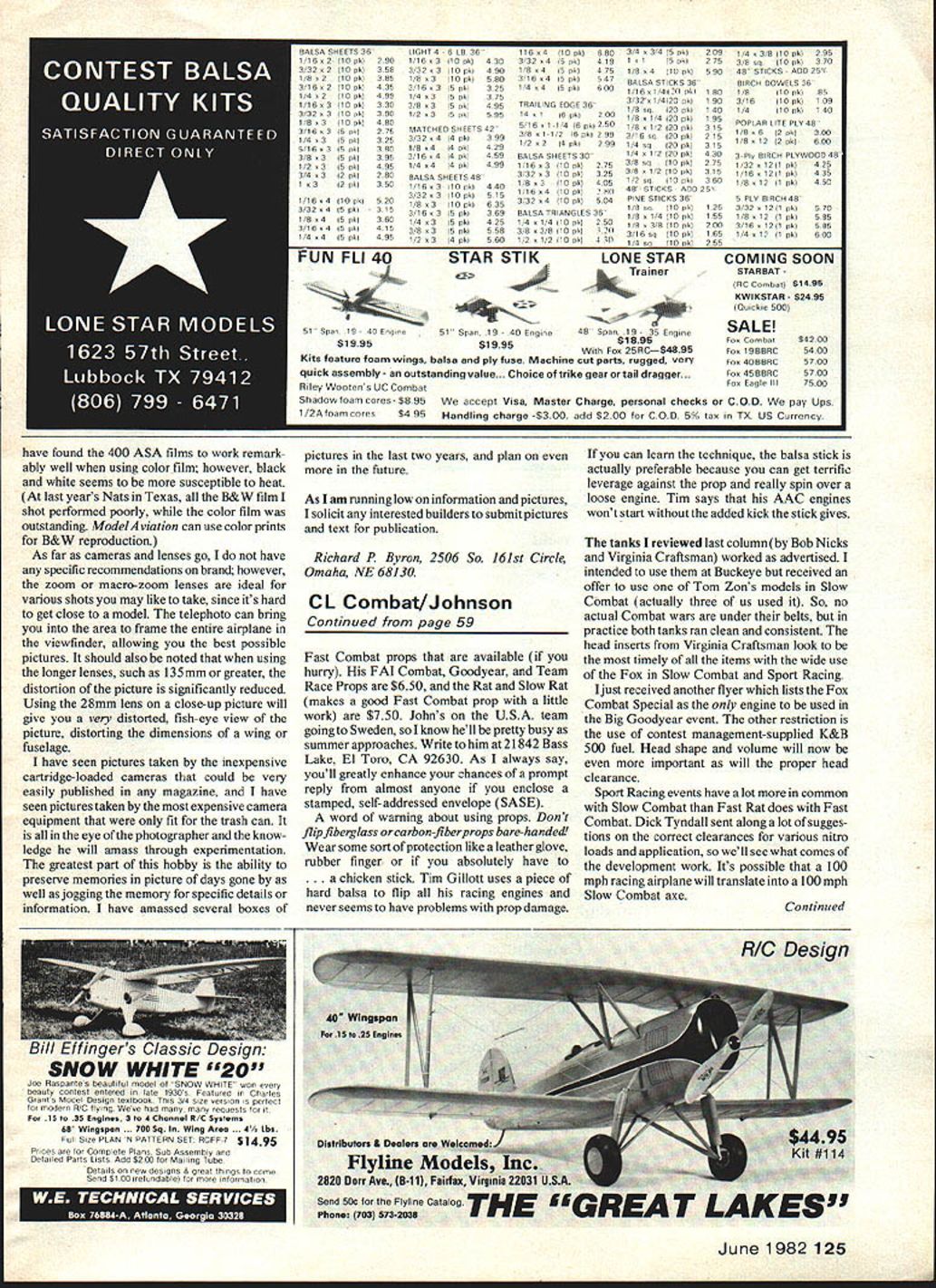
Control Line: SCALE
Dick Byron
Profile Publications
I received a letter from Mr. Donald Kirkpatrick, 1922 Ethan Way, No. 31, Sacramento, CA 95825. He has a collection of Profile Publications that he is willing to part with for reasonable prices. It is not a complete collection; there are many loose issues and some bound volumes. Interested persons should contact him for prices and available issues.
Miniature placards
In the April issue of Model Aviation I mentioned that I was having some information placards reduced and printed on aluminum plate. After receiving the work back from the Dudycha Group, 6969 Grover Street, Omaha, NE 68106, I determined this was a very feasible company to do the work. You need black-and-white artwork, and you must give the exact dimensions the actual finished item needs to be. They can reduce it any size (percentage) you desire.
I drew the placards (for use in the Zlin that I am building) four times the size I needed and had them reduced 75 percent, giving the exact dimensions that I desired. You will find the reduction in size makes the art much finer, and minor imperfections are hidden quite easily. The work was very good, although perhaps slightly expensive. Since this is not something that everybody does every day, the cost is worth the product that is received.
Precision Scale vs. Sport Scale
It has been my experience over the years in competition that the Precision Scale event is definitely decreasing in participation. With the complexity of models today and the dedication required to produce, in minute detail, a museum-quality Scale model, many people simply do not have the time to invest. In RC as well as CL, the Precision Scale event is on the decline; it is an art which may be lost in the future.
The 1981 Nats only had four Precision Scale entries competing for three places on the U.S. CL Scale team; RC also had four entries competing for three places. With the vast number of modelers in the United States, this is a very small percentage, but it is understandable due to the complexities of researching and building a museum-quality model.
The Sport Scale model, on the other hand, has had a vast increase in participation over the years because people enjoy seeing a "real" airplane fly—that is, a model airplane that looks real. The vast number of kits available allow practically any desired airplane to be modeled. With the increase in distance in the judging circle, less attention can be taken to minute detail. The fun of Sport Scale comes from its being a much lower-pressure event, either CL or RC, and it does seem to be gaining in popularity.
The Sport Scale event was designed as an entry level into Scale flying, with the hope that many would advance to the Precision Scale event. That has not really happened, and I do not feel that it will ever happen. The fun of building and flying Sport Scale models is reward enough for most modelers, and I am afraid the Precision Scale competition will continue to decline.
In the Omaha area there is one interested RC flier who may very well build a CL Precision Scale aircraft this winter to try to get on the U.S. Scale Team in 1984. Perhaps the idea of representing the United States in the world event may motivate some people when other things don't. Give it some serious thought. The competition, although stiff, is still low in numbers, and there is always a possibility you could achieve a place on the United States Scale team.
In actuality, the flying of the model appears to be the determining factor between winners and losers. The aircraft that have won the Nationals in the last several years have been the aircraft that flew the best, although not necessarily having the highest static score. It is imperative that anybody interested in competing practice with the aircraft many times before attending the Nationals. Work out all problems and get the engine to function properly for the best possible chance of winning.
Photography in modeling
Over the years many of us have been guilty of improper photographic habits, trying to use inferior equipment to take a good picture. We have all wasted time, film, and expense and gotten less-than-desired results. Several people have submitted pictures to me that show an outstanding ability at picture-taking.
Camera and lens recommendations
- The best type of camera to use when taking modeling pictures is a single-lens reflex (SLR) camera. Although other less-expensive cameras can be made to perform satisfactorily, the SLR allows you to see precisely the picture you will obtain.
- Using a long-focus lens, such as a 135mm or a telephoto zoom lens, gives a better perspective and allows you to frame the entire airplane without getting too close.
- Zoom or macro-zoom lenses are ideal for various shots you may want, since it's often hard to get close to a model.
Framing, background, and distortion
- Place the camera at ground level with a proper background to make the subject look more realistic.
- Using a telephoto lens tends to blur the background, rendering the scene more realistic and reducing distracting elements.
- When using longer lenses (135mm or greater), distortion is significantly reduced. Using a wide-angle lens (for example 28mm) for a close-up will produce a distorted, fish-eye view that alters the apparent dimensions of wings or fuselage.
Aperture, depth of field, and film speed
- Depth of field is the area between the nearest and farthest points in focus. A wide aperture (low f-number, e.g., f/2.8, f/4.5, f/5.6) gives a narrow depth of field. A small aperture (high f-number, e.g., f/16) gives a greater depth of field.
- When taking action shots, use higher-speed film so you can use a faster shutter or a smaller aperture to increase depth of field.
- In my experiments over the last two years, 400 ASA color films have worked remarkably well. Black-and-white film seems to be more susceptible to heat; at last year's Nats in Texas, all the B&W film I shot performed poorly while the color film was outstanding. Model Aviation can use color prints for B&W reproduction.
I have seen excellent pictures taken with inexpensive cartridge-loaded cameras and poor pictures taken with the most expensive equipment. It is all in the eye of the photographer and the knowledge amassed through experimentation. The greatest part of this hobby is the ability to preserve memories in pictures of days gone by as well as jotting the memory for specific details or information. I have amassed several boxes of pictures in the last two years and plan on even more in the future.
As I am running low on information and pictures, I solicit any interested builders to submit pictures and text for publication.
Richard P. Byron 2506 So. 161st Circle Omaha, NE 68130
Transcribed from original scans by AI. Minor OCR errors may remain.

