
Control Line: SCALE
Dick Byron
CL WORLD CHAMPIONSHIPS. It finally appears that there is going to be a World Championships in CL Scale, having received just this week the invitation from the Russian sponsors. I'll be able to obtain visas to travel to Russia for the championships' scheduled dates of August 19 through 26. Due to a very strenuous work schedule, I have been unable to complete my Zlin. Completing a Scale model takes a tremendous amount of time. Consequently, I will be competing with my SNJ-5 this year. I hope to have time this winter to complete the Zlin for next year's Nats.
Fly it again, Sam!
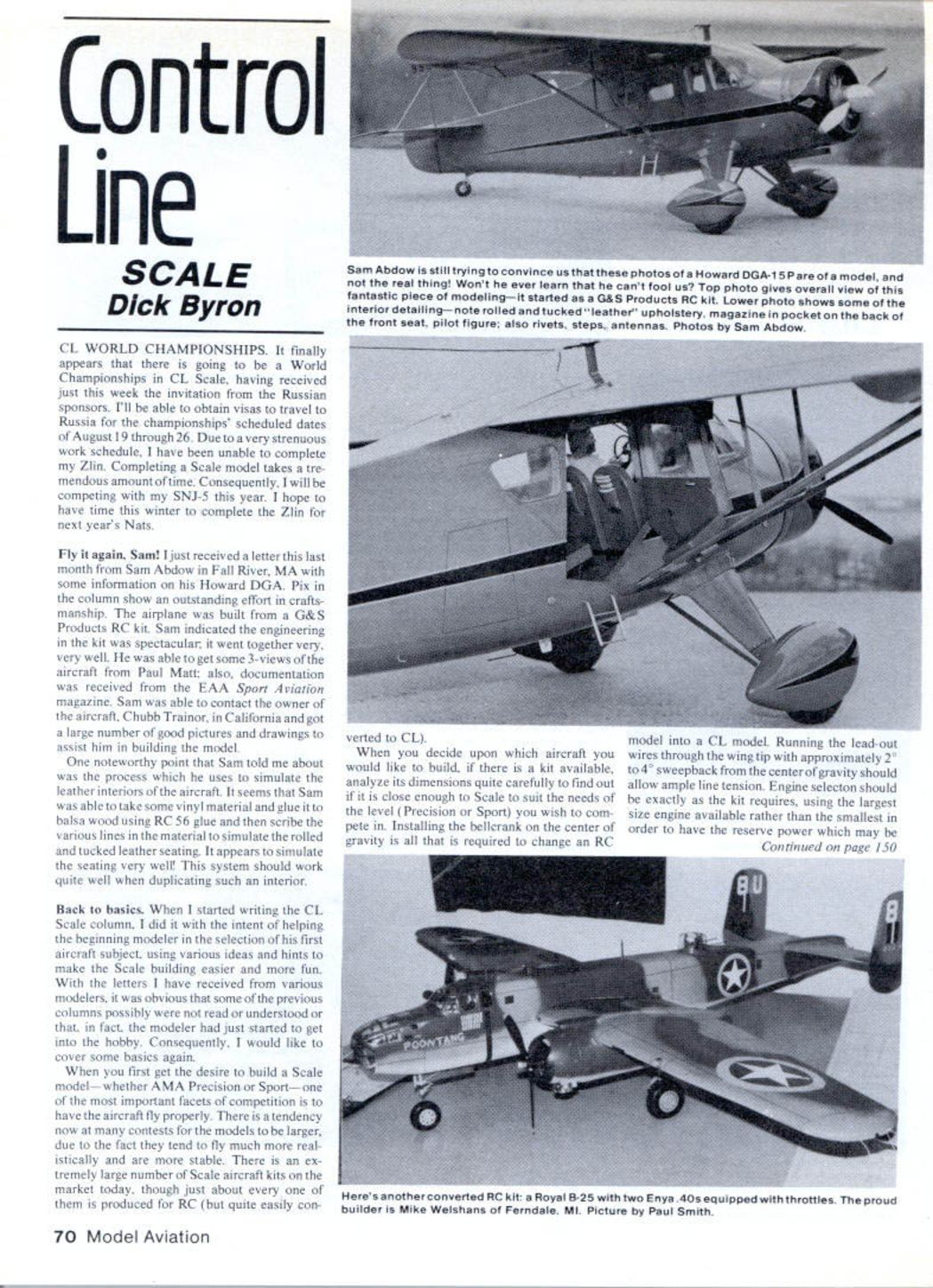
I just received a letter this last month from Sam Abdow in Fall River, MA with some information on his Howard DGA. Pix in the column show an outstanding effort in craftsmanship. The airplane was built from a G&S Products RC kit. Sam indicated the engineering in the kit was spectacular; it went together very, very well. He was able to get some 3-views of the aircraft from Paul Matt; also, documentation was received from the EAA Sport Aviation magazine. Sam was able to contact the owner of the aircraft, Chubb Trainor, in California and got a large number of good pictures and drawings to assist him in building the model.
One noteworthy point that Sam told me about was the process which he uses to simulate the leather interiors of the aircraft. It seems that Sam was able to take some vinyl material and glue it to balsa wood using RC 56 glue and then scribe the various lines in the material to simulate the rolled and tucked leather seating. It appears to simulate the seating very well! This system should work quite well when duplicating such an interior.
Back to basics.
When I started writing the CL Scale column, I did it with the intent of helping the beginning modeler in the selection of his first aircraft subject, using various ideas and hints to make the Scale building easier and more fun. With the letters I have received from various modelers, it was obvious that some of the previous columns possibly were not read or understood or that, in fact, the modeler had just started to get into the hobby. Consequently, I would like to cover some basics again.
When you first get the desire to build a Scale model—whether AMA Precision or Sport—one of the most important facets of competition is to have the aircraft fly properly. There is a tendency now at many contests for the models to be larger, due to the fact they tend to fly much more realistically and are more stable. There is an extremely large number of Scale aircraft kits on the market today, though just about every one of them is produced for RC (but quite easily converted to CL).
When you decide upon which aircraft you would like to build, if there is a kit available, analyze its dimensions quite carefully to find out if it is close enough to Scale to suit the needs of the level (Precision or Sport) you wish to compete in. Installing the bellcrank on the center of gravity is all that is required to change an RC model into a CL model. Running the lead-out wires through the wing tip with approximately 2° to 4° sweepback from the center of gravity should allow ample line tension. Engine selection should be exactly as the kit requires, using the largest size engine available rather than the smallest in order to have the reserve power which may be
Control Line: Scale
necessary to keep you out of a tight situation.
One of the most important factors in flying a CL model is to have ample power and a very dependable engine with a good throttle response. Become very familiar with the engine's operation, and break it in quite well.
Engine cooling is perhaps one of the most difficult things on the average Scale model, due to the presence of enclosed cowlings and the lack of air ducts out of the rear of the cowling. When you have a small air outlet, you should also have a small air inlet directed exactly at the engine cooling fins, rather than just a complete open cowl. This has been one of the problems with my SNJ-5, and it will be cured this year through different ducting arrangements in the cowling which will direct the cool air in through the top center of the cowling strictly to the engine cooling fins, thereby allowing the engine to run cooler.
Scale model building has been a tremendous amount of enjoyment for me and for many other people as well as the spectators; however, it requires a tremendous amount of time and patience and dedication to build and fly them. It is this lack of time (due to business reasons) which has made me decide to resign from writing this CL Scale column, effective with this issue. I do not know who my replacement will be; however, the publisher will find an excellent, qualified individual to take over. Address any correspondence or pictures to Model Aviation, as they will forward any such material to the new CL Scale columnist. Thank you very much for your letters, pictures, and correspondence. I have enjoyed tremendously doing the column.
Transcribed from original scans by AI. Minor OCR errors may remain.

