
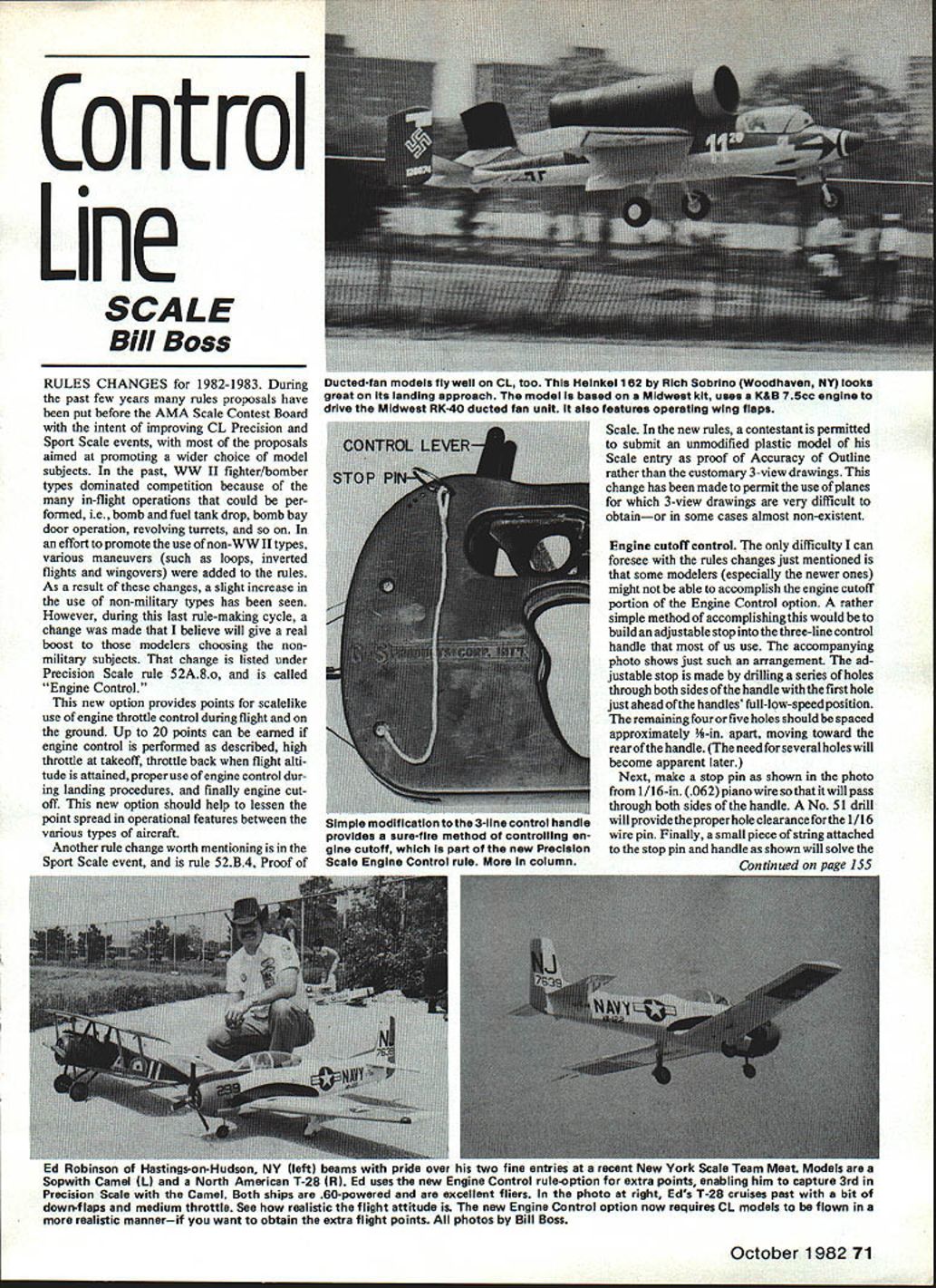
Control Line: Scale
Bill Boss
Rules changes for 1982–1983
During the past few years rules proposals have been put before the AMA Scale Contest Board with the intent of improving CL Precision and Sport Scale events, with most of the proposals aimed at promoting a wider choice of model subjects. In the past, World War II fighter and bomber types dominated competition because of the many in-flight operations that could be performed (bomb and fuel-tank drop, bomb-bay door operation, revolving turrets, and so on). In an effort to promote the use of non–World War II types, various maneuvers (such as loops, inverted flights and wingovers) were added to the rules. As a result of these changes, a slight increase in the use of non-military types has been seen.
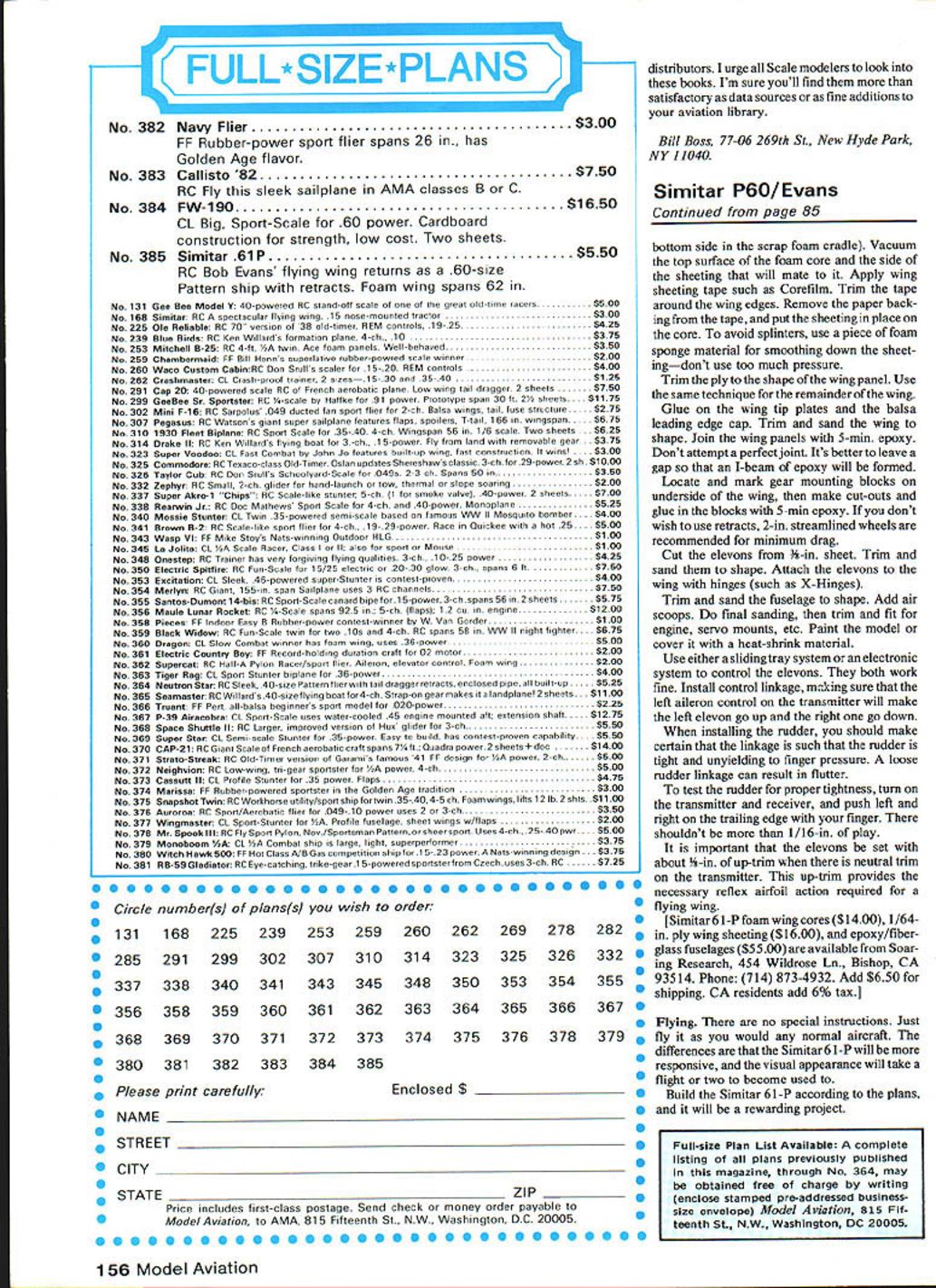
During the last rule-making cycle a change was made that should give a real boost to modelers choosing non-military subjects. That change is listed under Precision Scale rule 52A.8.o and is called "Engine Control." This new option provides points for scale-like use of engine throttle control during flight and on the ground. Up to 20 points can be earned if engine control is performed as described: high throttle at takeoff; throttle back when flight altitude is attained; proper use of engine control during landing procedures; and finally engine cutoff. This option should help lessen the operational-feature point spread between various types of aircraft.
Another rule change worth mentioning is in the Sport Scale event: rule 52B.4, Proof of Scale. Under the new rules, a contestant may submit an unmodified plastic model of his Scale entry as proof of Accuracy of Outline rather than the customary three-view drawings. This change permits use of planes for which three-view drawings are very difficult to obtain—or in some cases almost non-existent.
Engine cutoff control
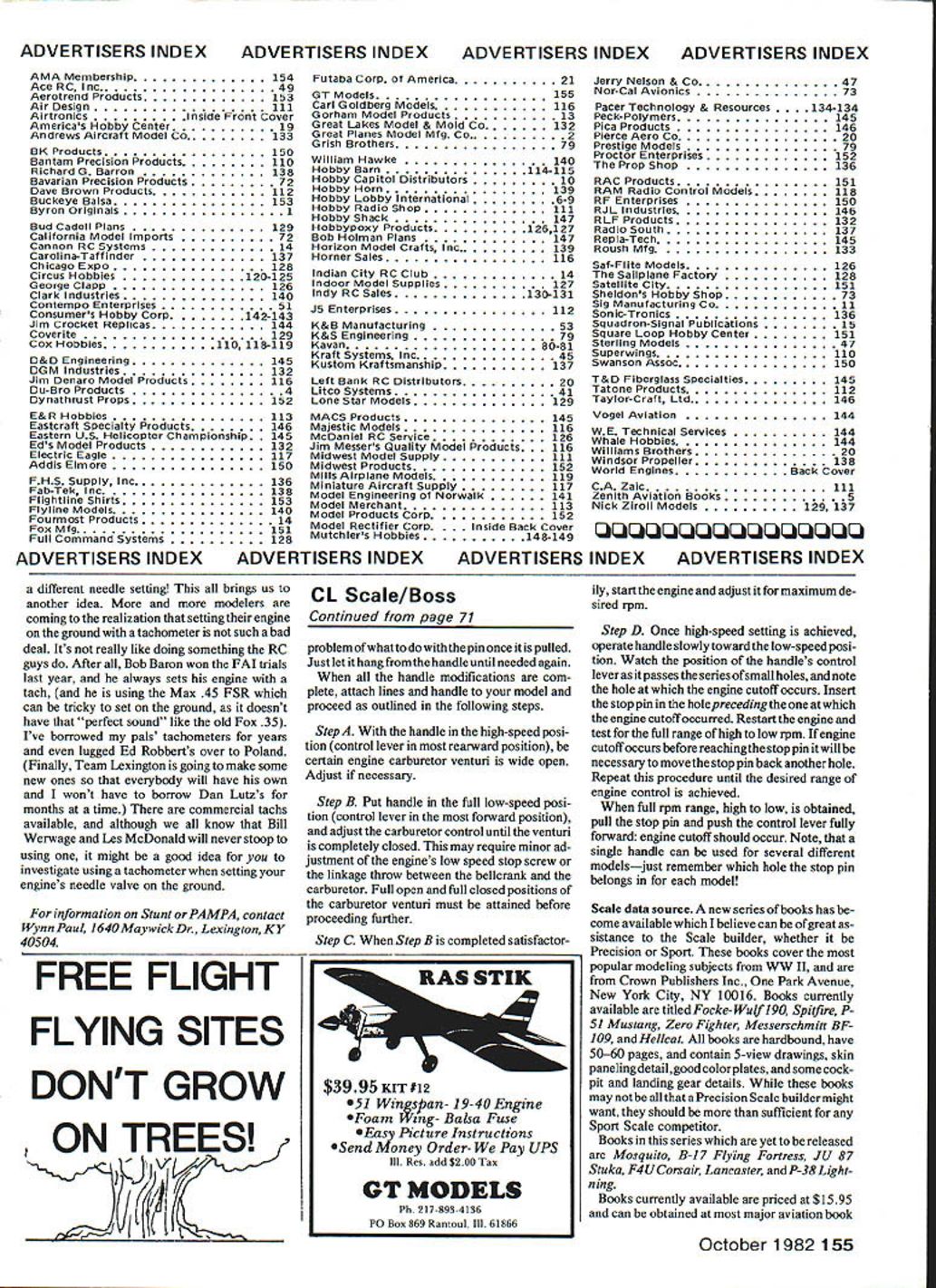
The only difficulty I can foresee with the Engine Control option is that some modelers (especially newer ones) might not be able to accomplish the engine cutoff portion. A simple method is to build an adjustable stop into the three-line control handle. The arrangement is as follows:
- Drill a series of holes through both sides of the handle, with the first hole just ahead of the handle's full-low-speed position. The remaining four or five holes should be spaced approximately 3/8 in. apart, moving toward the rear of the handle. (Several holes are needed to allow fine adjustment.)
- Make a stop pin from 1/16-in. (0.062 in.) piano wire so it will pass through both sides of the handle. A No. 51 drill will provide proper hole clearance for the 1/16-in. wire pin.
- Attach a small piece of string to the stop pin and the handle so the pin can hang from the handle when pulled.
When the handle modifications are complete, attach lines and handle to your model and proceed as follows:
- With the handle in the high-speed position (control lever in the most rearward position), be certain the engine carburetor venturi is wide open. Adjust if necessary.
- Put the handle in the full low-speed position (control lever in the most forward position) and adjust the carburetor control until the venturi is completely closed. This may require minor adjustment of the engine's low-speed stop screw or the linkage throw between the bellcrank and the carburetor. Full open and full closed venturi positions must be attained before proceeding.
- When Step 2 is completed satisfactorily, start the engine and adjust it for the maximum desired rpm.
- Once the high-speed setting is achieved, operate the handle slowly toward the low-speed position. Watch the position of the handle's control lever as it passes the series of small holes, and note the hole at which engine cutoff occurs. Insert the stop pin in the hole preceding the one at which cutoff occurred. Restart the engine and test for the full range of high to low rpm. If engine cutoff occurs before reaching the stop pin, move the stop pin back another hole. Repeat until the desired range of engine control is achieved.
When the full rpm range (high to low) is obtained, pull the stop pin and push the control lever fully forward; engine cutoff should occur. A single handle can be used for several different models—just remember which hole the stop pin belongs in for each model.
Scale data source
A new series of books from Crown Publishers, Inc. (One Park Avenue, New York, NY 10016) can be of great assistance to the Scale builder, whether Precision or Sport. Current titles cover the most popular World War II subjects and include:
- Focke-Wulf 190
- Spitfire
- P-51 Mustang
- Zero Fighter
- Messerschmitt Bf 109
- Hellcat
All books are hardbound, have 50–60 pages, and contain five-view drawings, skin paneling detail, full-color plates, and some cockpit and landing-gear detail. While these books may not be everything a Precision Scale builder might want, they should be more than sufficient for any Sport Scale competitor.
Books yet to be released in the series include:
- Mosquito
- B-17 Flying Fortress
- Ju 87 Stuka
- F4U Corsair
- Lancaster
- P-38 Lightning
Books currently available are priced at $15.95 and can be obtained at most major aviation bookstores.
I urge all Scale modelers to look into these books. They're fine as data sources or as additions to your aviation library.
Bill Boss 77-06 269th St. New Hyde Park, NY 11040
Transcribed from original scans by AI. Minor OCR errors may remain.

