
Control Line: SCALE
Bill Boss
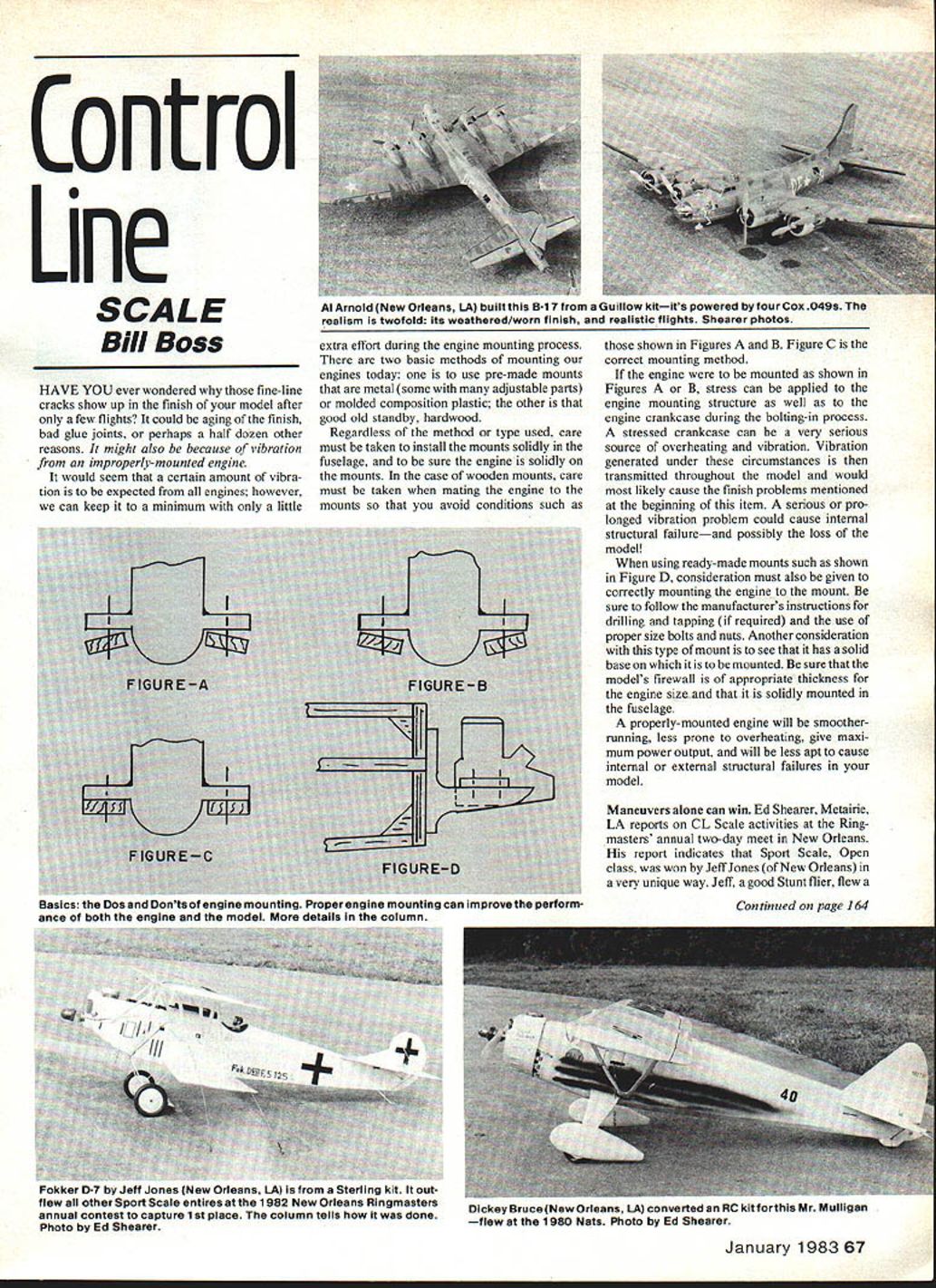
Have you ever wondered why fine-line cracks show up in the finish of your model after only a few flights? It could be aging of the finish, bad glue joints, or a half dozen other reasons. It might also be vibration from an improperly mounted engine.
Some vibration from any engine is to be expected; however, you can keep it to a minimum with a little extra care during the engine mounting process.
There are two basic methods of mounting engines today:
- Premade mounts — metal (some with many adjustable parts) or molded composition plastic.
- Hardwood mounts — the traditional standby.
Regardless of the mount type, care must be taken to install the mounts solidly in the fuselage and to be sure the engine is solidly fastened to the mounts. In the case of wooden mounts, take care when mating the engine to the mounts so you avoid stress conditions such as those shown in Figures A and B. Figure C illustrates the correct mounting method.
If the engine is mounted as in Figures A or B, stress can be applied to the mounting structure and to the engine crankcase during bolting. A stressed crankcase can be a serious source of overheating and vibration. Vibration generated under these circumstances transmits throughout the model and is likely to cause the finish problems mentioned above. A serious or prolonged vibration problem could cause internal structural failure—and possibly the loss of the model.
When using ready-made mounts (see Figure D), also consider correct mounting of the engine to the mount. Be sure to follow the manufacturer's instructions for drilling and tapping (if required) and use proper-size bolts and nuts. Also be sure the mount has a solid base: the model's firewall should be of appropriate thickness for the engine size and solidly mounted in the fuselage.
A properly mounted engine will run smoother, be less prone to overheating, deliver maximum power, and be less likely to cause internal or external structural failures in your model.
Control Line: Scale
Jeff flew a Sterling Fokker D-7 that did not have throttle control or any other mechanical options. His six flight options selected for the event included:
- wingover
- inside loop
- two laps inverted flight
- outside loop
- inside square loop
- three laps at 45° elevation
He evidently flew them well enough to beat out several entries. It appears that Jeff met the challenge of flying against WWII types — and won! Among his competition were a B-17, a Me 109E, and a P-51H Mustang.
Ed (and several other Scale fliers) reported in his contest report that contest managers did not enforce the CL Scale muffler rule, and that lack of enforcement seems to encourage more Scale models to compete. It was also reported that some radio operators in the pits used "muffs" to keep scale models from being heard at the Nats.
I agree with Ed that the non-use of mufflers should not keep anyone from competing in the Nats. From my own experience on the East Coast contest circuit, the muffler rule has not been enforced since its origination in 1978. It doesn't seem appropriate to require mufflers on relatively quiet Scale models when all other CL models at the same contest are flown with wide-open exhausts. The only place the CL Scale muffler rule is enforced consistently appears to be at the Nats.
Ed asked what could be done about reversing the rule. If anything is to be done, CL Scale modelers must let the AMA Scale Contest Board know how they feel, and many individuals should submit rules-change proposals. (Editor's note: Two proposals submitted for the current rules-change cycle — SC-84-9 and SC-84-10 — propose deleting the requirement for mufflers in CL Sport Scale and CL Precision Scale, respectively. See the December "Competition Newsletter" for the full summaries. R/M C.M.)
You might also consider writing to the National Association of Scale Aeromodellers (c/o Bob Underwood) at:
- Bob Underwood
- 4109 Concord Oaks Dr.
- St. Louis, MO 63128
If enough pressure is placed on the Scale board and NASA, the muffler rule for CL Scale models may be reversed.
A final thought: I am not (nor are Ed and his fellow modelers, I believe) against the use of mufflers where required to preserve flying sites or meet community noise standards. It makes sense to do all we can to keep aeromodelling in good standing. However, it does not make sense to have a rule that deters competition at any level when noise is not an issue. A possible solution would be to modify the rule wording so that CL Scale entries at all meet levels (including the Nats) would not need mufflers unless contest management specifies them to meet flying-site noise requirements.
New sanding tool
Pete Bianchini of Yonkers, NY, brought to my attention a new hand-held sanding tool that does a great job. The tool is plastic, has a palm-size grip, and contains a built-in sandpaper-receptacle. It is made by the 3M Co., is available at most auto supply stores, and is called the Auto-Pak Press'n Sand.
The sandpaper comes in rolls of varying length (55 in. to 85 in.), depending on grit (100, 180, and 220). The usable sanding surface measures approximately 2-1/2 in. by 4-1/2 in., and is excellent for sanding large semi-flat surfaces such as wings and tails. Instructions for applying the sandpaper are on the package and are clear and easy to follow. The tool costs about $6.00, and rolls of sandpaper are about $1.75 each.
Bill Boss 77-06 269th St. New Hyde Park, NY 11040
Transcribed from original scans by AI. Minor OCR errors may remain.

