
Control Line Scale
Mike Stott
I'M GOING to begin this month's article with a little bit of a follow-up on last month's article. If you didn't get a chance to read last month's CL Scale column, be sure and do so — it could benefit us all. Here is a bit of a summary of last month's article to whet your appetite.
The Flying Dutchmen Aeromodelers of Reading, Pa., wrote me a letter a little while back with an idea that agreed with my own feelings. It concerned a Scale Organization, made up of people like you and me. Not just expert builders and fliers, but everyone who is interested in Scale. Everyone's viewpoint is needed in an organization if it is going to work. This Scale Organization would work for the members by promoting Scale, assisting the existing Scale Board, being active in rule proposals and changes, judging and keeping one another informed. These are just a few advantages we have come up with. Now we need to hear from you. Your ideas and suggestions are what is needed to get the ball off the ground. If enough interest is shown, maybe we will be able to hold a meeting at this year's Nats to determine the feasibility of a Scale Organization.
Don't feel that I have neglected to acknowledge your letters on this subject, or any other items you might send me, but my article must be written two to three months in advance of the publishing date. So this column that you are reading now was written before you were even able to read last month's article on a Scale Organization.
A while back, I received a real nice letter from Bob Buenzly of Phillipsburg, N.J. Bob reported that Sport Scale is becoming very popular in the New Jersey area. He enclosed a photograph, shown in this column, by his friend, Ted Prasol of Ft. Washington, Pa. Ted's plane is a modified Royal kit, a stand-off Phantom jet powered by an Enya .45. The weight of Ted's model came out at 6 lbs. As evident from the photo, Ted is an excellent builder and does a fantastic job on finishing. In fact, Ted twice has won the Testors Best Finish award at the Nats. The Phantom in the photo placed 2nd at the October Garden State Circle Burners' contest.
Let's hope with the growing popularity of Sport Scale that it will increase the number of good builders that go on to build fly competitive scale models.
Stanley Sands Jr., Fleetwood, Pa., also sent some photos of a TP-40E. As can be seen, Stan has come up with a unique way of preventing plane nosing over — set detachable training wheels. Extra wheels mounted on an axle at the firewall. I feel a very practical method, especially on a test flight. When you exactly know the handling characteristics of a new plane it can save an awful lot of work rebuilding cowls, nose pieces and touching up paint scheme. Also note the highly detailed surfaces, rivets and panel markings. Thanks much for sending the photo and idea, Stan.
Paul M. Smith, Captain, USAF, sent a note on an unusual modeling project. It seems the USAF needed a scale model KC-135 put on display for the Bicentennial... and fly the more competitive scale models in the future.
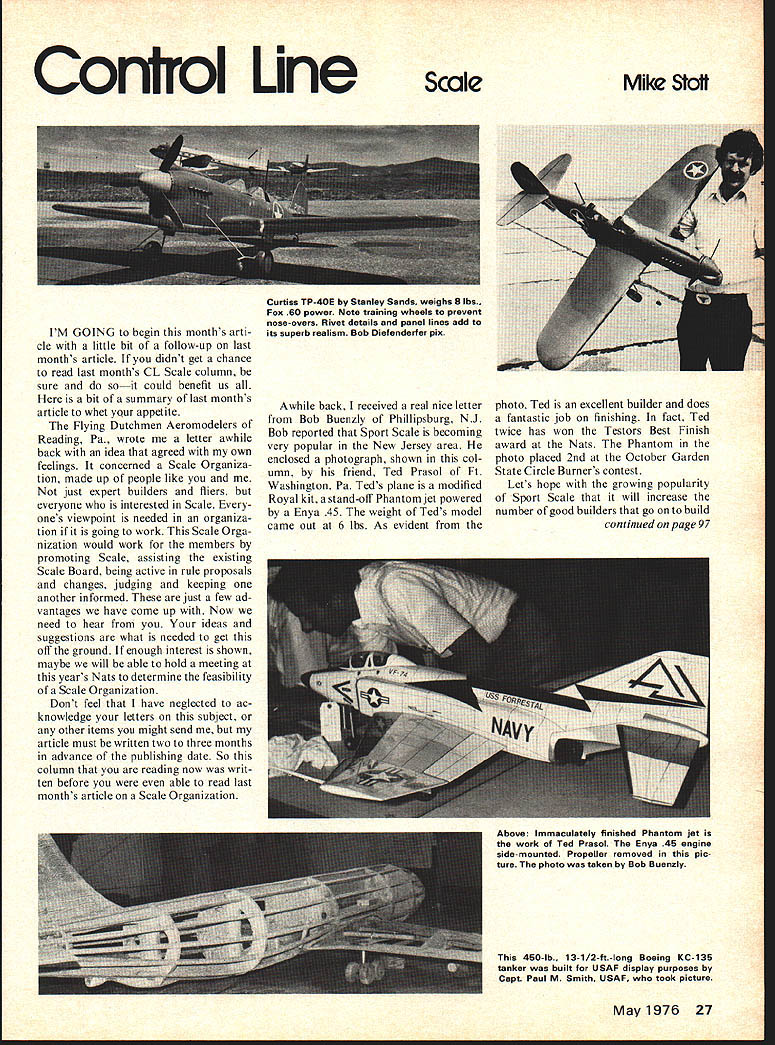
Stanley Sands, Jr., of Fleetwood, Pa., also sent me some photos on his TP-40E. As you can see Stan has come up with a unique way of preventing his plane from nosing over, with a set of detachable training wheels. These extra wheels are mounted to the axle and firewall. I feel this is a very practical method, especially in your test flight when you do not exactly know the handling characteristics of your plane. This can save an awful lot of work rebuilding cowls and nose pieces and touching up the paint scheme. Also note the highly detailed surfaces, rivets and panel markings. Thanks so much for sending the photo and the idea, Stan.
Paul M. Smith, a Captain in the USAF sent me a note on an unusual modeling project. It seems the USAF needed a scale model of a KC-135 to put on display on a float for the Bicentennial. Well, since Paul was a modeler they asked him and he tackled the project. The full-sized aircraft is 135 feet long. Paul's measured 135 feet and weighed 450 lbs. The primary material used was 3/4" A.D. plywood and it is held together with finishing nails and one and a half gallons of Elmer's glue. Capt. Smith has his doubts on whether it could ever possibly fly — anyway, I'd hate to be the one to try!
Next month I'm going to cover some news I've received regarding a new consideration in FAI judging. This may affect various members in the future. The Dec. '75 FAI meeting passed a new ruling that includes a great emphasis on the flying sequence in realism in flight, so therefore if it truly simulates the flight of the full-sized aircraft it will get the extra points.
My address is: 118 E. Wheeler St., North Mankato, Minn., 56001.
Transcribed from original scans by AI. Minor OCR errors may remain.

