
Control Line: Scale
Bill Boss
Scale Documentation
Orin Humphries (Spokane, WA) sent a letter about one of his favorite subjects—proper scale documentation. Orin emphasized the need for scale modelers to be especially careful when interpreting three-view drawings and applying that interpretation to building a scale model. He points out that drawings are not always accurate, even when they come from sources that appear beyond reproach. In fact, there are many instances when a modeler finishes a model based on a set of three-views and is disappointed when, at a contest, his plane does not measure up.
Orin noted that publications we assume accurate are not always so. He states, "I have drawings by Nye on the P-82 Twin Mustang that look great until you compare station number data from the factory to them. This station data tells how many inches aft of the nose each of the craft's components are to be located. On the model P-82 drawings, the canopy is off 18 in., and the horizontal stabilizer is 12 in. forward. Four P-82's have been built in the past five years, and three of them are wrong because they were based on Nye drawings—and the builders didn't carefully compare them to photos or other data sources." The important point is to never take any set of drawings as the final source. One of the best ways to be sure the three-views are good is by comparing them to many photographs, which, for most of the subjects we model (WW I and WW II eras), are plentiful. Scan the pages of most modeling magazines and you'll turn up advertisements for books on most of our subjects.
While on the subject of documentation, I want to review a basic but important aspect of scale modeling—making up your model's presentation. This is an item many scale builders do not pay enough attention to. Current AMA Scale rules require each contestant to provide a certain amount of documentation when presenting a model for judging.
Presentation Requirements
Sport Scale
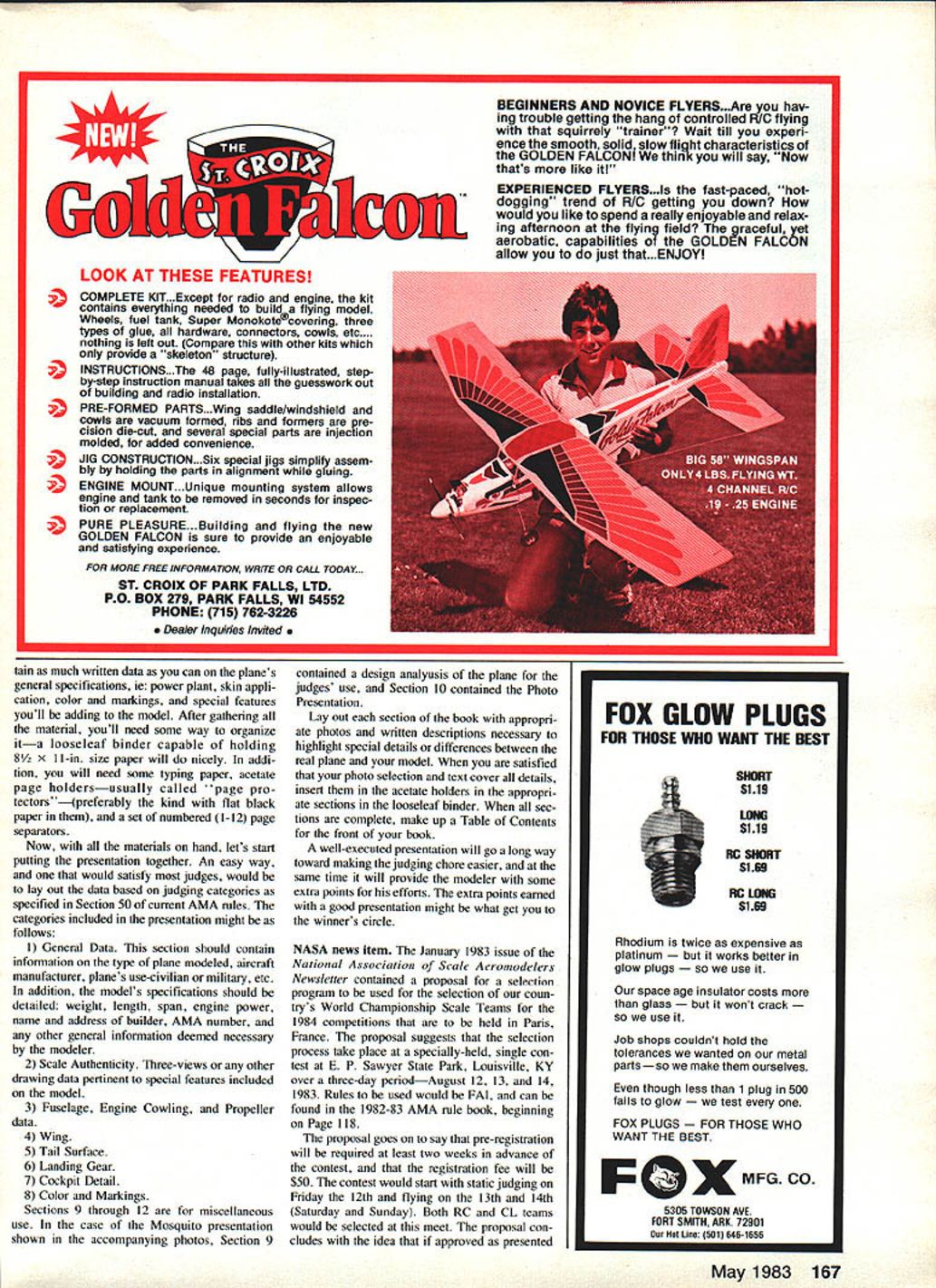
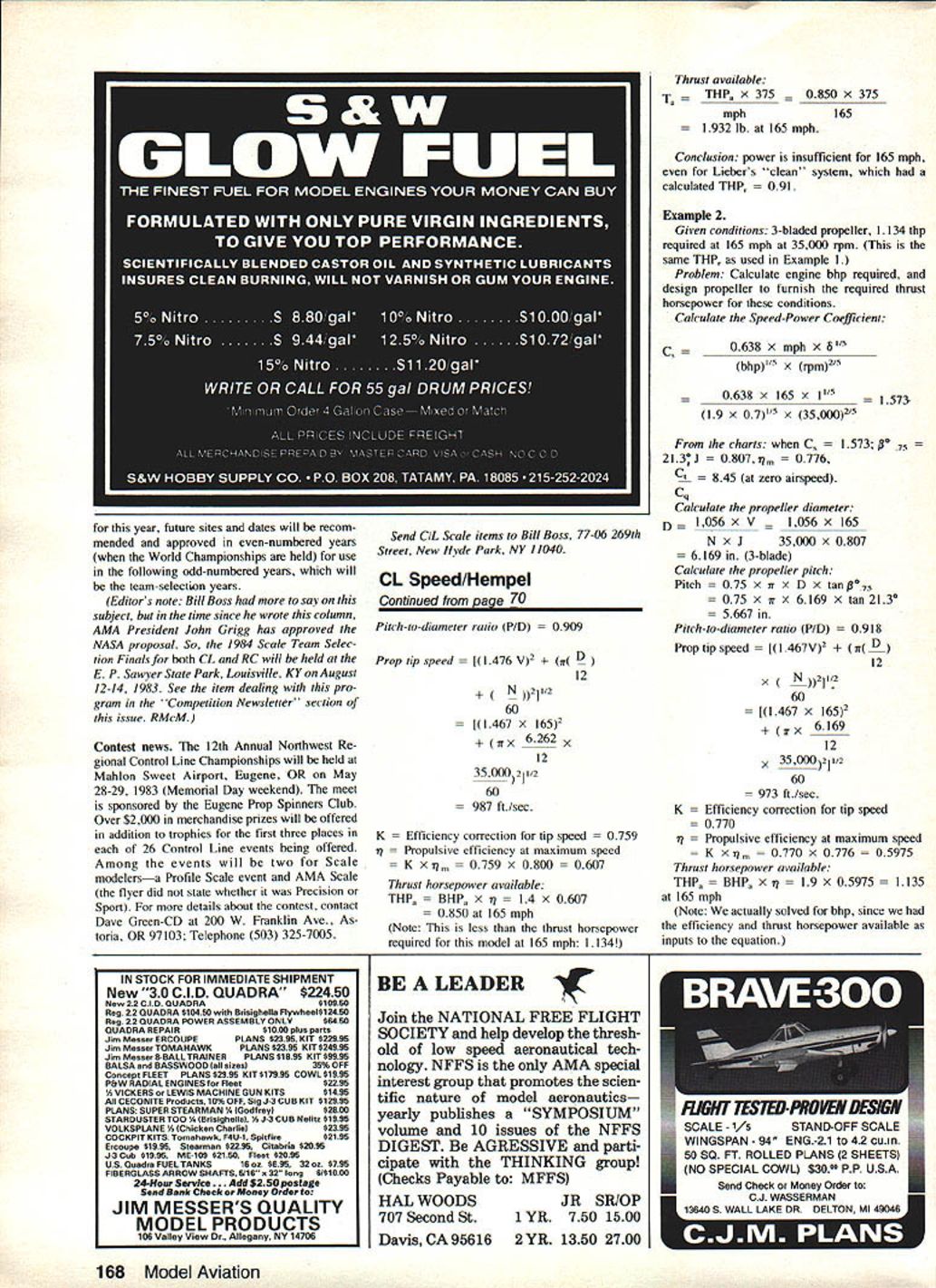
If it is Sport Scale, a minimal amount of documentation is required. The presentation must be confined to the equivalent of six pages of 8½ x 11 in. paper (one side only). The six pages are to include:
- Three-view drawings or a series of photographs that show the aircraft outline in side, front and plan views.
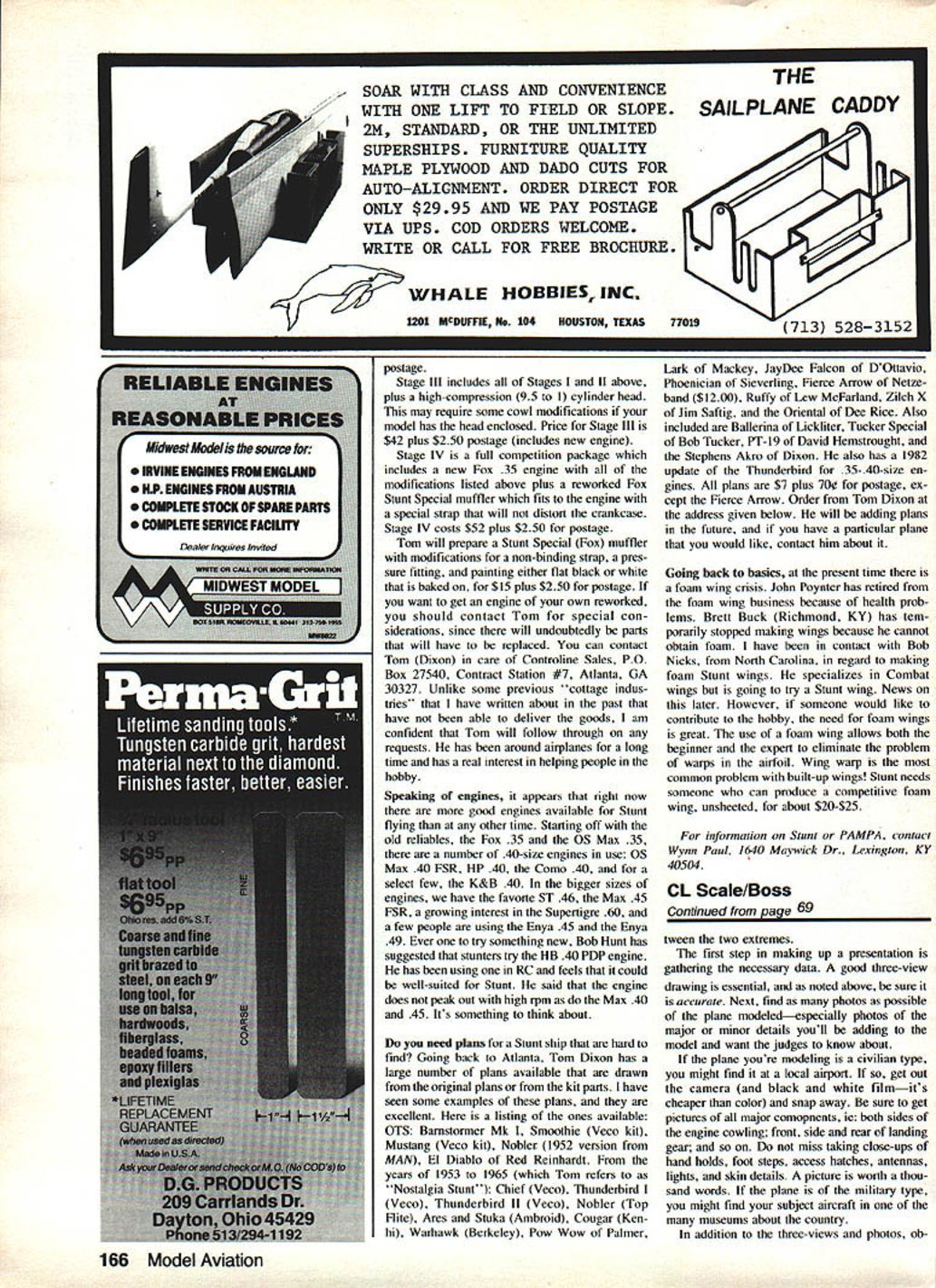
- Proof of color and markings in the form of photographs or a color drawing similar to those found in Profile Publications.
- A statement by the modeler attesting to what major components he did not make (e.g., canopy, formed fuselages).
No points are awarded for the presentation in the Sport Scale event.
Precision Scale
In the Precision Scale event, presentation can be more challenging and can add as many as 50 points to your overall score. The 50 points are awarded as follows:
- 0–15 for drawings (three-views)
- 0–15 for photos
- 0–15 for proof of color and markings
- 0–5 for special written descriptions
The presentation need not be overly complicated. Too much data is just as bad as too little. You could deluge a judge with so much data that it becomes impossible for him to find what he needs, or you could provide so little data that the judge cannot properly score the model. A properly executed presentation strikes a happy medium between the two extremes.
Preparing a Good Presentation
The first step is gathering the necessary data. A good three-view drawing is essential—be sure it is accurate. Next, find as many photos as possible of the plane you are modeling, especially photos of the major or minor details you plan to add and want the judges to know about.
If the plane is a civilian type, you might find it at a local airport. Go out with a camera (black-and-white film is cheaper than color) and take pictures of all major components: both sides of the fuselage, engine cowling, front/side/top views of the landing gear, etc. Don’t miss close-ups of the instrument panel, cockpit, steps, access hatches, antennas, lights, and skin details. A picture is worth a thousand words. If the plane is military, you may find your subject in one of the many museums around the country.
In addition to three-views and photos, obtain factory drawings, service manuals, parts catalogs, or contemporary scale drawings. These often contain station numbers, rib spacings, antenna locations, and other data not visible in photographs. List the sources of your information so the judges can verify them if they wish.
Arrange the presentation logically and neatly:
- Attach the three-view drawing, then the photos with notes and arrows indicating the location of each detail on the three-view.
- If you used a kit, show the kit parts that were modified and how they were altered; photos or sketches of the modification steps are excellent.
- Identify any major components you did not make (canopy, landing gear, etc.) as required by the rules.
- Include color chips or swatches and identify paint manufacturers and paint codes whenever possible. If you matched camouflage or markings from a specific aircraft, show the photograph and indicate the exact positions of national insignia, squadron markings, and serial numbers on the three-view.
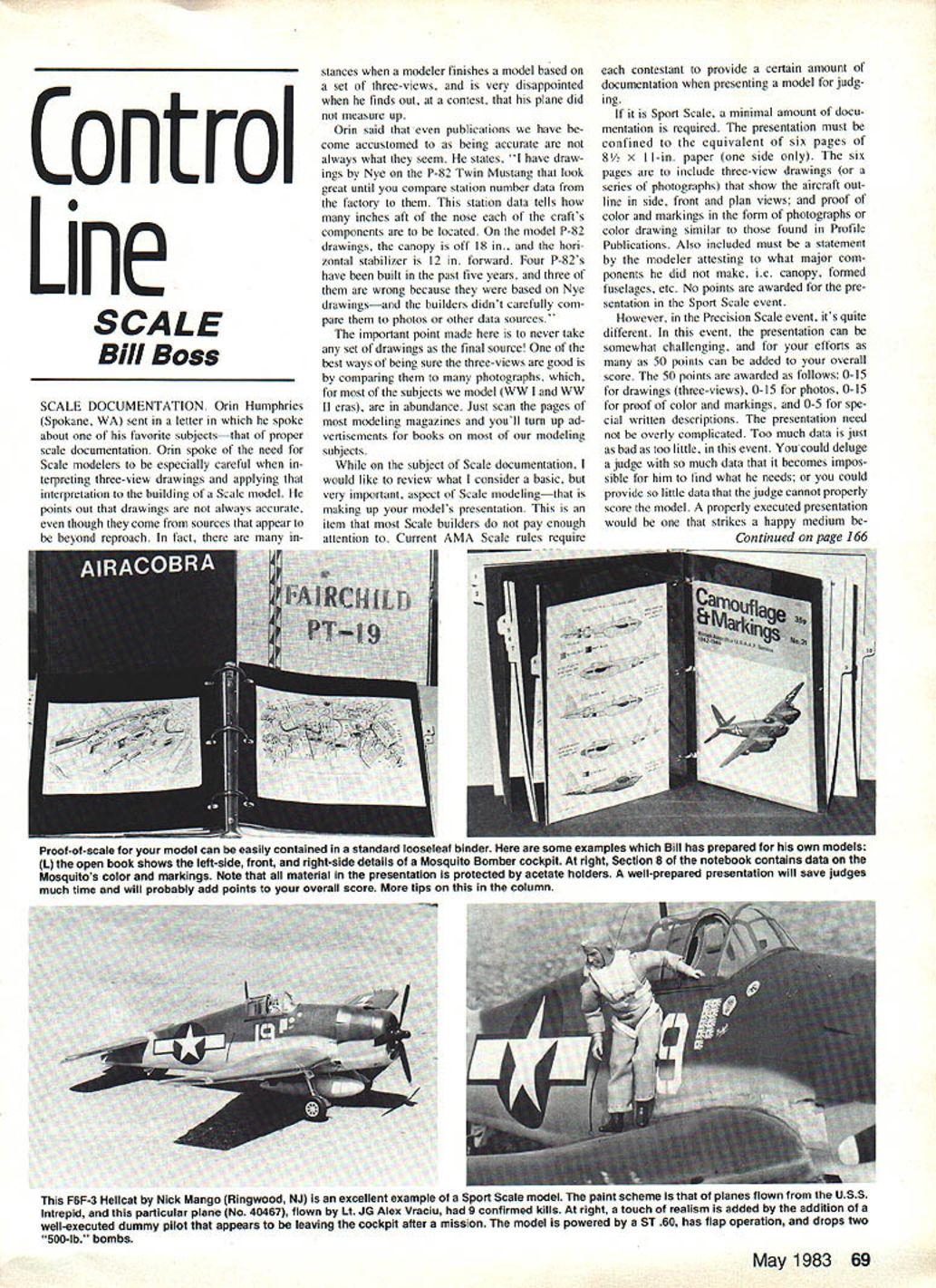
Keep the presentation concise—enough information to prove scale and accuracy without burying the judge in irrelevant detail. A three-ring binder with clear acetate sleeves works well for protection and convenience. Well-executed documentation will save the judges time and will probably add points to your overall score.
Contain as much written data as you can on the plane's general specifications, i.e., power plant, skin application, color and markings, and special features you'll be adding to the model. After gathering all the material, organize it in a looseleaf binder capable of holding 8½ x 11 in. paper. You will also need typing paper, acetate page protectors (preferably the kind with flat black paper in them), and a set of numbered (1–12) page separators.
An easy, judge-friendly layout is to arrange the data based on judging categories as specified in Section 50 of the current AMA rules. Suggested sections:
- General Data
- Type of plane modeled, aircraft manufacturer, plane's use (civilian or military)
- Model specifications: weight, length, span, engine power, name and address of builder, AMA number, and any other general information
- Scale Authenticity
- Three-views or other drawing data pertinent to special features included on the model
- Fuselage, Engine Cowling, and Propeller data
- Wing
- Tail Surfaces
- Landing Gear
- Cockpit Detail
- Color and Markings
9–12. Miscellaneous use (e.g., design analysis, photo presentation)
Lay out each section with appropriate photos and written descriptions to highlight special details or differences between the real plane and your model. When satisfied that your photos and text cover all details, insert them in the acetate holders in the appropriate sections of the looseleaf binder. When all sections are complete, make up a Table of Contents for the front of your book.
A well-executed presentation will make the judging chore easier and may provide the extra points that get you into the winner's circle.
NASA News Item
The January 1983 issue of the National Association of Scale Aeromodellers Newsletter contained a proposal for a selection program to choose the U.S. World Championship Scale Teams for the 1984 competitions in Paris, France. The proposal suggests holding a specially-held, single contest at E. P. Sawyer State Park, Louisville, KY over a three-day period—August 12–14, 1983. Rules to be used would be FAI, as found in the 1982–83 AMA rule book (beginning on Page 118).
The proposal states that pre-registration would be required at least two weeks in advance and that the registration fee would be $50. The contest would start with static judging on Friday the 12th and flying on the 13th and 14th (Saturday and Sunday). Both RC and CL teams would be selected at this meet. The proposal concludes that if approved as presented for this year, future sites and dates will be recommended and approved in even-numbered years (when the World Championships are held) for use in the following odd-numbered years, which will be the team-selection years.
(Editor's note: Bill Boss had more to say on this subject, but in the time since he wrote this column, AMA President John Grigg approved the NASA proposal. So, the 1984 Scale Team Selection Finals for both CL and RC will be held at E. P. Sawyer State Park, Louisville, KY on August 12–14, 1983. See the item dealing with this program in the "Competition Newsletter" section of this issue. RCM&C.)
Contest News
The 12th Annual Northwest Regional Control Line Championships will be held at Mahlon Sweet Airport, Eugene, OR on May 28–29, 1983 (Memorial Day weekend). The meet is sponsored by the Eugene Prop Spinners Club. Over $2,000 in merchandise prizes will be offered in addition to trophies for the first three places in each of 26 control line events being offered. Among the events will be two for scale modelers—a Profile Scale event and AMA Scale (the flyer did not state whether it was Precision or Sport). For more details, contact Dave Green, CD, at 200 W. Franklin Ave., Astoria, OR 97103; Telephone (503) 325-7005.
Send C/L Scale items to Bill Boss, 77-06 269th Street, New Hyde Park, NY 11040.
Transcribed from original scans by AI. Minor OCR errors may remain.

