
Control Line: Scale
Bill Boss
Sorta-Scale — Seattle Skyraiders Round-Up
BIGGER is not always better. Dave Mullens, Seattle, WA (editor of the Seattle Skyraiders' Newsletter) sent a report of the Raiders Round-Up — the 1982 Washington State Control Line Championships — which included an interesting local event called Sorta-Scale. Dave describes Sorta-Scale as a very relaxed form of Sport Scale.
The entries were not the usual large, heavy, well-powered models we see at many contests. The heaviest model in this year's Sorta-Scale was a 3-1/4-lb. Me 109 and the lightest was an 18-oz. P-47. The report also included an excellent Bucker Jungmeister that weighed a very light 20 oz. Flying lines for the models ranged from 35 to 60 ft.
Dave pointed out that the three models shown are good examples of RC kits converted to Control Line use. The overall object of the Sorta-Scale event is to build a model, apply some outward detail, use few if any operational features, make the plane fly, and have fun.
Back to basics tips
These tips came from Dave Mullens while we corresponded about the Sorta-Scale event. Dave told me about his first venture in Scale: a Sig Ryan STA, an ambitious project for anyone starting in Precision Scale. The kit and plans were fine and the plane received a high static score at its first competition, but the flight performance was disappointing.
Major problems Dave encountered were as follows:
- While taxiing, the plane pulled/crabbed to the outside of the circle so badly that the inboard wing dipped, touched the ground, and eventually caused a nose-over.
- On landing, the wheels would pancake and lodge against the wheel pants, which decreased forward motion rapidly and again caused nose-overs.
- The engine would overheat.
Below are suggestions for correcting these problems.
Taxiing problem
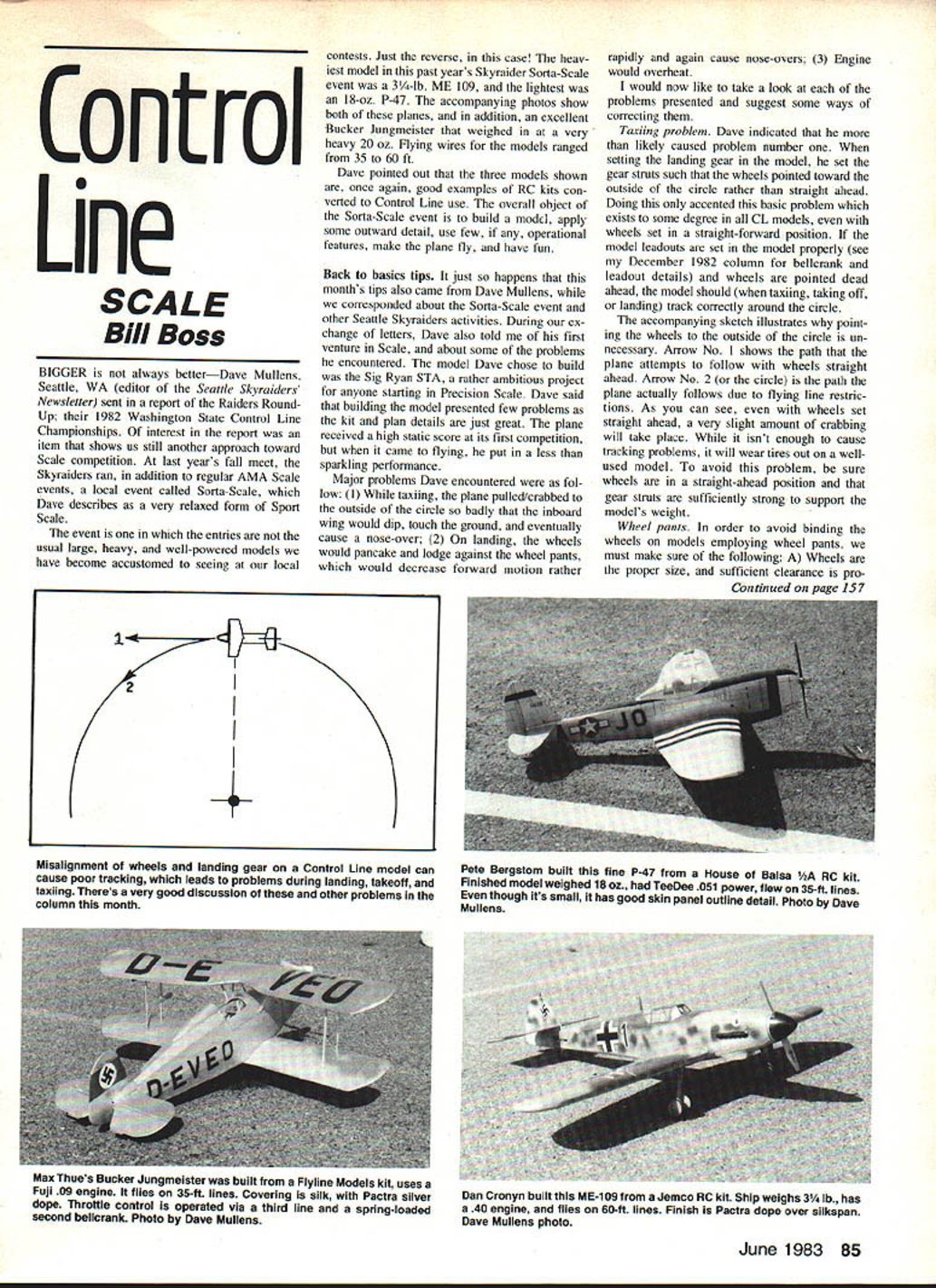
Dave most likely caused problem number one when he set the landing gear. He aligned the gear struts such that the wheels pointed toward the outside of the circle rather than straight ahead. That only accentuates a basic problem that exists to some degree in all CL models, even with wheels pointed straight ahead.
If the leadouts are set in the model properly (see my December 1982 column for bellcrank and leadout details) and the wheels are pointed dead ahead, the model should track correctly when taxiing, taking off, or landing.
A small amount of crabbing is unavoidable because of flying line geometry: the plane attempts to follow one path while the circle path forces a slightly different track. With wheels straight ahead this slight crabbing usually causes no tracking problems (though it will wear tires on a well-used model). To avoid worsening the condition, set the wheels straight ahead and make sure the gear struts are strong enough to support the model's weight.
Wheel pants
To avoid wheel binding on models with wheel pants, be sure of the following:
- The wheel is the proper size and there is sufficient clearance all around (sides and top).
- The wheel is not mounted too deeply in the wheel pants. Mounting the wheel too deep can allow the tire to flatten and press against the sides of the pants on landing, causing pancaking and a sudden loss of forward motion.
- When mounting the wheel on the gear strut/axle, make sure the wheel stays centered within the wheel pants and cannot shift side to side while taxiing. This can be accomplished by installing a wheel-retaining collar on each side of the wheel during installation.
After the wheel pants structure is completed, center the wheel and lock each wheel collar in place. Following these basic steps should eliminate wheel-binding problems where wheel pants are used.
Overheated engines
Because of column space limitations, I will not cover the overheating problem this month; however, it will be an item in next month's column.
Reminders
- Mike Welshans (Ferndale, MI) asked Irv Searl, Chairman of the Scale Contest Board, about using removable control line leadout guides that could be taken off for static judging to improve appearance, then reinstalled for flying. Irv reminds us that current rules allow nothing to be added or removed from a Control Line Scale model after static judging except for the spinner and propeller for flying purposes. If a spinner is on the model during static judging, a spinner of like size and color must be on the model during flight performance. See Unified Scale Judging Regulations — Items 50.6 (a) through (f), page 74 of the AMA 1982-83 rule book.
- Item 50.6.c permits a radio antenna to be added to an RC model after static judging. Adding a leadout guide to a CL model seems similar to adding an antenna to an RC model, so this is an area of the rules that could be changed. Any proposal must wait for the next rules-change cycle.
- A muffler is required on all Scale models at the Nats. This reminder is timely because recent Northeast local contests have not required mufflers. Don't show up at the Nats without a muffler on your engine!
Bill Boss 77-06 269th St., New Hyde Park, NY 11040
Transcribed from original scans by AI. Minor OCR errors may remain.

